

TL;DR:
- Hospitality compliance rules in Europe include food safety, health and safety, data protection, employment, and licensing standards that property owners must follow. Proper documentation, regular reviews, and automated controls are essential to meet these regulations and pass inspections. Implementing recurring checks ensures ongoing compliance and reduces risks of penalties or legal issues.
Hospitality compliance rules are the concrete legal and operational standards that property owners must follow to operate short-term rentals lawfully across Europe. These rules span food safety, health and safety, data protection, employment law, and licensing. The industry term is “regulatory compliance,” and the examples of hospitality compliance rules covered here are drawn from real frameworks including HACCP, GDPR, and national fire safety legislation. Getting these right is not optional. Regulators in France, Italy, the Netherlands, and the UK all conduct inspections, and evidence of compliance must be documented and available on demand.
1. What are examples of hospitality compliance rules in food safety?

Food safety compliance is governed by the HACCP system, which requires property owners to identify, assess, and control biological, chemical, and physical hazards in food preparation. HACCP with full ingredient labelling under Natasha’s Law has applied in the UK since 2021. Natasha’s Law requires that any food prepared on the premises and offered for sale or as part of a stay must carry a full ingredient list and allergen declarations.
France and Italy apply equivalent EU food hygiene regulations under Regulation (EC) No 852/2004, which mandates temperature controls, pest management, and staff hygiene training. Italian properties must also maintain a self-monitoring plan (piano di autocontrollo) that mirrors HACCP principles. The practical difference between countries is in inspection frequency and documentation format, not in the underlying obligation.
Property owners offering catering services should implement the following food safety practices:
- Record fridge and freezer temperatures daily and retain logs for at least three months
- Label all pre-prepared food with ingredients, allergens, and preparation dates
- Train all staff handling food in basic food hygiene (Level 2 Food Hygiene Certificate in the UK)
- Maintain a cleaning schedule with signed completion records
- Keep supplier delivery records to demonstrate traceability
Pro Tip: Keep your HACCP documentation in a shared digital folder that any inspector can access within minutes. Audit-ready records are the single fastest way to close an inspection without a penalty notice.
2. Health and safety compliance rules and risk assessments
Health and safety compliance in European hospitality requires formal, documented risk assessments. France mandates the Document Unique d’Évaluation des Risques Professionnels (DUERP), Italy requires the Documento di Valutazione dei Rischi (DVR), and the Netherlands uses the Risico-Inventarisatie en Evaluatie (RI&E). Each document must be reviewed annually or whenever significant changes occur at the property.
Fire safety is a specific and non-negotiable category. French fire safety regulations (ERP Type O) require periodic Safety Commission inspections for hospitality premises. Italy mandates the appointment of a fire safety officer (Responsabile del Servizio di Prevenzione e Protezione, or RSPP). The UK requires a written fire risk assessment under the Regulatory Reform (Fire Safety) Order 2005.
Legionella control is another area that catches property owners off guard. Any property with a hot water system must assess the risk of Legionella bacteria and implement a written control scheme. This applies to short-term rentals just as it does to hotels.
Typical health and safety controls for hospitality properties include:
- Annual fire risk assessment with a named responsible person
- Monthly checks of fire extinguishers, smoke detectors, and emergency lighting
- Quarterly Legionella temperature checks and flushing of infrequently used outlets
- Staff emergency evacuation training at least once per year
- Clear emergency signage in all guest-accessible areas
Pro Tip: Integrate health and safety checks into your weekly property walkthrough. A five-minute checklist completed every week is far more defensible than a comprehensive review done once a year and then forgotten.
3. Data protection and privacy rules under GDPR
GDPR is the primary data protection framework for all European short-term rental operators. It requires that guest data is collected lawfully, stored securely, and deleted when no longer needed. Data protection compliance now requires tracking consent, cross-border transfers, and managing automated decision-making under expanded rules for 2026. Property managers who use booking platforms such as Airbnb or Booking.com must understand that they remain a data controller for any guest information they process independently.
Non-compliance carries real consequences. The UK Information Commissioner’s Office and national data protection authorities across the EU can issue fines of up to €20 million or 4% of annual global turnover, whichever is higher. For a small property management business, even a modest fine can be operationally damaging.
Guest data security is a practical daily obligation, not a one-time setup task. Best practices for guest data collection and protection include:
- Collect only the data you genuinely need (name, contact details, identification for registration purposes)
- Store guest records in encrypted systems with access restricted to authorised staff only
- Conduct a quarterly review of who has access to guest data and remove access for former staff immediately
- Maintain a record of processing activities (ROPA) as required under GDPR Article 30
- Publish a clear privacy notice that guests can access before or at check-in
4. Employment and licensing rules for hospitality operators
Employment compliance covers minimum wage, working hours, written contracts, and rest period entitlements. In the UK, the National Living Wage applies to all workers aged 21 and over, and employers must provide written terms of employment from day one. In Germany, the Mindestlohngesetz sets the statutory minimum wage, and working council involvement is required for certain employment decisions in businesses with five or more employees.
Alcohol licensing is a separate and frequently overlooked obligation. In the UK, any property offering alcohol to guests requires a Premises Licence under the Licensing Act 2003. In Germany, the Gaststättengesetz (or its state-level equivalents) governs the sale of alcohol on hospitality premises. Operating without the correct licence exposes property managers to criminal liability, not just civil penalties.
For managers running multiple properties, compliance mapping is the most practical approach. It means listing every applicable rule, assigning a responsible person, and scheduling recurring checks. Key tips for multi-property compliance include:
- Maintain a central register of all licences, their expiry dates, and renewal deadlines
- Assign a named compliance lead for each property, even if that person manages several sites
- Use a shared calendar to track inspection dates, licence renewals, and staff training deadlines
- Document all employment contracts and keep copies accessible for at least six years
- Review employment terms annually to reflect changes in national minimum wage rates
5. Guest registration and reporting obligations
Guest registration is a legal requirement in most European countries, and it is one of the most frequently missed hospitality compliance obligations for short-term rental operators. Spain, Italy, Portugal, Greece, and France all require property owners to submit guest identification data to national police or immigration authorities within a defined window, often within 24 hours of arrival. Failure to report is a criminal offence in several jurisdictions, not merely an administrative oversight.
The data required typically includes the guest’s full name, date of birth, nationality, passport or identity card number, and arrival date. Some countries also require the departure date and the address of the property. Italy’s Alloggiati Web system and Spain’s SES.Hospedería portal are the two most widely used government submission platforms in Southern Europe.
Automating guest registration removes the risk of missed deadlines and manual data entry errors. Platforms like Guestadmin capture guest data at check-in and submit it directly to the relevant authority, with a timestamped record retained for audit purposes.
6. Licensing and short-term rental registration rules
Short-term rental registration is now a formal legal requirement across much of Europe. The EU Short-Term Accommodation Regulation, which came into force in 2024, requires member states to establish registration systems for short-term rental properties. France, the Netherlands, and Portugal already operate mandatory registration schemes, and non-compliant listings can be removed from platforms such as Airbnb and Booking.com.
In France, properties in regulated municipalities must register with the local mairie and display their registration number on all listings. In the Netherlands, Amsterdam requires a permit for short-term rentals, with a maximum of 30 nights per year for unhosted properties in certain zones. These are not suggestions. Platforms are now legally required to remove unregistered listings in participating jurisdictions.
Property managers should treat registration as the first compliance step, not an afterthought. A missing registration number on a listing is visible to both guests and regulators, and it signals broader non-compliance to inspectors.
7. How automation and recurring controls improve compliance management
Continuous internal audits and automated monitoring are now the standard for effective hospitality compliance, replacing one-time risk assessments. The reason is straightforward: regulations change, staff change, and properties change. A static compliance document becomes inaccurate within months.
Controls lacking defined owners, frequency, documented procedures, and audit-proof evidence cause compliance programmes to fail within 18 months. Each control must have four attributes: a designated owner, a scheduled cadence, a documented procedure, and stored evidence. A quarterly user access review, for example, satisfies multiple regulations including GDPR, SOC 2, and PCI DSS simultaneously. That is compliance efficiency in practice.
Automated compliance systems can send alerts on vendor certification expiry and trigger mitigation workflows for critical failures. This removes the reliance on memory or manual calendar reminders.
| Approach | Manual compliance | Automated compliance |
|---|---|---|
| Evidence storage | Paper files or local spreadsheets | Centralised, timestamped digital records |
| Deadline tracking | Calendar reminders, prone to error | Automated alerts before expiry |
| Multi-property oversight | Separate processes per property | Single dashboard across all sites |
| Audit readiness | Requires manual collation | Records available on demand |
| Regulatory updates | Owner must monitor changes | Platform updates controls automatically |
Pro Tip: Start with your highest-risk compliance area, typically fire safety or guest data reporting, and build your automated controls there first. Add complexity gradually rather than attempting to automate everything at once.
Key takeaways
Effective hospitality compliance requires documented, recurring controls across food safety, health and safety, data protection, employment, guest registration, and licensing, with each control assigned a named owner and a scheduled review date.
| Point | Details |
|---|---|
| Food safety requires HACCP and allergen labelling | Natasha’s Law applies in the UK; equivalent EU rules apply across France and Italy. |
| Health and safety needs formal risk assessments | DUERP, DVR, and RI&E are mandatory in France, Italy, and the Netherlands respectively. |
| GDPR governs all guest data handling | Quarterly access reviews and encrypted storage are minimum requirements for compliance. |
| Guest registration is a criminal obligation in many countries | Italy, Spain, and Portugal require submission to authorities within 24 hours of arrival. |
| Automation prevents compliance failure | Controls with defined owners, cadence, and stored evidence are the only defensible approach. |
Why compliance feels harder than it should be
Working with European property managers over many years, the pattern I see most often is not ignorance of the rules. It is the absence of a system. Managers know they need to submit guest data, renew licences, and maintain fire safety records. What they lack is a reliable mechanism that makes these tasks happen on schedule, every time, without depending on someone remembering.
The uncomfortable truth about hospitality compliance is that the rules themselves are rarely the problem. The problem is treating compliance as a project rather than a routine. A fire risk assessment completed once and filed away is not compliance. It is a document. Real compliance is the monthly check, the signed log, the quarterly review, and the annual renewal, all assigned to a named person and tracked in a system that flags when something is overdue.
I have seen properties pass inspections with minimal paperwork because their recurring controls were tight and their evidence was organised. I have also seen well-resourced operations fail audits because their documentation was scattered across email threads and shared drives. The difference is always process, not intent.
The most practical shift any property manager can make is to treat compliance like property maintenance. You would not skip a boiler service because you were busy. Apply the same logic to your DUERP, your GDPR access review, and your guest registration submissions.
— Alex
Guestadmin: compliance management built for European rentals
Managing hospitality compliance across multiple properties and jurisdictions is genuinely complex. Guestadmin is built specifically for property owners and managers in Europe who need to meet hospitality industry regulations without building a compliance team from scratch.
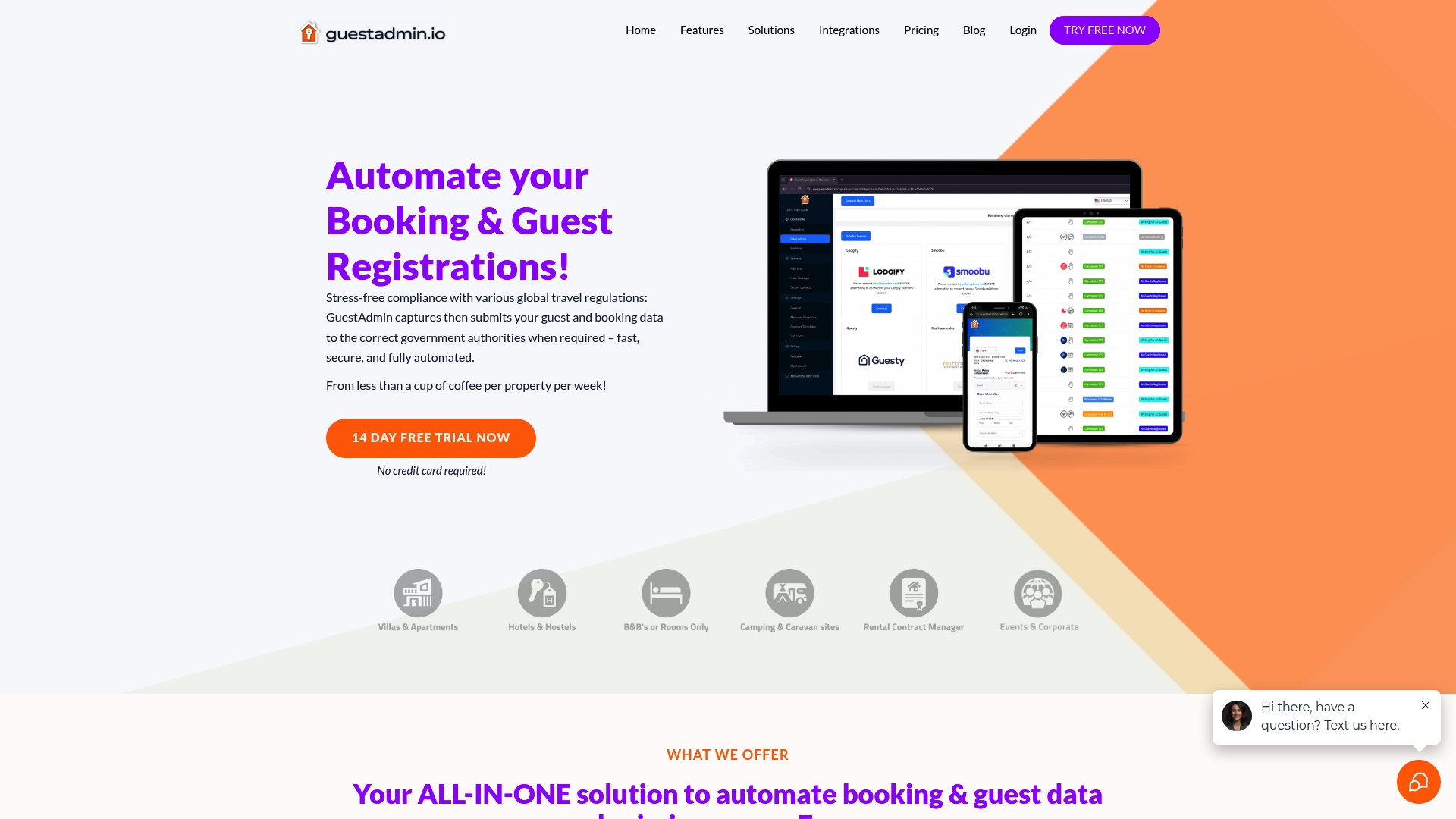
Guestadmin automates guest data capture, processes identification documents with AI, and submits registration data to government authorities within 24 hours. The platform supports multi-property management from a single dashboard, integrates with leading PMS and OTA platforms, and stores all records in a GDPR-compliant, audit-ready format. For managers who want to move from manual processes to a system that tracks, alerts, and documents compliance automatically, Guestadmin removes the administrative burden and replaces it with confidence. Explore the 2026 compliance guide to see how the platform maps to your specific obligations.
FAQ
What are hospitality compliance rules?
Hospitality compliance rules are the legal and regulatory standards that property owners must meet to operate lawfully, covering food safety, health and safety, data protection, employment, and licensing across European jurisdictions.
Is GDPR relevant to short-term rental operators?
GDPR applies to any business that collects or processes personal data from guests, including short-term rental operators. Property managers must store guest data securely, obtain lawful consent, and conduct regular access reviews.
Which countries require guest registration reporting?
Italy, Spain, Portugal, France, and Greece all require property owners to submit guest identification data to national authorities, typically within 24 hours of arrival, using government portals such as Italy’s Alloggiati Web or Spain’s SES.Hospedería.
What is Natasha’s Law and does it apply to my rental?
Natasha’s Law requires full ingredient and allergen labelling on any food prepared on the premises and offered to guests in the UK. It applies to short-term rentals that provide catering or pre-prepared food as part of the stay.
How do recurring controls improve compliance audit outcomes?
Recurring controls with a named owner, scheduled cadence, documented procedure, and stored evidence are the most defensible approach to compliance. They demonstrate to inspectors that compliance is an ongoing operational practice, not a one-time exercise.
One Comment
What is travel compliance for short-term rentals?
[…] the relevant authority within a set timeframe, and retain records for audit purposes. Understanding what these rules cover is the starting point for any compliant […]