

TL;DR:
- Compliance pressure on European short-term rental operators is increasing with diverse jurisdictional rules.
- Digital and automated registration systems are becoming essential to meet deadlines and ensure GDPR compliance.
- GuestAdmin.io offers a unified platform to automate multi-country guest registration processes across Europe.
Compliance pressure on short-term rental operators across Europe has never been higher. From Spain’s 24-hour reporting windows to Italy’s Alloggiati Web system and Portugal’s SEF requirements, every jurisdiction sets its own rules, its own portals, and its own deadlines. For property managers running multiple listings, choosing the wrong guest registration method can mean missed submissions, regulatory fines, and operational chaos. This article breaks down every major registration method available today, compares them clearly, and gives you a practical framework for selecting the approach that keeps your properties compliant and your operations running smoothly.
Table of Contents
- Understanding guest registration requirements across Europe
- Manual guest registration: Traditional methods explained
- Digital guest registration: Online platforms and dedicated apps
- Automated system-to-system guest registration: The frontier of compliance
- Choosing the right guest registration method for your property
- Our perspective: Stop treating registration as an afterthought
- How GuestAdmin.io simplifies your compliance workflow
- Frequently asked questions
Key Takeaways
| Point | Details |
|---|---|
| Digital methods dominate | Digital guest registration systems are now standard for regulatory compliance across Europe. |
| Automation supports efficiency | Automated platforms minimise errors and streamline authority communication for property managers. |
| Regional variations matter | Compliance rules and required systems can change by country and region—even within the same country. |
| Manual methods are outdated | Paper-based registration is rarely compliant and is being replaced by digital alternatives. |
Understanding guest registration requirements across Europe
Before choosing a registration method, you need to understand what you are actually being asked to do. Guest registration for short-term rentals is distinct from border immigration checks. As a host or property manager, your obligation is to collect specific guest data, including full name, nationality, document number, and dates of stay, and submit that data to the relevant local or national authority within a defined window.
The requirements vary considerably across Europe. Some countries require submission within 24 hours. Others allow 48 hours. Some mandate biometric data collection. Others focus purely on travel document details. The authority you report to also changes by country and sometimes by region within the same country.
Common obligations that property managers need to track include:
- Guest identity data: full name, date of birth, nationality, and document type
- Travel document details: passport or ID number, issue date, and expiry date
- Booking data: arrival and departure dates, number of guests, and accommodation address
- Submission deadlines: typically 24 to 48 hours after check-in
- Data retention: most jurisdictions require records to be kept for a minimum of one to three years
- Secure storage: GDPR-compliant handling of all personal data collected
The direction of travel across the EU is clear. As the European Parliament notes, the EU short-term rental framework pushes towards standardised digital processes and centralised digital entry points for data sharing, meaning that compliant guest registration increasingly relies on digital submission rather than paper or purely manual workflows.
“The EU approach pushes toward standardised digital processes and centralised digital entry points for data sharing, implying that compliant guest registration increasingly relies on digital submission.”
— European Parliament, Short-Term Rentals: EU Rules for More Transparency
When evaluating any registration method, weigh it against four core criteria: speed (can it meet the submission deadline reliably?), compliance fit (does it support the specific fields and formats required by your authority?), digital security (is guest data handled in a GDPR-compliant way?), and regional fit (does it accommodate the specific portal or authority for your property’s location?). Use the EU guest registration guide to map your obligations by country before making any decision.
Manual guest registration: Traditional methods explained
Now that you know the general framework, let’s examine the oldest method: manual guest registration.
Manual registration means collecting guest information on paper forms or physical logbooks, then either posting, faxing, or hand-delivering that data to the relevant authority. In practice, the process looks like this: a guest arrives, fills in a registration card, the host checks the details against the travel document, retains a copy, and submits the form to the local police or tourism authority, either in person or by post.

The advantages of this approach are straightforward. It requires no technology, no internet connection, and no software subscription. For very small rural operations with infrequent bookings and limited digital infrastructure, manual registration can feel manageable.
However, the limitations are significant:
- Speed: Physical submission cannot reliably meet 24-hour deadlines in most urban or high-volume settings
- Error rates: Handwritten forms introduce transcription errors that can trigger compliance failures
- Bulk handling: Managing paper records for multiple properties or back-to-back bookings is genuinely unsustainable
- Audit risk: Retrieving specific records during an inspection is slow and unreliable without a structured filing system
- Digital mandates: Many EU authorities no longer accept paper submissions at all
Manual methods are still technically permitted in a small number of localities, particularly in rural areas where digital enforcement has not yet been implemented. However, this is changing rapidly. The manual guest registration overview at GuestAdmin confirms that even where paper methods are tolerated, the trend is firmly towards mandatory digital submission.
Pro Tip: Even if your local authority still accepts paper forms, you must follow documentation retention rules. Store all completed registration forms securely, restrict access to authorised personnel only, and retain records for the minimum period required by your jurisdiction, which is typically one to three years.
The honest assessment is this: manual registration is a legacy method that introduces unnecessary risk. If you are still relying on it, the question is not whether to switch, but when.
Digital guest registration: Online platforms and dedicated apps
Manual methods aside, the digital revolution has transformed guest registration for rental properties. Today, property managers have three main types of digital registration tools available: government authority portals, property management system (PMS) integrated solutions, and guest-facing apps.
Government portals are the direct submission route. Spain’s SES.HOSPEDAJES system is one of the most well-known examples. As Spanish solicitors confirm, owners and managers must register the accommodation and then submit guest information online within 24 hours of check-in. Italy uses Alloggiati Web. Portugal uses SEF. Each portal has its own login, its own data format, and its own submission interface.
PMS-integrated solutions connect your booking management software directly to the registration workflow, reducing the need to re-enter data manually across multiple systems.
Guest-facing apps allow guests to complete their own registration digitally before or upon arrival, with the data flowing into the host’s compliance workflow automatically.
Here is a direct comparison of the main digital approaches:
| Criteria | Government portals | PMS-integrated software | Guest-facing apps |
|---|---|---|---|
| Compliance fit | High (authority-specific) | High (if configured correctly) | Moderate (depends on integration) |
| Ease of use | Low to moderate | High | High |
| Automation | None | High | Moderate |
| Error reduction | Low | High | Moderate |
| Regional rule support | Native | Depends on provider | Limited |
| Setup complexity | Low | Moderate | Low |
The features driving adoption of digital tools over manual portals include:
- Instant submission confirmation: digital systems generate a receipt or confirmation number immediately
- Automatic reminders: alerts before deadlines reduce the risk of missed submissions
- Secure cloud storage: guest data is stored in GDPR-compliant environments with access controls
- Multi-property management: one dashboard handles registrations across multiple listings simultaneously
- Audit-ready records: data is retrievable instantly during inspections
One important regional nuance: Spain’s SES.HOSPEDAJES is the default national portal, but Catalonia and the Basque Country submit to different authorities with their own specific requirements. This is why understanding your exact jurisdiction matters before selecting a tool. Explore digital guest books and automated registration explained for a deeper look at how these tools work in practice.
Automated system-to-system guest registration: The frontier of compliance
Building on digital solutions, automation is rapidly raising the bar for guest registration. System-to-system registration means your management software transmits guest data directly to the relevant authority with no manual input at any stage. The host or manager does not log into a portal, copy-paste data, or click submit. The system handles it entirely.
The clearest model for where this is heading is the EU’s Entry/Exit System (EES). The European Commission describes EES as an automated IT system registering travellers’ name, travel document data, biometric data, and entry/exit dates, with full operation from 10 April 2026. While EES applies at external Schengen borders rather than short-term rentals directly, it signals the direction regulators are moving: real-time, automated, biometric-capable data submission with no manual bottleneck.
For STR managers, this matters because national authorities are beginning to adopt similar logic. Here is a summary of where system-to-system reporting is being explored or piloted:
| Country/region | System | Status |
|---|---|---|
| Spain (national) | SES.HOSPEDAJES API | Live (API access available) |
| Portugal | SEF digital submission | Active, partial automation |
| Italy | Alloggiati Web | Manual portal, API under development |
| France | Local municipality systems | Fragmented, varies by commune |
| EU (borders) | EES | Operational from April 2026 |
The practical implication for property managers is significant. If your current software cannot connect via API to your national authority’s portal, you are already behind the curve. Future-proofing your compliance workflow means selecting a platform that supports secure rental data reporting via direct system integration, not just manual portal access.
Preparing now means auditing your current tools, confirming API availability with your relevant authority, and ensuring your PMS or compliance platform is built to handle automation in guest registration as requirements evolve. The managers who act early will avoid the scramble that always follows a regulatory deadline.
Choosing the right guest registration method for your property
With all major methods compared, here is how to decide what suits your properties.
The selection process should be methodical, not reactive. Follow this step-by-step checklist:
- Identify your jurisdiction’s authority: Confirm which body you report to. In Spain, is it SES.HOSPEDAJES, Mossos d’Esquadra (Catalonia), or Ertzaintza (Basque Country)? In Italy, is it the local Questura via Alloggiati Web? Each authority has specific format requirements.
- Check the submission deadline: If your authority requires 24-hour submission, manual methods are not viable for most operations. Automation becomes essential.
- Assess your property volume: A single property with low occupancy may manage with a government portal. Ten properties with back-to-back bookings require integrated, automated software.
- Evaluate data security requirements: Confirm that any tool you use is GDPR-compliant, encrypts data in transit and at rest, and restricts access appropriately.
- Test regional edge cases: Before committing to any integration, verify it handles your specific region. A platform built for SES.HOSPEDAJES may not support Catalonia’s separate submission route without additional configuration.
- Check scalability: Will the solution grow with you? If you plan to add properties in a new country, does the platform support that jurisdiction?
As Spanish solicitors highlight, portal responsibility and data requirements can vary by region within the same country. This is not a minor detail. Choosing a tool that covers the national default but misses your regional authority can leave you non-compliant even when you believe you are covered.
Pro Tip: Before signing up for any compliance platform, ask the provider directly: “Does your system support submission to [your specific authority]?” Request confirmation in writing. Regional edge cases are where compliance failures most commonly occur.
Key considerations to summarise your decision:
- Scalability: can it handle growth across properties and jurisdictions?
- Automation depth: does it submit data automatically, or does it still require manual steps?
- Support quality: is there responsive support when a submission fails or a portal changes its format?
- Regional upgrades: does the provider update the platform when authorities change their requirements?
Use the registration guide by region to cross-reference your obligations before finalising your choice.
Our perspective: Stop treating registration as an afterthought
Here is an uncomfortable truth that most compliance guides avoid: many property managers choose their registration method based on what is cheapest or most familiar, not what is most compliant. That is a significant risk, and it is one that regulators are increasingly willing to act on.
The conventional wisdom is to start simple, use the government portal, and upgrade later if needed. In practice, “later” often arrives as a fine or an inspection notice. The 24-hour submission window in Spain, for example, is not flexible. Miss it once during a busy check-in period and the consequences are immediate.
What we have observed working with operators across Europe is that the managers who avoid compliance crises are not necessarily the most technically sophisticated. They are the ones who treated registration infrastructure as a core operational decision from the start, not a box-ticking exercise.
The shift from manual to digital to automated is not just a technology upgrade. It is a fundamental change in how you manage risk. Automated system-to-system reporting removes the human error variable entirely. That is not a luxury for large operators. It is the baseline standard that regulations are moving towards, and the EES rollout in April 2026 makes that direction undeniable.
Our strong recommendation: evaluate your current method against the criteria in this article today, not when a new regulation forces your hand.
How GuestAdmin.io simplifies your compliance workflow
If you are managing short-term rentals across Europe and finding that no single tool covers all your jurisdictions cleanly, GuestAdmin.io was built precisely for that challenge.
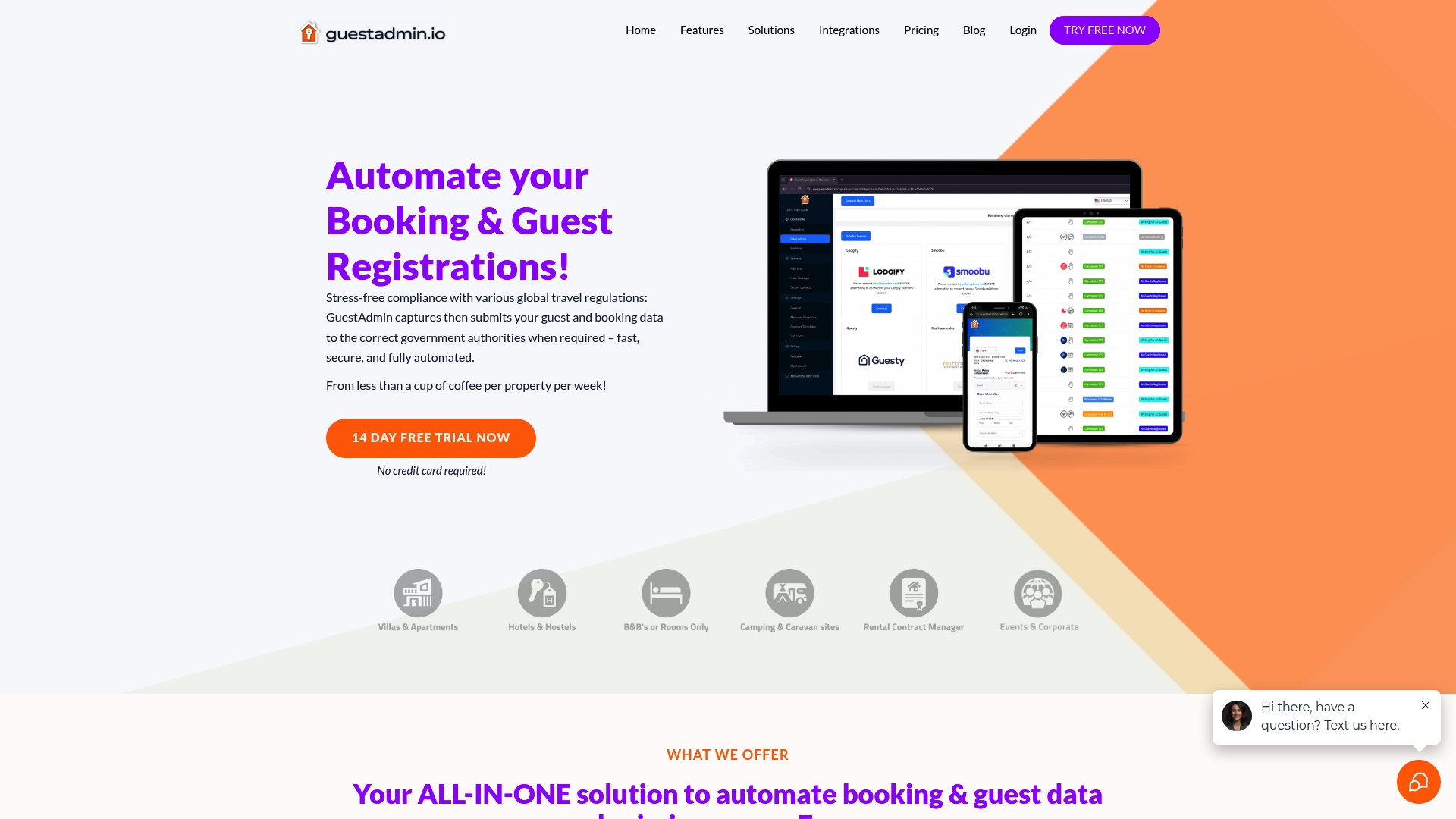
GuestAdmin.io automates guest data capture, processing, and submission to relevant government authorities across multiple European jurisdictions, all from a single web-based dashboard. Whether you are submitting to SES.HOSPEDAJES in Spain, Alloggiati Web in Italy, or SEF in Portugal, the platform handles the submission within 24 hours, with no manual portal logins required. It integrates with popular PMS and OTA platforms via APIs and webhooks, supports multi-property management, and is fully GDPR-compliant. For property managers who want to stop juggling portals, spreadsheets, and paperwork, GuestAdmin.io is the practical next step.
Frequently asked questions
Which guest registration method ensures compliance in Spain?
Registering via the SES.HOSPEDAJES digital system within 24 hours ensures compliance for most of Spain, though regions like Catalonia and the Basque Country require submission to different authorities with their own specific portals.
Are paper guest books still allowed in Europe?
Paper methods are increasingly phased out in favour of digital systems, and EU rules confirm that compliant registration increasingly relies on digital submission rather than manual workflows.
What is a system-to-system registration in guest management?
It is an automated process where guest data is transmitted directly from management software to the relevant authority with no manual input, following the model of the EU Entry/Exit System.
How fast must guest registration data be submitted in Spain?
Guest data must be submitted online within 24 hours of check-in, making manual or delayed submission methods non-viable for most operators.
One Comment
Industry terminology in guest management explained
[…] guest registration methods available to short-term rental owners now range from manual paper forms to fully digital […]