

Managing compliance for multiple European properties can leave you feeling buried under an avalanche of data, deadlines, and regulations. Juggling booking platforms, accounting systems, and guest registrations across different jurisdictions often leads to confusion and mistakes. Even a simple oversight can result in costly penalties or hours of administrative work.
There is a smarter way to run your portfolio. When you harness centralised platforms, AI tools, and real-time dashboards, compliance stops being a guessing game and becomes a seamless part of daily operations. These practical strategies will help your team save time, reduce errors, and regain control over compliance submissions no matter how many properties you oversee.
Get ready to discover proven solutions that tackle scattered data, automate the most tedious tasks, and give you peace of mind with GDPR-compliant systems. Every tactic in this list is designed to simplify complex processes and provide decision-making clarity you can act on immediately.
Table of Contents
- 1. Centralise Data With Integrated Platforms
- 2. Automate Compliance Submissions For All Properties
- 3. Monitor Bookings Using Real-Time Dashboards
- 4. Utilise AI-Powered Guest Data Processing
- 5. Secure GDPR-Compliant Access Across Devices
- 6. Leverage Insights For Smarter Property Decisions
Quick Summary
| Key Message | Explanation |
|---|---|
| 1. Centralise your data | Integrate multiple property systems into a unified platform to enhance visibility and reduce manual errors. |
| 2. Automate compliance tasks | Use automation to handle compliance submissions, ensuring timely and accurate compliance with regulations without manual interference. |
| 3. Implement real-time dashboards | Utilise dashboards to monitor bookings and performance metrics in real-time, facilitating quicker, data-driven decisions. |
| 4. Leverage AI for data processing | Adopt AI technology to process guest data more efficiently, reducing errors and freeing up team resources for guest engagement. |
| 5. Ensure secure data access | Implement robust access controls to safeguard guest information and comply with GDPR, ensuring only authorised personnel can access sensitive data. |
1. Centralise Data with Integrated Platforms
When you manage multiple properties, data ends up scattered across different systems. PMS platforms, booking channels, accounting software, and compliance tools all hold crucial information that rarely communicate with one another.
Centralised data integration solves this fragmentation. By combining information from all your properties and systems into a single platform, you gain complete visibility and eliminate manual data entry errors.
Why this matters for your business:
Unified dashboards for multi-property portfolios consolidate data from multiple properties and software systems, eliminating data silos and enabling comprehensive oversight. This means you can access real-time insights about occupancy, revenue, guest arrivals, and compliance status without switching between five different portals.
Without centralisation, your team wastes hours copying data manually between systems. This creates delays, inconsistencies, and compliance risks. A property manager might miss a guest registration deadline simply because data from the booking engine never reached the compliance tracking system.
Centralised platforms reduce administrative workload whilst dramatically improving decision-making accuracy across your entire portfolio.
How integration works in practice:
- Automatically pulls booking data from your OTA channels and PMS
- Syncs guest information across all connected systems in real-time
- Eliminates duplicate data entry and manual spreadsheet updates
- Provides role-based dashboards tailored to different team members
- Tracks compliance status across all properties simultaneously
Imagine checking one dashboard and instantly seeing which properties have pending guest registrations, which ones are compliant with local regulations, and where revenue trends are heading. That’s the power of centralised data.
For property managers overseeing 10, 50, or even 100 properties, this isn’t a luxury. It’s operational necessity. Each property generates dozens of data points daily. Without integration, managing that information becomes impossible.
Practical benefits you’ll notice immediately:
Your team saves roughly 5-8 hours per week on data management tasks. Compliance submissions happen automatically rather than through scrambled manual processes. Guest onboarding becomes seamless because information flows directly from booking to check-in systems without manual intervention.
Pro tip: When selecting an integrated platform, prioritise one that connects with your existing PMS and booking channels—your current systems won’t change, but they’ll finally work together instead of against each other.
2. Automate Compliance Submissions for All Properties
Manual compliance submissions are your biggest operational burden. Every property in every jurisdiction requires timely guest registrations, tax reports, or regulatory filings. Miss a deadline by even one day, and you face penalties.
Automation removes this pressure entirely. By automating compliance submissions, you ensure every property meets its obligations regardless of local regulations, timezones, or administrative complexity.
The problem with manual submissions:
Your team currently manages compliance through spreadsheets, email reminders, and manual portal entries. One person handles France, another manages Spain, a third tracks Austria. Each jurisdiction has different deadlines, formats, and requirements. Human error creeps in. Deadlines slip.
AI-driven autonomous compliance management systems automate data governance across multiple regions and regulatory frameworks such as GDPR, reducing resource demands and human errors in compliance management.
Automation transforms compliance from a constant worry into a silent, reliable system that never sleeps and never forgets.
How automated submissions work:
When a guest books through your channels, their data flows automatically into the compliance system. The platform verifies the information against local regulations, prepares the submission in the correct format, and submits it to authorities within the required timeframe. All without human intervention.
You don’t need to remember deadline calendars. You don’t need separate software for each jurisdiction. The system handles everything.
What gets automated:
- Guest registration data submitted within 24 hours of arrival
- Tax reporting compliance across all European jurisdictions
- GDPR-compliant data handling and archiving
- Regulatory documentation generation and submission
- Audit trail creation for compliance verification
Imagine managing 50 properties across 12 countries with zero manual compliance paperwork. That’s what automation delivers.
The real business impact:
Your compliance team shrinks from 2-3 people managing submissions to one person overseeing the system. That’s significant cost savings. More importantly, compliance becomes predictable and stress-free. No more frantic calls about missed deadlines or format errors.
Pro tip: Set up automated compliance submissions first for your highest-risk jurisdictions, then expand gradually—this builds confidence in the system whilst minimising disruption to existing workflows.
3. Monitor Bookings Using Real-Time Dashboards
Right now, your booking information is scattered across multiple systems. Your PMS shows one occupancy picture, your OTA channels show another, and your accounting software has a third version of the truth. Nobody has a complete, current view of what’s actually happening across your portfolio.
Real-time dashboards solve this fragmentation by pulling all booking data into one unified view. You see occupancy, revenue, guest arrivals, and compliance status simultaneously across every property.
Why real-time visibility matters:
Property management decisions happen fast. A guest cancels, and you need to know immediately if that property is now available for a last-minute booking. Revenue dips unexpectedly, and you want to understand why across your entire portfolio. A compliance deadline approaches, and you need to see which properties have pending registrations.
Without real-time dashboards, this information reaches you slowly through multiple channels. By then, the moment for quick action has passed.
Real-time multi-property dashboards consolidate operational, financial, and asset data from multiple properties into a unified, cloud-based interface, enabling dynamic views tailored to roles and accelerating decision-making.
A single glance at your dashboard tells you more than hours spent juggling spreadsheets and portal logins.
What you can monitor in real-time:
- Occupancy rates across all properties simultaneously
- Revenue trends and pricing performance
- Guest arrivals and check-in status
- Pending compliance registrations by jurisdiction
- Maintenance requests and operational issues
- Booking sources and channel performance
Imagine your 20 properties spread across five countries. Instead of checking five different portals each morning, one dashboard shows you everything. You spot that your Barcelona property has suddenly dropped to 40 per cent occupancy while your Vienna property is fully booked. You can act immediately.
How dashboards accelerate management:
Your team spends less time gathering data and more time making decisions. Customised views mean the revenue manager sees financial metrics, the operations manager sees maintenance needs, and the compliance officer sees registration status. Everyone gets exactly what they need.
Practical benefits you’ll see immediately:
Your daily management meetings become 50 per cent shorter because the data is already current. Staff can answer guest questions faster because booking information is instantly available. Revenue optimisation becomes proactive rather than reactive.
Pro tip: Set up custom dashboard views for each team member based on their role, then train them to check their dashboard first thing every morning instead of waiting for email updates.
4. Utilise AI-Powered Guest Data Processing
Guest data processing is one of your most time-consuming tasks. Names, addresses, identification numbers, payment details, and compliance information arrive in different formats from different channels. Your team spends hours cleaning, verifying, and formatting this data before it can be submitted to authorities.
AI-powered processing changes everything. Machine learning algorithms instantly capture, verify, and process guest information with accuracy that humans cannot match, freeing your team from tedious data work.
The manual data problem:
When you handle guest data manually, errors multiply. A guest types their address differently than their ID shows. A booking system records a name in one format whilst your compliance portal expects another. Payment information doesn’t match registration data. Your team spends hours reconciling these inconsistencies.
AI and data analytics transform hospitality by enabling personalised guest experiences whilst maintaining data accuracy and addressing privacy considerations.
AI doesn’t just process data faster. It processes data more accurately, catching errors your team would miss.
How AI processes guest data:
- Automatically reads and extracts information from ID documents
- Validates data against regulatory requirements in real-time
- Reconciles guest details across booking, payment, and compliance systems
- Flags suspicious or incomplete information for manual review
- Formats data to match each jurisdiction’s submission requirements
- Archives processed data securely with full audit trails
Imagine a guest checking in with a booking confirmation, a passport, and a payment card. AI captures information from all three sources simultaneously, verifies consistency, and confirms compliance readiness in seconds.
What you gain operationally:
Your data quality improves dramatically because AI catches errors consistently. Processing speed accelerates from hours to minutes. Your team focuses on guest experience instead of data entry. Compliance submissions arrive on time with zero format errors.
Real-world impact:
A property manager overseeing 30 properties previously spent 10 hours weekly on guest data processing. With AI, that shrinks to 2 hours weekly for oversight and exception handling. That’s 16 hours per week recovered for higher-value work.
Better yet, the accuracy rate jumps from 94 per cent to 99.8 per cent. Compliance submissions no longer fail due to formatting errors.
Pro tip: Start with AI processing for your highest-volume properties first, then expand—this builds confidence and lets your team learn the system gradually before rolling out organisation-wide.
5. Secure GDPR-Compliant Access Across Devices
Your team works everywhere. The property manager checks bookings from her phone at breakfast. The compliance officer accesses guest data from a laptop at the office. The owner logs in from a tablet whilst travelling. But every device that accesses guest information is a potential security vulnerability.
GDPR compliance means controlling who accesses what data, from where, and when. Without proper safeguards, you risk fines up to €20 million or 4 per cent of global revenue for unauthorised data access.
The access control challenge:
Traditional systems grant access too broadly or require overly restrictive permissions. A team member logs in once and can access everything, even data they don’t need. Or alternatively, system restrictions are so tight that legitimate work becomes impossible.
Access control frameworks combining role-based and attribute-based systems enforce strict authentication, data minimisation, and traceability whilst adapting to diverse jurisdictional requirements.
Proper access control means giving people exactly what they need, nothing more, and being able to prove it.
How secure access works across devices:
- Staff members access data only based on their role and responsibilities
- Every login attempt requires strong authentication, even on personal devices
- Data is encrypted both in transit and at rest
- Access logs create permanent audit trails showing who accessed what and when
- Sessions automatically expire, preventing unauthorised lingering access
- Device identity is verified, blocking access from unknown or unsafe devices
Imagine your property manager accessing guest information on her phone using encryption that would take a supercomputer weeks to crack. Meanwhile, your system records exactly when she logged in, which properties she viewed, and what actions she took.
Why this matters for GDPR compliance:
GDPR requires data minimisation meaning staff access only necessary information. It demands accountability meaning you must prove how data is protected. It mandates audit trails showing every interaction with personal data.
Without device security and proper access controls, you cannot demonstrate compliance. With them, you can.
Practical security layers:
- Multi-factor authentication prevents password-only breaches
- Role-based permissions ensure the receptionist cannot access financial records
- Encrypted storage protects data if a device is lost or stolen
- Real-time monitoring alerts you to suspicious access patterns
- Automatic session timeouts prevent unattended device access
Your compliance officer can sleep knowing that a lost mobile phone containing guest data is worthless to thieves because the data is encrypted and inaccessible without authentication.
Pro tip: Implement role-based access where your receptionist sees only check-in information, your accountant sees only financial data, and your compliance officer sees registrations—this minimises risk and simplifies management.
6. Leverage Insights for Smarter Property Decisions
Right now, you’re making property decisions based on incomplete information. You know occupancy rates, but not why they’re changing. You see revenue numbers, but not which properties underperform or why. You manage compliance, but lack visibility into patterns that could improve your operations.
Data analytics transforms raw information into actionable insights. By analysing booking patterns, guest behaviour, and operational metrics, you make decisions based on facts instead of intuition.
The insight gap:
Without proper analytics, your team relies on gut feeling. One manager thinks pricing should increase. Another wants to reduce marketing spend. Nobody has solid evidence. Discussions become arguments rather than data-driven conversations.
Data-driven decision making in property management uses analytics to replace intuition with actionable insights from operational metrics, enhancing profitability and efficiency.
The best property managers aren’t the ones with the strongest opinions. They’re the ones with the best data.
What insights reveal:
- Which properties generate highest revenue per guest
- Which booking channels deliver the most valuable guests
- Seasonal patterns showing when to raise or lower prices
- Operational costs by property and category
- Guest satisfaction trends across your portfolio
- Compliance patterns and potential risk areas
Imagine discovering that your smaller properties actually generate better margins than your flagship properties. Or realising that guests from one booking channel spend 23 per cent more on add-ons than guests from another channel. These insights drive smarter strategy.
How insights translate to decisions:
Once you see patterns in your data, decisions become obvious. If occupancy drops every October in one property, you can investigate early and adjust pricing or marketing. If one property consistently maintains 96 per cent occupancy whilst another sits at 72 per cent, you can study what the successful property does differently.
Real-world impact:
Property managers using analytics report increased profitability through optimised pricing and targeted maintenance. Revenue improves by identifying high-performing properties worth investment. Operational efficiency gains happen through resource allocation guided by data rather than guesswork.
Your cleaning team can focus on properties with highest turnover. Your marketing budget concentrates on channels delivering best returns. Your pricing adjusts dynamically based on demand patterns, not static seasonal assumptions.
Actionable insights from your data:
- Occupancy trends showing which seasons need attention
- Revenue per guest revealing your most valuable guest segments
- Operational costs by property identifying efficiency opportunities
- Guest satisfaction ratings highlighting service improvement areas
- Compliance submission timing revealing process bottlenecks
Pro tip: Start tracking one key metric across all properties, such as revenue per available room, then add metrics gradually—building confidence in your data before making major strategic decisions based on it.
Below is a comprehensive table summarising the strategies and benefits outlined in the article related to optimising property management through innovative software systems.
| Topic | Key Features/Actions | Benefits/Outcomes |
|---|---|---|
| Centralising Data | Integrate information from multiple platforms and systems. | Save time, improve decision-making accuracy, and reduce errors. |
| Automating Compliance | Use AI-powered tools to handle regulatory submissions automatically. | Eliminate missed deadlines, reduce manual effort, and increase reliability. |
| Implementing Real-Time Dashboards | Consolidate booking, occupancy, and operation data into a single platform. | Gain instant insights, act quickly, and enhance operational efficiency. |
| Processing Guest Data with AI | Utilise AI for secure and efficient handling of guest information. | Boost accuracy, improve processing speed, and ensure GDPR compliance. |
| Securing Access Across Devices | Enforce role-based permissions and device-level security. | Protect sensitive data, ensure regulatory compliance, and maintain operational control. |
| Leveraging Data Insights | Apply analytical techniques to operational metrics and guest behaviours. | Promote data-driven decision-making, optimise costs, and improve revenue growth. |
Streamline Your Multi-Property Management with GuestAdmin.io
Managing multiple short-term rental properties across Europe means juggling complex compliance requirements, scattered data, and time-consuming manual tasks as highlighted in the article “6 Essential Tips for Multi-Property Management Success”. Pain points like fragmented booking systems, manual compliance submissions, and inconsistent guest data processing threaten efficiency and risk costly penalties. Achieving centralised data integration, automating compliance, and gaining real-time insights are no longer optional but necessary steps to reduce stress and improve operational control.
GuestAdmin.io is designed precisely to meet these challenges. Our SaaS platform simplifies regulatory compliance and automates guest data capture and submission across all your properties to relevant government authorities within 24 hours. With features including real-time booking dashboards, seamless integration with popular PMS and OTA platforms, and AI-powered data processing, you can finally take control of your portfolio. Secure, GDPR-compliant access ensures your team can work confidently from any device without risking data breaches.
Take your multi-property management from overwhelming to effortless today by exploring how GuestAdmin.io can centralise your data, automate submissions, and provide actionable insights tailored for your hospitality business.
Looking for a proven way to reduce administrative workload and stay ahead of regulatory demands?
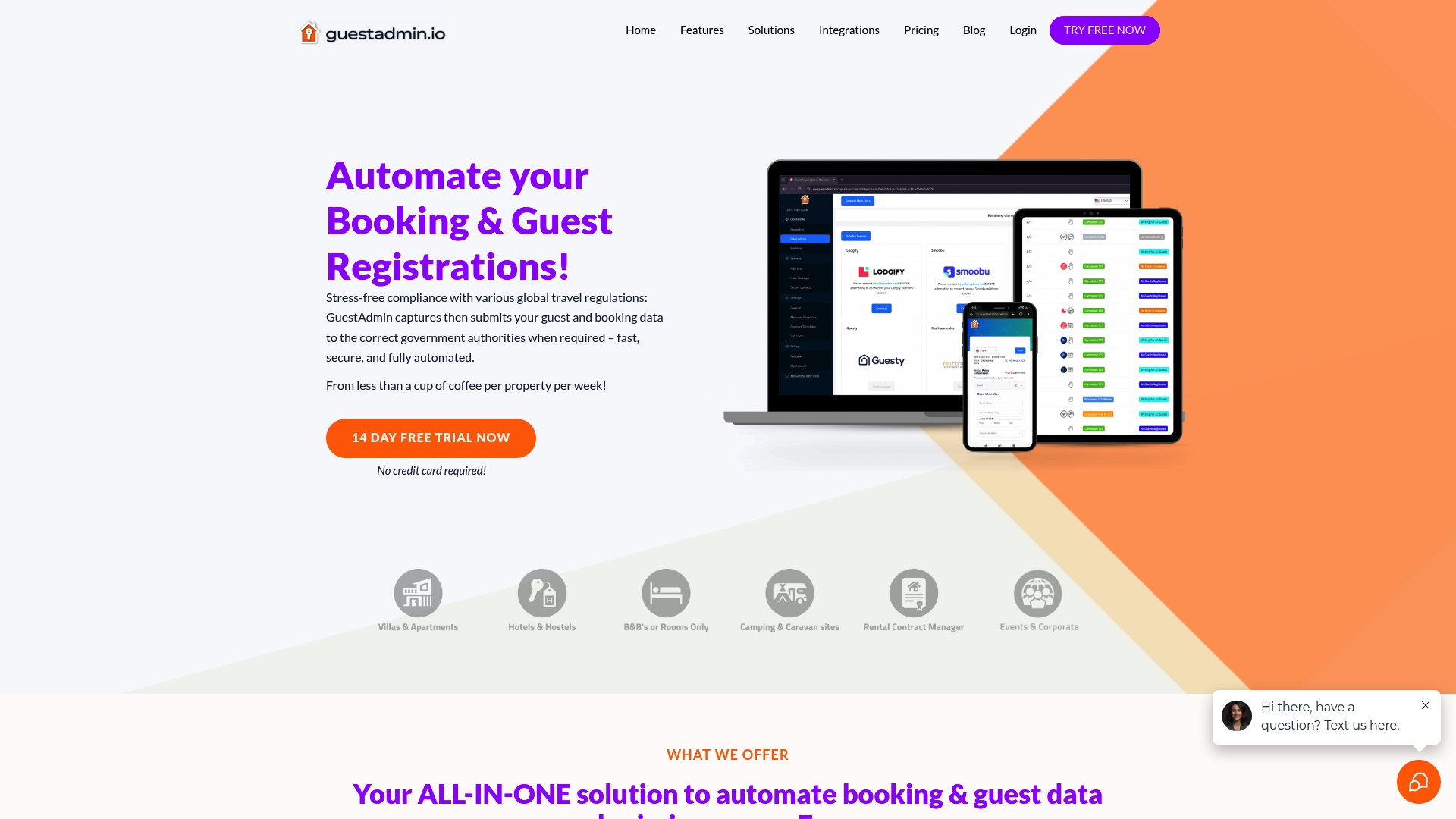
Discover the power of automation and integration with GuestAdmin.io. Get started now and transform your property management with smarter compliance and data solutions at https://guestadmin.io.
Frequently Asked Questions
How can centralising data improve my multi-property management?
Centralising data consolidates information from all properties into one platform, giving you complete visibility. Consider implementing an integrated platform to save up to 8 hours weekly on data management tasks, allowing your team to focus on decision-making instead.
What are the benefits of automating compliance submissions for my properties?
Automating compliance submissions ensures timely guest registrations and reduces the risk of human error. Start by automating submissions for your highest-risk properties to streamline the process and improve compliance by up to 100%.
How can I monitor bookings effectively across all my properties?
Utilising real-time dashboards allows you to see occupancy rates, revenue trends, and guest arrivals simultaneously. Set up a unified dashboard to reduce time spent on data gathering by 50%, enabling faster decision-making and more streamlined operations.
How does AI-powered guest data processing enhance accuracy?
AI-powered guest data processing captures and verifies information with high precision, significantly reducing errors. Implementing AI can improve your data accuracy rate from 94% to 99.8%, freeing your team for more valuable tasks right away.
What steps should I take to ensure GDPR-compliant access to data across devices?
To ensure GDPR compliance, implement strict access controls based on individual roles. Start by establishing role-based permissions and using multi-factor authentication, which can effectively safeguard sensitive data against unauthorized access.
How can I leverage insights from data to make smarter property decisions?
Analysing booking patterns and guest behaviour transforms raw data into actionable insights for decision-making. Begin tracking one key metric, such as occupancy trends, to facilitate data-driven decisions that can enhance operational efficiency and profitability.
Recommended
- 6 Essential Multi-Property Management Best Practices
- 7 Essential Multi-Property Management Tips for Managers
- 7 Property Management Compliance Best Practices Explained
- Multi-Property Management Explained: Streamlining Compliance
- 6 consejos clave para alquilar en Cambrils con éxito – Inmobiliaria Costa Cambrils