

TL;DR:
- A property management reporting hierarchy organizes financial data into property, entity, and portfolio layers for accurate reporting and compliance. Implementing this structure early simplifies reconciliation, improves owner communication, and supports rapid growth. Automating data collection and reporting reduces errors, time, and regulatory risks across all levels.
The property management reporting hierarchy is defined as the structured, multi-layered system that organises financial and operational data from individual properties up through legal entities to a consolidated portfolio view. Understanding what is property management reporting hierarchy is not optional for short-term rental managers. It determines how accurately you report to owners, how quickly you close your books, and whether you meet the compliance obligations that European regulators increasingly demand. Get the structure right from the start, and every other reporting task becomes faster and more reliable.
What is the property management reporting hierarchy?
The property management reporting hierarchy organises reporting into three distinct layers: property-level, entity-level, and portfolio-level. Each layer serves a different audience and answers a different question. Property-level reports answer “how is this specific rental performing?” Entity-level reports answer “how are the legal vehicles that own these rentals performing?” Portfolio-level reports answer “what is the consolidated picture across everything I manage?”
The industry term for this structure is “multi-layer consolidation reporting,” and it sits at the heart of professional property management structure. Without it, financial data stays siloed. Owners receive inconsistent summaries, and compliance gaps appear at audit time.
Institutional investors require consolidated reports within 10–15 business days of period close as a standard. That benchmark reflects how seriously professional operators treat the hierarchy. Short-term rental managers who adopt the same discipline gain a clear competitive advantage when communicating with owners.
What are the key layers of the reporting hierarchy?
Each layer of the property management hierarchy has a distinct function. Understanding all three prevents the most common reporting failures.
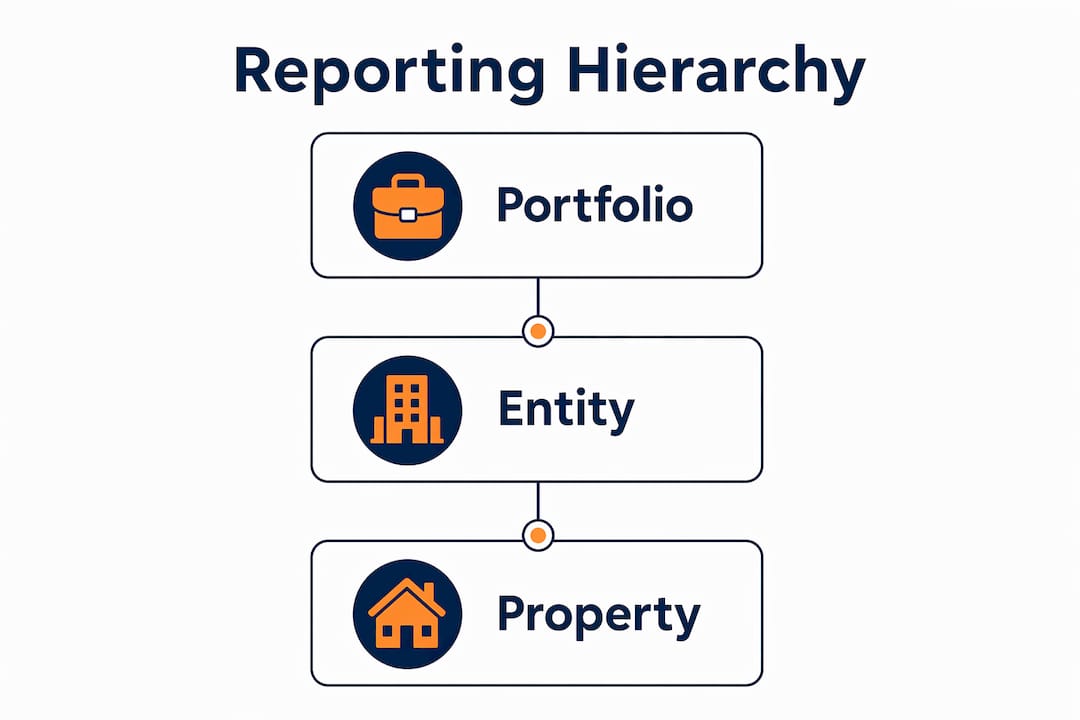
Property-level reporting
Property-level reporting focuses on the individual asset. It captures revenue, direct operating costs, and net operating income for each rental unit or property. The standard output is a monthly profit and loss statement, often called a P&L waterfall, which shows income lines, expense categories, and the resulting net figure. Standard industry cadence requires monthly property-level P&Ls, quarterly reforecasting, and mandatory monthly account reconciliations to avoid audit failures.

Entity-level reporting
Entity-level reporting consolidates the results of all properties held within a single legal vehicle. This layer manages intercompany transactions and tax positions. A common best practice is the “Golden Triangle” structure, which separates management, holding, and development entities to optimise tax compliance and clarify reporting lines. This separation creates clean intercompany flows and makes consolidated reporting significantly easier.
Portfolio-level reporting
Portfolio-level reporting aggregates all entities into one consolidated view. This is the layer that boards, investors, and senior owners see. Key outputs at this level include:
- Consolidated P&L across all properties and entities
- Variance reports comparing actual results to budget
- KPI dashboards covering occupancy, revenue per available room, and maintenance costs
- CapEx schedules for planned capital expenditure
- Owner distribution summaries
Reconciliation between all three layers is non-negotiable. Inconsistent account coding at property level creates errors that compound at portfolio level and can trigger compliance failures.
How does the reporting hierarchy integrate with team roles?
The property reporting hierarchy should directly dictate finance team structure and reporting workflows. This is the insight most growing operators miss. They build a team first and then try to fit reporting around it. The correct approach reverses that order.
For portfolios of 2,000 or more units, finance teams typically include five to eight roles: a CFO, controller, property accountants, accounts payable staff, and financial planning and analysis (FP&A) analysts. Each role maps to a specific layer of the hierarchy. Property accountants own property-level P&Ls. The controller owns entity-level reconciliations. The CFO and FP&A analysts own portfolio-level reporting and forecasting.
Smaller short-term rental operators often run leaner teams, but the same principle applies. One person may cover multiple roles, but the reporting responsibilities must still be clearly assigned. Ambiguity about who owns which layer is the single most common cause of delayed reporting cycles.
- Assign a named owner for property-level P&L production each month.
- Assign a named owner for entity-level reconciliation and intercompany eliminations.
- Assign a named owner for portfolio consolidation and owner-facing report delivery.
- Document the reporting cadence in writing and share it with all stakeholders.
- Review the cadence quarterly and adjust as the portfolio grows.
Pro Tip: If your close cycle regularly stretches beyond three weeks, the problem is almost always unclear role ownership at one of the three hierarchy layers, not a lack of data.
Automation reduces the headcount pressure at every layer. Operators with integrated platforms compress investor reporting preparation from days to hours. For short-term rental managers handling multiple properties across European jurisdictions, that time saving is material.
What systems and data structures underpin effective hierarchy reporting?
The technological foundation of any reporting hierarchy rests on three pillars: a standardised chart of accounts, transaction-level tagging, and a unified accounting database.
Standardised chart of accounts
The chart of accounts must be standardised across all properties and entities for integrated reporting and accurate consolidation. This means every property uses identical account codes for revenue, cleaning costs, maintenance, and management fees. Without this governance, consolidation becomes a manual matching exercise that introduces errors at scale.
Transaction-level tagging
Transactions must be tagged to specific property cost centres at the point of posting. This enables direct, automated property-level P&L reporting and removes the need for manual allocation. In practice, this means your accounting system records every invoice, payment, or revenue entry against a specific property identifier before it hits the general ledger.
Unified accounting database
Portfolios lacking automated consolidation depend heavily on error-prone spreadsheets. Firms managing multiple entities often maintain separate accounting files for the management company and each property company. Without a unified database, intercompany eliminations become laborious and unreliable.
The table below summarises the three pillars and their reporting impact.
| Pillar | What it does | Reporting impact |
|---|---|---|
| Standardised chart of accounts | Aligns account codes across all properties and entities | Enables automated consolidation without manual mapping |
| Transaction-level cost centre tagging | Tags every transaction to a specific property at posting | Produces accurate property P&Ls without manual allocation |
| Unified accounting database | Holds all entities in one system | Eliminates intercompany reconciliation errors and speeds close |
The reporting outputs that flow from this foundation include the P&L waterfall, variance reports with commentary, and KPI dashboards. Different audiences need different formats. Asset managers need detailed line-item P&Ls. Portfolio managers need variance summaries. Boards and investors need high-level KPI views.
What are common challenges in implementing the hierarchy?
The most frequent problems in property management hierarchy implementation fall into three categories: inconsistent data entry, multi-entity reconciliation failures, and manual report assembly.
Inconsistent account coding occurs when different properties use different codes for the same expense type. One property codes cleaning as “housekeeping,” another as “operational costs.” At consolidation, these appear as separate line items and distort the portfolio view.
Multi-entity reconciliation failures arise when intercompany transactions, such as management fees paid from a property company to the management company, are not eliminated before consolidation. The result is inflated revenue or cost figures at portfolio level.
Manual report assembly is the most time-consuming problem. Inadequate reporting remains the top complaint among property owners, primarily because of the lack of automation and integration. Assembling reports manually from multiple spreadsheets is slow, error-prone, and unsustainable as a portfolio grows.
Best practices to address these challenges include:
- Design the legal entity structure and chart of accounts before onboarding the first property.
- Implement a COA governance policy that requires approval for any new account code.
- Automate owner reports to include financial summaries, inspection updates, and maintenance logs in a single document.
- Integrate operational data, such as inspection results and maintenance records, directly into the reporting workflow.
Approximately 19% of owners switch managers annually due to reporting dissatisfaction. That figure represents a direct revenue risk. Retaining a single owner is valued at £2,400–£6,400 in annual management fees, depending on portfolio size and fee structure. Transparent, timely reporting is the most cost-effective retention tool available.
Pro Tip: Inspection results are the most requested but most often missing component of owner reports. Adding automated inspection summaries to your monthly owner pack reduces inbound queries faster than any other single change.
How can short-term rental managers apply the hierarchy in practice?
Short-term rental property managers face a specific version of the reporting challenge. Bookings arrive through multiple online travel agencies, occupancy fluctuates weekly, and European compliance requirements add a regulatory layer that traditional property management reporting does not always address.
The practical application of the management reporting process for short-term rentals follows a clear sequence:
- Set up property cost centres for every rental unit before the first booking is processed. This ensures all revenue and costs are tagged correctly from day one.
- Standardise your chart of accounts across all properties, even if you manage only five units today. Retrofitting account codes at scale is far more costly than getting it right early.
- Automate owner reports to combine financial performance, occupancy data, maintenance logs, and inspection results. Automating owner reporting saves 8–15 hours monthly per 200-unit portfolio and reduces owner enquiries by up to 80%.
- Align your reporting cadence with owner expectations. Monthly property-level P&Ls and quarterly portfolio summaries are the standard. Communicate the schedule in writing at the start of each management agreement.
- Integrate compliance data into your reporting workflow. European short-term rental regulations require guest data to be submitted to government authorities within defined timeframes. Platforms like Guestadmin automate this submission, ensuring hospitality compliance sits within the reporting hierarchy rather than outside it.
The short-term rental sector also benefits from workforce flexibility. Platforms that connect managers with flexible hospitality staffing help maintain service quality during peak periods without inflating fixed costs, which in turn keeps property-level P&Ls accurate and predictable.
Key takeaways
A well-designed property management reporting hierarchy is the single most reliable foundation for operational efficiency, owner retention, and regulatory compliance in short-term rentals.
| Point | Details |
|---|---|
| Three-layer structure | Property, entity, and portfolio layers each serve a distinct audience and must reconcile cleanly. |
| Chart of accounts governance | Standardised account codes across all properties are the prerequisite for accurate consolidation. |
| Role ownership | Every layer of the hierarchy needs a named owner to prevent delayed close cycles. |
| Automation impact | Automating owner reports saves 8–15 hours monthly per 200-unit portfolio and cuts owner enquiries by up to 80%. |
| Compliance integration | Embedding regulatory reporting into the hierarchy prevents compliance gaps and reduces audit risk. |
Why I think most operators build the hierarchy too late
The most expensive mistake I see short-term rental managers make is treating the reporting hierarchy as something to sort out once the portfolio gets “big enough.” By the time they reach 20 or 30 properties, the chart of accounts is a mess, intercompany transactions are unreconciled, and owner reports are being assembled manually every month at considerable cost in time and stress.
The hierarchy is not a finance team problem. It is a business design problem. The decisions you make about legal entity structure, account coding, and reporting cadence in your first year determine how much your reporting costs you in year five. Operators who design the structure early, even for a handful of properties, find that growth does not create a reporting crisis. It simply adds more data to a system that already works.
Automation has changed the calculus significantly. The gap between a well-structured operation and a poorly structured one used to be visible only at scale. Now, with integrated platforms handling consolidation, owner reporting, and compliance submissions automatically, the gap shows up much earlier. Managers who have not invested in structure find themselves spending hours on tasks that their competitors complete in minutes.
The other shift I find genuinely underappreciated is the link between reporting quality and owner retention. Owners do not leave because of poor property performance alone. They leave because they feel uninformed. A monthly report that arrives on time, includes inspection results, and explains variances clearly is worth more to an owner than a slightly higher net yield with opaque reporting. Structure your hierarchy to serve that communication need, and retention takes care of itself.
— Alex
Guestadmin and the reporting hierarchy for short-term rentals
Short-term rental managers operating across Europe face a reporting challenge that goes beyond standard property accounting. Guest data must be submitted to government authorities, compliance deadlines vary by jurisdiction, and the administrative load compounds as the portfolio grows.
Guestadmin is built specifically for this environment. The platform automates guest data capture, processing, and submission to relevant authorities, integrating compliance directly into your reporting workflow. It connects with leading property management systems and online travel agencies, so data flows into your hierarchy without manual entry. Explore hospitality compliance for managers to see how Guestadmin fits within a structured reporting hierarchy, or review the full guide to hospitality industry regulations in 2026 to understand the compliance layer your hierarchy must support.
FAQ
What is the property management reporting hierarchy?
The property management reporting hierarchy is the structured system that organises financial and operational data across three layers: property-level, entity-level, and portfolio-level. Each layer consolidates data from the one below it to produce accurate reports for owners, investors, and regulators.
How many layers does the reporting hierarchy have?
The standard hierarchy has three layers: property-level reporting for individual assets, entity-level reporting for legal vehicles, and portfolio-level reporting for the consolidated view across all entities.
Why does the chart of accounts matter for reporting hierarchy?
A standardised chart of accounts ensures every property uses identical account codes, which makes automated consolidation possible. Without it, manual mapping introduces errors at every layer of the hierarchy.
How often should property managers produce reports at each layer?
The standard cadence is monthly property-level P&Ls, monthly account reconciliations, and quarterly portfolio-level reforecasting. Institutional investors typically expect consolidated reports within 10–15 business days of period close.
How does automation improve the reporting hierarchy for short-term rentals?
Automation eliminates manual report assembly, reduces owner enquiries by up to 80%, and compresses reporting preparation from days to hours. For short-term rental managers, automation also integrates compliance submissions into the reporting workflow, reducing regulatory risk.