

TL;DR:
- Travel regulation automation uses specialized software to verify guest data and ensure compliance in real time. It updates legal rules constantly, reducing errors, administrative workload, and legal risks for property managers. Automated systems improve accuracy, efficiency, and guest experience while supporting multi-jurisdiction reporting across Europe.
Travel regulation automation is the use of specialised software to digitally manage, verify, and submit guest data and travel compliance requirements in real time, removing the need for manual document checks and portal submissions. For property owners and managers in the European short-term rental market, understanding travel regulations has never been more pressing. Regulations vary by country, update frequently, and carry real financial penalties for non-compliance. The right travel regulation software captures guest data at booking, validates it against current legal requirements, and reports it to the relevant authorities automatically. The result is fewer errors, less administrative burden, and a defensible audit trail.
What is travel regulation automation and how does it work?
Travel regulation automation is the end-to-end digital process of verifying guest documents, applying jurisdiction-specific compliance rules, and submitting required data to government authorities without manual intervention. The industry term for the underlying technology is Advance Document Checking, or ADC, and it sits at the heart of most modern travel regulation software.
The core of any ADC system is a global rules engine. These engines update over 600 times daily from government sources across 190+ countries. That frequency matters because a visa requirement or police reporting deadline can change overnight, and a static spreadsheet will never keep pace.
When a guest books a short-term rental, the system pulls their document data, runs it against the current ruleset for the relevant jurisdiction, and returns an instant Go/No-Go compliance status. This happens in under one second, which means the check is invisible to the guest and effortless for the manager. The system also handles 35+ languages, so a Portuguese property manager receiving a booking from a Japanese guest faces no additional complexity.
API integration is what connects this engine to your existing workflow. When travel automation technologies connect directly to your Property Management System or channel manager, guest data flows automatically from booking to compliance check to authority submission. There is no copy-and-paste, no manual portal login, and no risk of a typo causing a failed submission. Full API integration typically takes 4–6 weeks to implement, which is a modest investment given the ongoing time savings.

Pro Tip: Ask any travel regulation software vendor to confirm which specific government portals their system submits to in your country. Generic document validation is not the same as local authority reporting, and the distinction matters for legal compliance.
What are the key benefits of automated travel compliance?
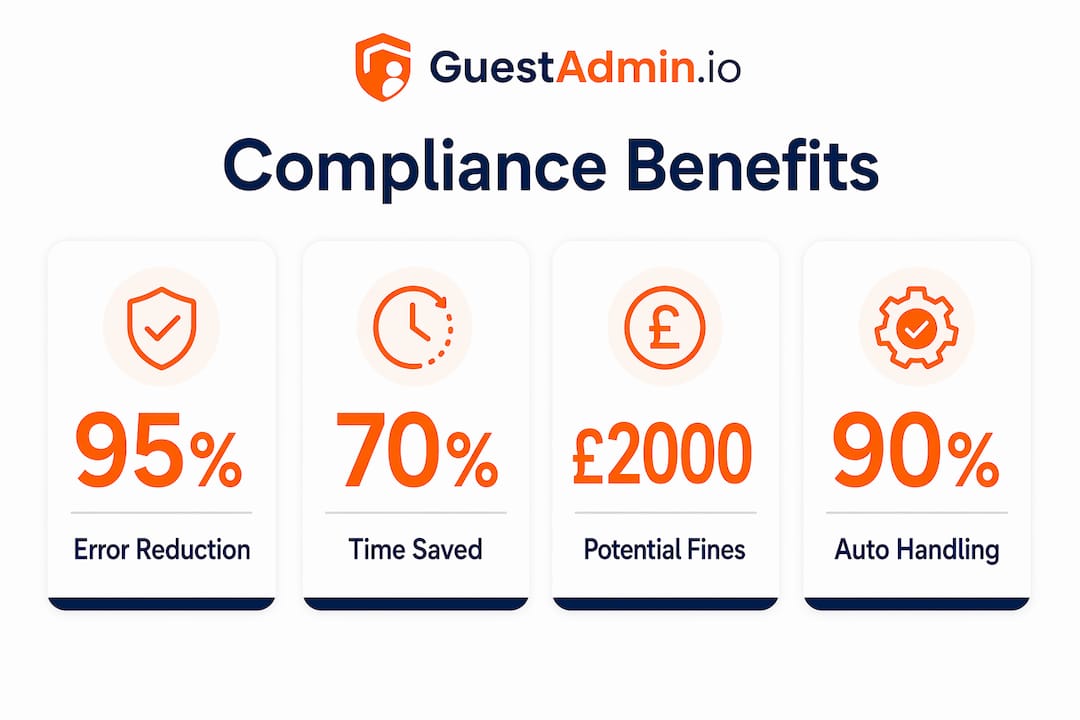
Automated travel compliance delivers three categories of benefit: financial risk reduction, operational efficiency, and guest experience improvement. Each one compounds the others.
Financial risk reduction
Non-compliance with travel reporting obligations is expensive. Fines range from £800 to £2,000 per incident, and operators with multiple properties can face cumulative penalties reaching seven figures annually. Automation removes the human errors that trigger those fines. Every submission is logged, timestamped, and stored, giving you a searchable audit trail that satisfies inspectors without scrambling through email threads and spreadsheets.
Operational efficiency
The time savings are measurable. Automated systems reduce document processing time by 70% compared to manual workflows. For a manager handling 20 properties across three countries, that difference is the gap between a manageable workload and a permanent administrative crisis. Automated check-in processes also cut queue times by up to 70%, which translates directly to smoother guest arrivals and fewer complaints.
Guest experience and booking conversion
Pre-booking document validation resolves compliance issues before they become travel disruptions. A guest who discovers a document problem at check-in is a frustrated guest. A guest who is flagged and guided through a correction at the booking stage is a satisfied one. Fewer last-minute complications also reduce booking abandonment, which has a direct impact on revenue.
The key benefits at a glance:
- Error reduction: Automated systems reduce compliance errors by up to 95% compared to manual checks.
- Audit readiness: Every compliance check is recorded and retrievable, supporting inspections and legal reviews.
- Multi-jurisdiction coverage: A single platform handles reporting obligations across Spain, Italy, Portugal, France, and beyond.
- Time savings: Staff spend minutes on exceptions rather than hours on routine data entry.
- Guest satisfaction: Compliance issues are resolved early, not at the front door.
How does automated compliance compare to manual management?
The gap between manual and automated compliance is not just about speed. It is about reliability, scalability, and legal exposure.
| Factor | Manual Compliance | Automated Compliance |
|---|---|---|
| Update frequency | Relies on staff awareness | Rules engine updates 600+ times daily |
| Error rate | High, due to manual data entry | Reduced by up to 95% |
| Processing speed | Minutes to hours per guest | Under 1 second per check |
| Audit trail | Paper records or spreadsheets | Searchable digital logs |
| Multi-jurisdiction support | Requires separate portals per country | Unified workflow across jurisdictions |
| Staff time required | High for routine tasks | Minimal, focused on exceptions only |
Manual compliance management requires staff to log into separate government portals for each jurisdiction, re-enter guest data by hand, and track submission deadlines in a calendar or spreadsheet. Each step is a potential failure point. A missed deadline in Spain or an incorrect document type submitted in Italy can trigger a fine before anyone realises the error.
Automated travel compliance removes those failure points for the vast majority of cases. Hybrid compliance models validate 90–95% of routine guest data through AI, with human review reserved for the exceptions. That is the right balance. Automation handles volume and consistency; trained staff handle nuance.
Roughly 5–10% of guest document cases still require manual follow-up due to expired documents, unusual nationalities, or data mismatches. A well-designed system flags these cases clearly and routes them to the right person, rather than failing silently.
Pro Tip: When evaluating travel policy automation tools, check whether the platform distinguishes between border eligibility checks and local authority reporting. Many generic tools cover the former but miss the latter, which is where most short-term rental compliance obligations actually sit.
How to automate travel regulations: practical steps for property managers
Implementing travel regulation automation is a structured process. The following steps reflect what works in practice for European short-term rental managers.
-
Audit your current compliance obligations. List every jurisdiction where you operate and identify the specific reporting requirements for each. Spain requires police reporting within 24 hours. Portugal has its own SIBA system. Italy uses the Alloggiati Web portal. Knowing your obligations precisely is the foundation of any automation project.
-
Select software with genuine API integration. API integration with your PMS eliminates manual data entry and the errors it introduces. Confirm that the travel regulation software you choose connects directly to your existing system, whether that is Lodgify, Hostaway, Guesty, or another platform. A tool that requires manual CSV exports is not true automation.
-
Verify jurisdiction-specific reporting coverage. Effective compliance automation must adapt its logic to different legal frameworks, not apply a single global template. Ask vendors to demonstrate how their system handles the specific portals and deadlines in your operating countries.
-
Plan for exception handling. Designate a team member or process for the 5–10% of cases that require human review. Automation minimises this workload but does not eliminate it entirely. A clear escalation path prevents exceptions from falling through the cracks.
-
Confirm the vendor’s update process. Regulations change. Your software must change with them. Ask how quickly the vendor’s rules engine reflects new government requirements, and whether updates are automatic or require manual configuration on your end.
-
Review audit and reporting capabilities. Before signing a contract, confirm that the platform stores every compliance check with a timestamp and that records are exportable for inspections. This is non-negotiable for properties in markets with active enforcement.
For managers running multiple properties across borders, the compliance workflow across jurisdictions becomes the central operational challenge. A platform that unifies this into a single dashboard is worth the investment.
Key takeaways
Travel regulation automation is the most reliable method for European short-term rental managers to meet multi-jurisdiction compliance obligations accurately, efficiently, and at scale.
| Point | Details |
|---|---|
| Core definition | Travel regulation automation uses software to verify guest data and submit it to authorities in real time. |
| Rules engine frequency | Systems update 600+ times daily, keeping compliance current without manual monitoring. |
| Financial risk | Non-compliance fines can reach £2,000 per incident, making automation a cost-effective safeguard. |
| Human oversight | Roughly 5–10% of cases still need manual review, so automation reduces but does not replace human judgement. |
| Implementation timeline | Full API integration with a PMS typically takes 4–6 weeks and eliminates manual data entry errors. |
Why i think most rental managers are still underestimating this
From working closely with the European short-term rental market, the most common mistake I see is treating compliance as a back-office task rather than a front-of-house risk. Managers invest heavily in pricing tools, channel managers, and guest communication software, then leave compliance to a part-time admin and a folder of bookmarked government portals.
The financial exposure is real. A single missed submission in a market with active enforcement can cost more than a month’s revenue from that property. Multiply that across a portfolio of ten or twenty properties in three countries, and the risk profile becomes genuinely serious.
What I find most interesting about the current generation of travel automation technologies is the hybrid model. The idea that AI handles 90–95% of routine checks while staff focus only on genuine exceptions is not a compromise. It is the correct architecture. Trying to automate 100% of cases, including irregular documents and edge cases, produces a brittle system that fails at the worst moments. Keeping humans in the loop for exceptions produces a system that is both efficient and accurate.
My practical advice is this: do not wait for a fine to trigger the investment. The EU short-term rental regulations are tightening, not loosening. Platforms that automate guest data collection and authority reporting are no longer a luxury for large operators. They are the baseline for anyone running a compliant rental business in Europe in 2026.
— Alex
How Guestadmin makes compliance automation straightforward
Guestadmin is built specifically for property owners and managers in the European short-term rental market who need to meet local reporting obligations without the administrative overhead.
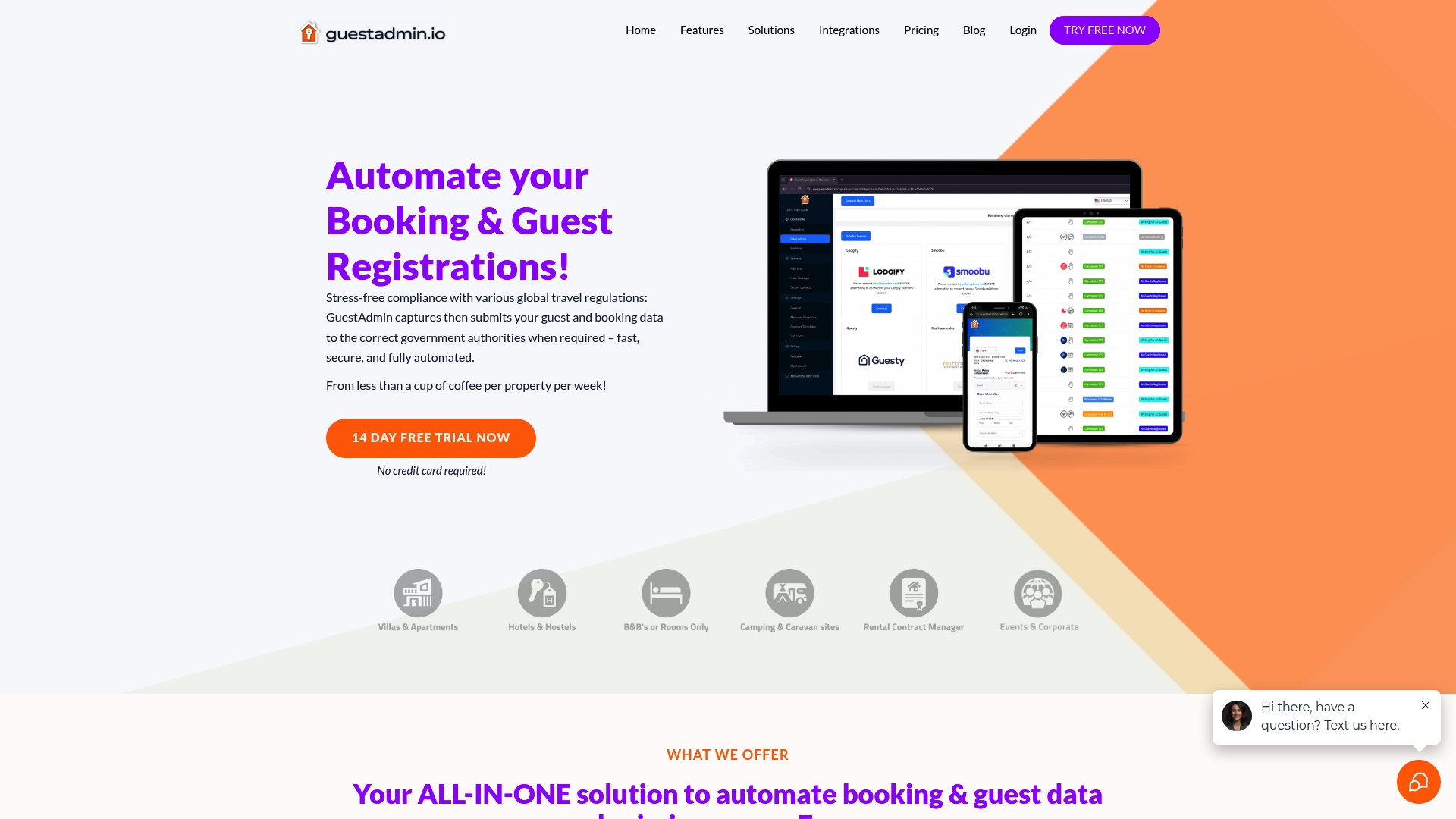
The platform connects to your existing PMS or OTA via API, captures guest data at booking, and submits it to the relevant government authorities within 24 hours. Every submission is logged in a GDPR-compliant dashboard, giving you a clear audit trail across all your properties. Whether you manage two apartments in Lisbon or twenty villas across Spain and Italy, Guestadmin handles the compliance layer so you can focus on the guest experience. Explore the automated guest compliance features, or review the multi-property management tips to see how the platform fits your operation. Book a demo to see it in action.
FAQ
What is travel regulation automation in simple terms?
Travel regulation automation is software that captures guest data, checks it against current legal requirements, and submits it to government authorities automatically. It replaces manual portal logins and spreadsheet tracking with a single, integrated workflow.
Which european countries require short-term rental guest reporting?
Spain, Portugal, Italy, France, and Greece all require property managers to report guest data to local police or tax authorities within strict timeframes. Requirements vary by country, so jurisdiction-specific software coverage is critical.
How accurate is automated travel compliance software?
Automated systems reduce compliance errors by up to 95% compared to manual processes. Roughly 5–10% of cases still require human review due to document exceptions or data mismatches.
Does automation replace the need for staff in compliance management?
No. Hybrid models handle 90–95% of routine cases automatically, but human oversight remains necessary for irregular documents and edge cases. Automation reduces staff time spent on compliance, it does not eliminate the need for human judgement entirely.
How long does it take to implement travel regulation software?
Full API integration with a Property Management System typically takes 4–6 weeks. Most platforms are designed for straightforward onboarding, with vendor support available throughout the setup process.