

Chasing regulatory deadlines across Amsterdam, Vienna, and Barcelona can leave any property manager questioning how to keep up. Short-term rental operators throughout Europe face mounting compliance demands as privacy laws tighten and local authorities speed up audits. With webhook integrations, you gain the power of real-time data management and automated alerts between your booking systems and compliance tools, drastically reducing manual errors and administrative burden. Embrace this modern solution to keep pace with shifting laws and fast data flows.
Table of Contents
- Webhooks In Property Management Explained
- Types And Functions Of Webhook Integrations
- GDPR, Security And Legal Compliance Essentials
- Real-Time Use Cases For European Rentals
- Avoiding Risks And Common Integration Mistakes
Key Takeaways
| Point | Details |
|---|---|
| Webhooks Ensure Real-Time Compliance | Automated notifications allow for immediate data transfer to compliance systems, helping to meet strict regulatory deadlines without manual input. |
| Error Reduction through Automation | The use of webhooks minimises human error by eliminating manual data entry, thereby increasing the accuracy of compliance records. |
| Scalability for Multi-Property Management | Webhooks facilitate the management of numerous properties simultaneously, streamlining operations and enhancing overall efficiency. |
| Security and GDPR Compliance are Crucial | It is essential to implement robust security measures and ensure compliance with GDPR when handling sensitive guest data through webhooks. |
Webhooks in Property Management Explained
Webhooks are the backbone of modern property management automation. Instead of manually checking systems for updates, webhooks send automated notifications the moment something happens—a guest books a property, a compliance deadline approaches, or payment arrives.
Think of webhooks as messengers that deliver real-time alerts between your systems. When you configure a webhook, you’re telling your property management software: “When X event occurs, send me a notification immediately.” This is far more efficient than constantly polling systems for changes.
How Webhooks Work in Property Management
Real-time communication through automated HTTP requests enables your booking platform, payment processor, and compliance system to stay synchronised without manual intervention. Here’s what happens behind the scenes:
- A guest completes their booking on your OTA
- The booking platform triggers a webhook event
- Your compliance system receives the notification instantly
- Guest data begins processing automatically for regulatory submission
No delays. No forgotten steps. No spreadsheets.
Why Webhooks Matter for Compliance
Compliance timelines are unforgiving. Many European jurisdictions require guest registration within 24 hours. Webhooks ensure you meet these deadlines consistently.
Key benefits include:
- Instant data flow: Booking information reaches your compliance system immediately
- Reduced errors: Automation eliminates manual data entry mistakes
- Audit trails: Every webhook request creates a record for compliance documentation
- Multi-property scaling: Manage hundreds of properties without manual coordination
Webhooks transform compliance from a reactive, manual process into an automated workflow that runs continuously in the background, reducing administrative burden by up to 80%.
Real-World Example
You manage 15 properties across Amsterdam, Barcelona, and Vienna. A guest books property #7 in Amsterdam at 11 PM. Normally, you’d receive an email tomorrow morning and manually enter their details into the compliance system by afternoon—cutting it dangerously close to the 24-hour deadline.
With webhooks, the booking triggers an instant notification. Your compliance system receives the guest data automatically, validates it against local requirements, and queues it for submission. By midnight, compliance filing is complete. You never lose sleep worrying about missed deadlines.

Event-Driven Automation
Event-driven notifications automatically provide real-time updates when guest activities or booking changes occur. Your property manager dashboard shows you what’s happening across all properties without refreshing manually.
You can automate workflows based on specific events:
- New booking received → Validate guest identity and address
- Cancellation processed → Remove from compliance queue
- Payment confirmed → Trigger financial reporting
- Review posted → Flag for management response
Getting Started with Webhooks
You don’t need to be technical to use webhooks effectively. Most modern property management platforms offer webhook configuration through simple dashboards. You specify which events trigger notifications and where those notifications should go.
The integration handles the complexity. Your compliance platform receives guest data, processes it according to local regulations, and maintains secure records—all without manual intervention.
Pro tip: Start by connecting your booking channel (Airbnb, Booking.com, Vrbo) to your compliance system via webhooks, then add payment processors and communication tools once you’re comfortable with the workflow.
Types and Functions of Webhook Integrations
Not all webhooks are identical. Different scenarios in property management demand different webhook types, each serving a specific function in your automation workflow. Understanding which type solves which problem is essential for building an effective compliance system.
Webhooks operate on a push-based model, meaning they actively deliver data to your systems rather than waiting passively for you to request it. This fundamental difference from traditional APIs makes webhooks significantly faster for real-time operations.
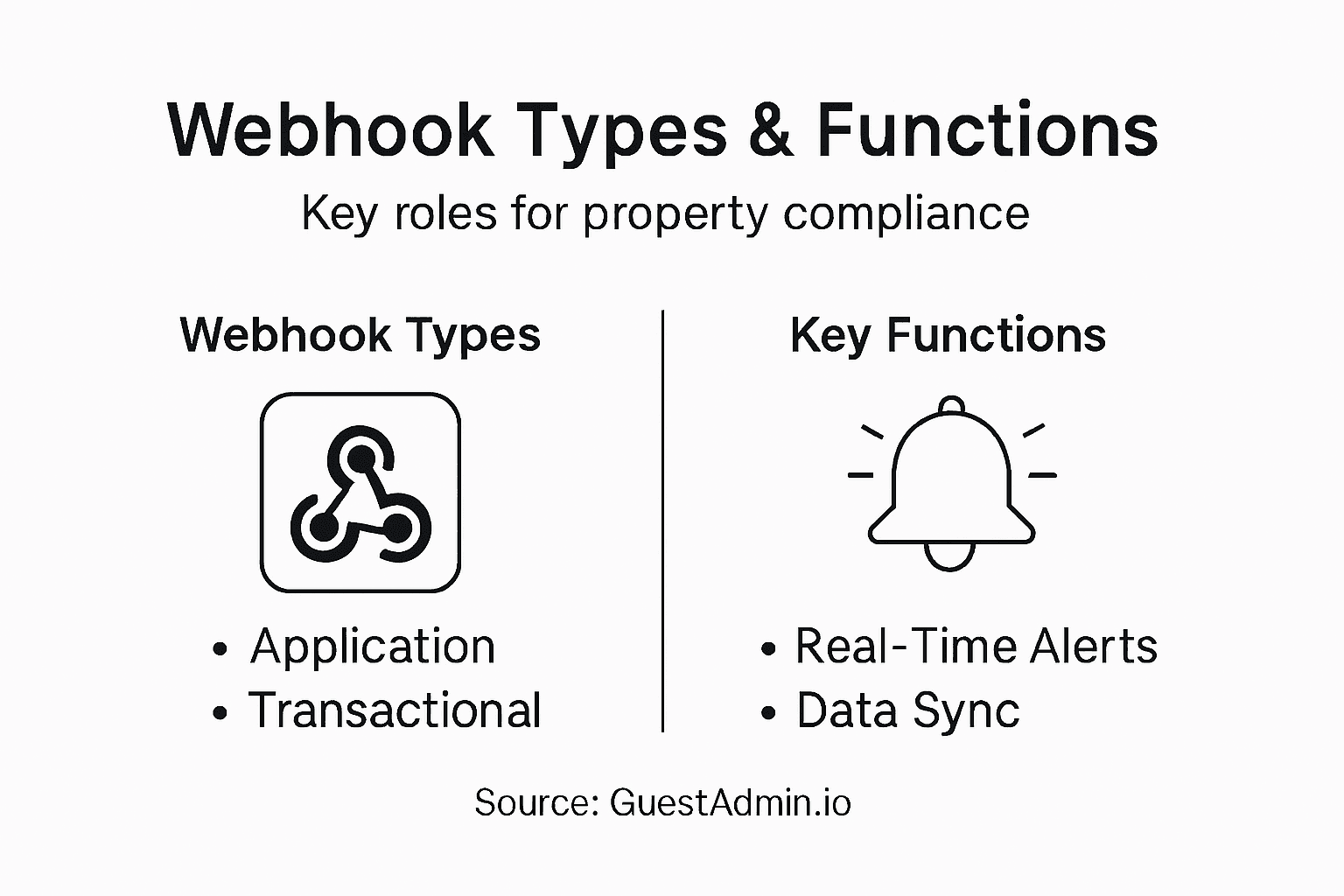
Application Webhooks
Application webhooks connect your booking platforms directly to your compliance system. When a guest books through Airbnb, Booking.com, or your own website, this webhook type captures that event and forwards the guest data instantly.
They handle:
- New bookings and guest arrival notifications
- Cancellations and schedule updates
- Guest communication and pre-arrival messages
- Review submissions and guest feedback
These webhooks are your frontline automation—they’re the first point where guest information enters your compliance workflow.
Transactional Webhooks
Transactional webhooks monitor financial activities and critical business events. Payment processors use these webhooks to notify you when deposits clear, refunds process, or disputes arise.
Key functions include:
- Payment confirmations and failed transaction alerts
- Refund processing notifications
- Tax calculation triggers
- Financial reconciliation updates
Missing a payment notification can cascade into compliance issues. Transactional webhooks ensure your financial records stay current and accurate.
Here’s a comparison of webhook types and where they add value in property management:
| Webhook Type | Main Focus | Critical Business Use | Ideal For |
|---|---|---|---|
| Application | Booking events | Guest registration, check-in | Compliance and guest logistics |
| Transactional | Payment notifications | Reconciliation, tax reporting | Accounting, finance, regulators |
| System | Infrastructure changes | Security, admin updates | IT, access control, audit trails |
System Webhooks
System webhooks monitor your infrastructure itself—account changes, security events, and administrative updates. Push-based notifications enable instant system alerts when something requires immediate attention.
They track:
- User login and access changes
- Property or account updates
- System errors and failures
- Compliance deadline reminders
Core Webhook Functions
Event triggers, payloads, and error handling form the anatomy of effective webhook systems. Each webhook performs critical functions that keep your compliance operation running smoothly.
Four core functions matter most:
- Instant notification delivery — Data reaches your system immediately, not hours later
- Efficient communication — Minimal bandwidth because only necessary information transfers
- Error handling — Failed requests retry automatically with built-in resilience
- Scalability — Manage hundreds of properties without infrastructure strain
A single webhook can handle hundreds of events daily without manual oversight, transforming your property management from reactive chaos into proactive automation.
Choosing the Right Webhook Type
Your compliance needs determine which webhook types to prioritise. Property managers handling guest registration compliance need application webhooks first. Those managing multiple payment methods need transactional webhooks immediately.
Start with your biggest pain point. If missed bookings cause compliance failures, activate application webhooks. If payment delays trigger financial penalties, prioritise transactional webhooks.
Pro tip: Test each webhook type in a staging environment before activating it across all properties, ensuring data flows correctly before relying on it for compliance submissions.
GDPR, Security and Legal Compliance Essentials
Webhooks handle sensitive guest data constantly. Every booking notification, payment confirmation, and personal detail flowing through your automation system carries legal weight. GDPR and data protection laws apply whether you’re using webhooks or manual spreadsheets—but automation raises the stakes significantly.
You’re legally responsible for how webhooks process, store, and transmit guest information. Negligence here isn’t just inefficient. It’s a liability.
Understanding GDPR Obligations
Transparent data usage and lawful processing form the foundation of GDPR compliance. You must document why you’re collecting each piece of guest data and how you’re using it. Webhooks automate data transfer, but you still own the responsibility.
Key GDPR requirements for webhook integration:
- Lawful basis: Justify why you’re collecting and processing each data field
- Transparency: Guest privacy policies must explain webhook data flows clearly
- Consent: Obtain explicit permission before sharing data with third parties
- Minimal data: Only transfer essential information through webhooks, not everything
Data Security in Webhook Systems
Guest data travels between systems constantly when webhooks are active. Encryption, authentication, and access controls protect this data during transit and at rest.
Secure webhook practices include:
- HTTPS encryption: All webhook connections must use secure protocols
- Authentication tokens: Verify webhook sources before processing data
- Payload validation: Confirm data hasn’t been altered or compromised
- Audit logging: Maintain records of every webhook request for compliance documentation
A single unencrypted webhook carrying guest payment details or identification documents violates GDPR and exposes you to substantial fines, regardless of whether data was actually breached.
Privacy Policies and Agreements
Your privacy policy must explicitly mention webhooks and automated data processing. Guests expect transparency about how their information flows through your systems.
Update your agreements to cover:
- What data webhooks collect and process
- Which third-party systems receive guest data via webhooks
- How long data persists in your systems
- Guest rights to access, correct, or delete their information
Handling Guest Data Across Jurisdictions
European property managers face additional complexity. Guest data cannot freely move to servers outside the EU without proper legal mechanisms. Webhooks connecting to international systems require data transfer agreements.
Verify that your webhook integrations use GDPR-compliant data processors. Request data processing agreements from any third-party service receiving guest information.
Liability and Risk Management
Negligent webhook configuration creates legal exposure. If a breach occurs because webhooks transmitted unencrypted data, you cannot claim ignorance. Document your security measures, test your integrations, and maintain audit trails.
Pro tip: Request a data processing agreement from your webhook platform or compliance software provider, ensuring they accept liability for security incidents and provide transparent encryption documentation.
Real-Time Use Cases for European Rentals
Webhooks transform property management from reactive firefighting into proactive automation. Real-world scenarios across Europe demonstrate how webhooks solve genuine compliance challenges that plague property managers daily.
These aren’t theoretical examples. They’re problems you face every day, now solved through intelligent webhook integration.
Instant Guest Registration Across Markets
Your property in Vienna books a guest at 3 AM. Amsterdam requires registration within 24 hours. Barcelona demands submission by noon the next day. Without webhooks, you’re manually entering data across three different government portals, racing against the clock.
With webhooks connected to your booking platforms:
- Guest information arrives instantly in your compliance system
- Automated validation checks against local requirements
- Compliance data queues for submission to each jurisdiction
- You never miss a deadline, even across multiple time zones
Payment Reconciliation and Tax Compliance
Event-based data automatically updates project details across connected systems, eliminating manual sync delays. Payment webhooks reconcile bookings with actual deposits in real time.
Scenario: You manage 12 properties using three different payment processors. A guest cancels with partial refund. Without webhooks, you manually track the refund, update your accounting, and notify tax authorities. With webhooks:
- Payment processor triggers refund webhook
- Your system records the transaction instantly
- Tax calculations update automatically
- Compliance reports reflect accurate financial data
Channel Manager Synchronisation
You list properties on Airbnb, Booking.com, and Vrbo simultaneously. A guest books on Airbnb; you forget to block dates on Booking.com. Another guest books your now-double-booked property. Disaster.
Webhooks solve this:
- Airbnb booking triggers webhook to your channel manager
- All OTA listings update instantly
- Double bookings become impossible
- Guest communications synchronise automatically
A single missed webhook synchronisation can cost you hundreds in penalties, lost bookings, and guest disputes—webhooks make this scenario nearly impossible.
Compliance Deadline Management
Italy changes its short-term rental regulations next month. Germany introduces new registration requirements. France raises tax thresholds. Managing these changes across multiple properties manually is chaotic.
Webhook-driven systems adapt instantly:
- Regulatory updates trigger automated reconfiguration
- New data fields populate for affected properties
- Deadline reminders route to your calendar automatically
- Compliance documentation organises by jurisdiction and property
Guest Communication Automation
Webhooks connect booking platforms to your communication systems. When a guest completes checkout, webhooks trigger:
- Post-stay review requests
- Tax compliance confirmations
- Damage report deadlines
- Future booking incentives
Guests receive timely messages without you manually sending anything. Timing improves response rates significantly.
Multi-Property Dashboard Synchronisation
You need one dashboard showing all 20 properties’ compliance status. Without webhooks, you manually refresh data from multiple sources daily. With webhooks, your dashboard updates in real time as events occur across all properties simultaneously.
Pro tip: Start by connecting your highest-volume booking channel via webhooks first, then progressively add payment processors and communication platforms as you become comfortable with the automation flow.
Avoiding Risks and Common Integration Mistakes
Webhook integration sounds straightforward until something breaks. A misconfiguration silently duplicates guest registrations. A missed signature validation exposes guest data. A slow response timeout causes failed submissions. Property managers rarely anticipate these problems until they occur.
Knowing common pitfalls prevents costly mistakes before they happen.
Security Validation Failures
Ignoring signature validation creates security vulnerabilities that expose guest data to interception and unauthorised modification. Every webhook request must cryptographically verify that it genuinely comes from your booking platform, not a malicious actor.
Implement these security practices:
- Verify webhook signatures: Confirm every incoming webhook using authentication tokens
- Use HTTPS only: Reject unencrypted webhook connections entirely
- Validate payloads: Confirm data hasn’t been altered in transit
- Restrict IP addresses: Limit webhook sources to known booking platform IP ranges
Duplicate Data Problems
Webhooks may retry failed requests automatically. Without idempotency, a single booking event creates two guest records in your compliance system. You then submit duplicate registrations to authorities, causing rejected filings and compliance failures.
Guard against duplicates:
- Assign unique identifiers to every webhook event
- Check your database before processing—if the event exists, skip it
- Log all processed webhooks with timestamps
- Monitor for duplicate submissions in compliance reports
Timeout and Performance Issues
Your webhook handler takes 45 seconds to process a guest registration. The booking platform times out after 30 seconds. The webhook retries three times, each failing. The guest registration never completes.
Fast, non-blocking responses prevent this:
- Acknowledge webhooks immediately (within 2 seconds)
- Queue processing for background jobs
- Never perform complex calculations in webhook handlers
- Monitor response times continuously
A webhook that blocks for more than 5 seconds risks timeout failures that cause lost guest data and missed compliance deadlines, no matter how well-configured your system otherwise is.
Calendar Synchronisation Breakdowns
Poor calendar synchronisation causes double bookings when properties sell on multiple channels simultaneously. One guest books on Airbnb at 2 PM; another books Booking.com at 2:01 PM before calendars synchronise.
Prevent double bookings:
- Enable real-time, two-way calendar synchronisation
- Test synchronisation across all channels before going live
- Set up alerts when bookings conflict
- Block calendars immediately upon confirmation, before webhooks process
API Incompatibility Issues
You choose a booking API that doesn’t integrate with your compliance system. You build custom middleware to bridge the gap. Three months later, the API updates and breaks everything.
Avoid incompatibility:
- Verify webhook compatibility before selecting integrations
- Test full integration workflows in staging environments
- Document all custom code and assumptions
- Request direct technical support from platform providers
Schema Versioning Mistakes
Your booking platform updates its webhook payload structure. Your system expects old field names. Guest data fails validation silently. Compliance submissions queue indefinitely without anyone noticing.
Implement backward-compatible updates:
- Support multiple payload versions simultaneously
- Map old field names to new ones gracefully
- Test payload changes before deploying to production
- Monitor schema compatibility continuously
Pro tip: Test every webhook integration in a staging environment for at least two weeks, simulating real booking scenarios and monitoring logs for errors, before activating it across production properties.
Below is a summary of common webhook integration pitfalls and how to avoid them:
| Mistake Type | Real-World Effect | Best Prevention Method |
|---|---|---|
| Missing validation | Data leaks or spoofed requests | Enforce token and payload checks |
| Duplicate data entries | Double guest registration, errors | Use unique event identifiers |
| Timeout response | Lost bookings or failed compliance | Respond quickly, process in queue |
| Schema incompatibility | Data not processed, silent failure | Support all payload versions |
Automate Your Compliance with Confidence Using GuestAdmin.io
Managing short-term rental compliance across multiple European jurisdictions is challenging. From meeting tight 24-hour guest registration deadlines to synchronising booking data with payment confirmation and communication tools, the risks of missed submissions, duplicate entries, and security lapses are real. This article highlights the power of webhooks to automate these processes, ensuring real-time notifications and reducing administrative burdens dramatically.
GuestAdmin.io transforms these challenges into seamless workflows by offering a fully integrated SaaS platform designed specifically for property owners and managers in the hospitality sector. With features like AI-powered data processing, multi-property dashboards, and secure GDPR-compliant data handling, GuestAdmin uses webhook integrations to simplify your compliance journey. Whether you need instant guest registration submissions or reliable payment reconciliation, our platform ensures you never miss a deadline or regulatory update.
Discover how to elevate your compliance automation and operational efficiency by exploring our Stratus Archives – Guest Registration Services and Uncategorized Archives – Guest Registration Services.
Start securing your property management workflows today with GuestAdmin.io and see how effortless compliance can be by visiting GuestAdmin.io. Act now to reduce risk and streamline your European rental operations.
Frequently Asked Questions
What are webhooks in property management?
Webhooks are automated notifications sent in real time from one system to another when specific events occur, such as a booking or payment. They streamline communication between property management systems, reducing manual checks and improving efficiency.
How do webhooks help with compliance in property management?
Webhooks ensure instant data flow to compliance systems, allowing property managers to meet regulatory requirements, such as guest registration deadlines, without manual intervention. This automation reduces the risk of missed deadlines and errors.
What types of webhook integrations are available for property managers?
Property managers typically use application webhooks for booking events, transactional webhooks for financial activities, and system webhooks for infrastructure changes. Each type serves a unique function in automating workflows and maintaining compliance.
How can I get started with webhooks for my property management system?
You can start by configuring webhooks through your property management platform’s dashboard. Identify the key events you want to track, such as new bookings or payment confirmations, and set up notifications to streamline data flow to your compliance systems.
One Comment
Webhooks in property tech: a developer's guide
[…] data capture and submission to government authorities, a workflow that Guestadmin uses to automate regulatory compliance for short-term rentals across European […]