

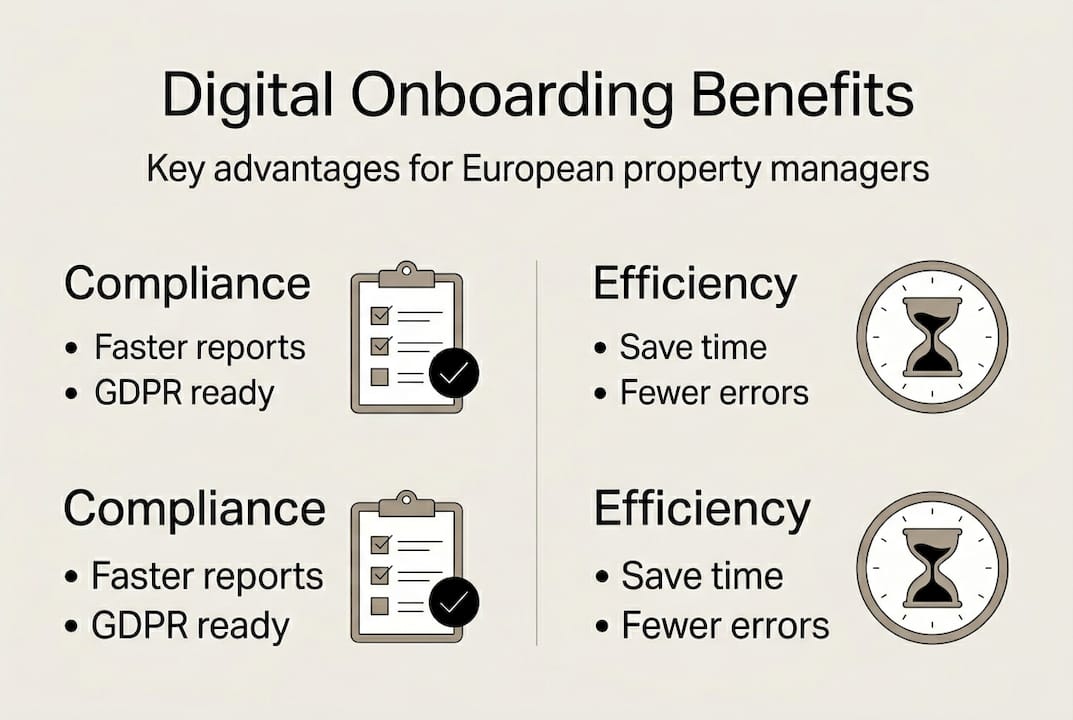
Managing short-term rentals across Europe means juggling complex regulations, tight deadlines, and mountains of guest data. Digital onboarding slashes manual workload by up to 60% whilst cutting onboarding time in half, transforming how property managers handle compliance and guest registration. With European regulations like SES Hospedajes demanding 17 data points within 24 hours and EU Regulation 2024/1028 requiring unique registration numbers from May 2026, automation isn’t just convenient, it’s essential. This guide shows you how digital onboarding streamlines operations, reduces errors, and scales multi-property portfolios efficiently.
Table of Contents
- How Digital Onboarding Streamlines Guest Registration And Compliance
- Regulatory Challenges Property Managers Face In Europe And How Automation Helps
- Technology Features That Maximise Efficiency And Guest Experience
- Scaling Multi-Property Management With Digital Onboarding
- Discover Efficient Digital Onboarding Solutions For Your Properties
- Frequently Asked Questions About Digital Onboarding For Property Managers
Key takeaways
| Point | Details |
|---|---|
| Time savings | Digital onboarding reduces manual workload by 40-60% and cuts onboarding time by over 50%. |
| Regulatory compliance | European STR laws require rapid guest data submission with fines ranging from €100 to €30,000 for non-compliance. |
| Automation benefits | Automated systems enhance accuracy, reduce costs, and enable seamless scaling for multi-property managers. |
| Technology features | eKYC, PMS integrations, and contactless check-in improve guest experience whilst ensuring GDPR compliance. |
How digital onboarding streamlines guest registration and compliance
Traditional guest registration involves collecting passports, manually entering data into multiple systems, and submitting information to government portals before deadlines. This process consumes hours weekly and introduces human error at every step. Digital onboarding automates guest check-in, ID verification, and data submission to authorities, cutting manual workload by 40-60% and onboarding time by over 50%.
European regulations demand precise, timely submissions. Spanish guest registration laws require property managers to submit 17 specific data points within 24 hours of guest arrival. EU Regulation 2024/1028 adds another layer, mandating unique registration numbers for all short-term rentals from May 2026. Missing these deadlines or submitting incomplete data triggers substantial fines.
Automation replaces manual tasks with intelligent workflows. When guests book, they receive QR codes or links to digital forms. They scan their identification documents using smartphones, and eKYC technology extracts data automatically. The system validates information against regulatory requirements, encrypts sensitive details for GDPR compliance, and submits everything to the appropriate authorities without human intervention.
Key automation features include:
- Contactless check-in via QR codes or mobile apps
- Automated ID scanning and data extraction
- Real-time validation against regulatory checklists
- Encrypted storage and secure transmission to government portals
- Instant notifications for incomplete submissions or errors
This transformation reduces errors dramatically. Manual data entry mistakes account for compliance failures in traditional systems, but automated validation catches missing fields, incorrect formats, or expired documents before submission. Your European compliance checklist becomes a built-in safeguard rather than a manual task.
“Digital onboarding turns regulatory burden into background automation, letting property managers focus on guest experience rather than paperwork.”
The technology handles edge cases too. When guests cancel last minute, systems automatically update submissions. When authorities change requirements, platforms update validation rules across all properties simultaneously. This scalability proves essential for managers handling multiple units or operating across different jurisdictions.
Regulatory challenges property managers face in Europe and how automation helps
European short-term rental regulations vary significantly by country and region, creating compliance complexity for property managers. In Spain, property managers must comply with strict guest registration laws like SES Hospedajes requiring 17 data points within 24 hours, with fines from €100 to €30,000 for non-compliance. These data points include full names, passport numbers, nationality, dates of birth, and detailed booking information.
The regulatory landscape intensifies further. EU Regulation 2024/1028 mandates unique registration numbers for STRs from May 2026, with platforms verifying them and reporting data monthly. This means property managers must register each property, display registration numbers in listings, and ensure platforms can access and verify this information automatically.
Non-compliance carries serious consequences beyond fines. Authorities can suspend rental licences, platforms may delist non-compliant properties, and repeated violations trigger escalating penalties. Manual processes struggle to maintain accuracy under these pressures, especially during peak seasons when turnover accelerates.
Pro Tip: Prioritise tools that support multi-certificate management and GDPR-compliant encryption to handle complex multi-property portfolios safely whilst meeting varying regional requirements.
Digital onboarding addresses these challenges through systematic automation. Systems maintain updated regulatory templates for each jurisdiction, automatically adjusting data collection forms when requirements change. When Spain updates SES Hospedajes fields or deadlines, your platform updates instantly across all properties without manual configuration.
| Country | Required Data Points | Submission Deadline | Typical Fine Range | Digital Onboarding Benefit |
|---|---|---|---|---|
| Spain | 17 fields | 24 hours | €100-€30,000 | Automated validation and submission |
| Italy | 15 fields | 24 hours | €200-€500 | Real-time compliance tracking |
| France | 12 fields | 48 hours | €450-€1,500 | Multi-property certificate management |
| Portugal | 14 fields | 24 hours | €500-€3,740 | Encrypted GDPR storage |
Automation also simplifies registration number management. Platforms store registration certificates, display them in booking confirmations, and provide API access for OTA verification. This eliminates the manual task of updating registration numbers across multiple platforms when renewals occur.
Your legal compliance guide for 2026 becomes operational through automation rather than remaining a reference document. Systems track submission status, flag missing data before deadlines, and maintain audit trails proving compliance if authorities request documentation.
Technology features that maximise efficiency and guest experience
Modern digital onboarding platforms combine several technologies to deliver operational efficiency and enhanced guest satisfaction. eKYC (electronic Know Your Customer) technology uses AI-powered document scanning to extract data from passports, national ID cards, and driving licences. Guests simply photograph their documents using smartphones, and systems process information within seconds.

QR-code based check-in revolutionises guest arrival. You generate unique codes for each booking, guests scan them upon arrival, and access instructions appear instantly. This eliminates physical key handovers, reduces reception desk queues, and enables truly contactless experiences that guests increasingly expect.
Tools like HostPass, Chekin, and GuestAdmin automate eKYC, QR check-ins, and PMS integrations, boosting data accuracy and security whilst cutting costs with smart locks achieving ROI in under three months. These platforms connect directly to property management systems through APIs and webhooks, ensuring real-time synchronisation of bookings, cancellations, and guest information.
PMS integration delivers continuous operational benefits:
- Automatic guest data transfer from booking to onboarding forms
- Real-time updates when guests modify reservations
- Instant cancellation processing and compliance updates
- Centralised dashboard showing all properties and booking statuses
Cost savings extend beyond labour reduction. DanCenter achieved savings of €625 per unit annually by implementing digital onboarding and smart lock systems. ADAPT Apartments reduced software costs by 25% through consolidated platforms handling both onboarding and property management system integration.
Pro Tip: Choose solutions that offer predictive logic for edge cases and multi-property scalability to avoid disruption with high turnover exceeding 25 turnovers per year.
| Platform Feature | eKYC | PMS Integration | Contactless Check-in | Smart Lock Support | Estimated Annual ROI |
|---|---|---|---|---|---|
| Comprehensive platforms | Yes | API + Webhooks | QR codes | Yes | €500-€700/unit |
| Basic automation | Limited | API only | Email links | No | €200-€300/unit |
| Manual systems | No | None | Physical keys | No | Negative (labour costs) |
Contactless check-in solutions also improve guest reviews and satisfaction scores. Properties offering seamless digital experiences receive higher ratings for convenience and modernity. Guests appreciate avoiding reception queues, accessing properties on their schedules, and completing compliance requirements from their devices before arrival.
Advanced platforms include predictive features identifying potential issues. If a guest’s passport expires during their stay, systems flag this during onboarding. If submitted data fails validation checks, guests receive immediate notifications to correct information rather than discovering problems at check-in. These proactive features prevent compliance failures and guest frustration simultaneously.
Scaling multi-property management with digital onboarding
Managing multiple properties multiplies compliance complexity exponentially. Each property requires separate registration certificates, jurisdiction-specific data submissions, and individual audit trails. Volume alone creates challenges, with managers overseeing 10+ properties handling hundreds of guest onboardings monthly. Manual processes simply cannot maintain accuracy and timeliness at this scale.
Multi-property managers require multi-certificate support and automated cancellations, with digital onboarding reducing 25 hours of weekly manual work and achieving up to 50% cost savings. GDPR-compliant encryption becomes critical when managing thousands of guest records across different properties and jurisdictions.
Digital onboarding platforms designed for scale handle these challenges through centralised management and automated workflows. A single dashboard displays all properties, current bookings, compliance status, and pending submissions. You see immediately which properties need attention, which guests haven’t completed onboarding, and which submissions approach deadlines.
Implementing multi-property onboarding automation effectively:
- Audit current compliance requirements across all property locations and jurisdictions to identify varying data submission rules and deadlines.
- Select platforms supporting multi-certificate management that store and display registration numbers for each property automatically in listings and confirmations.
- Configure automated workflows connecting your PMS to onboarding systems via APIs, ensuring booking data flows instantly without manual entry.
- Establish validation rules matching each jurisdiction’s requirements so systems check data completeness before guests arrive.
- Enable automated submission to government portals, eliminating manual uploads and ensuring 24-hour deadlines are met consistently.
- Set up monitoring dashboards tracking compliance status across all properties with alerts for incomplete submissions or approaching deadlines.
- Implement GDPR protocols including encrypted storage, automated data deletion after retention periods, and access controls for staff handling guest information.
Best practices for workflow automation focus on reducing manual touchpoints. Configure systems to send onboarding links immediately upon booking confirmation. Set reminders escalating in urgency as check-in approaches. Automate follow-ups for incomplete forms, reducing the need for staff intervention.
Your multi-property management approach transforms from reactive firefighting to proactive oversight. Instead of manually checking each property’s compliance status, you receive alerts only when intervention is needed. This efficiency enables managers to oversee larger portfolios without proportionally increasing staff.
Cost efficiencies compound at scale. Whilst a single property might save 3-4 hours weekly through automation, a 20-property portfolio saves 60-80 hours, equivalent to two full-time employees. These savings translate directly to profitability or enable reinvestment in guest experience improvements and property upgrades.
GDPR compliance deserves particular attention in multi-property contexts. Centralised systems must encrypt data in transit and at rest, maintain detailed access logs, and enable rapid data deletion upon request. Platforms meeting these requirements protect you from penalties whilst building guest trust through transparent data handling.
For additional strategies, explore these multi-property management tips essential for managers to optimise operations further.
Discover efficient digital onboarding solutions for your properties
Navigating European compliance requirements whilst delivering exceptional guest experiences demands purpose-built technology. GuestAdmin provides comprehensive digital onboarding tailored specifically for European short-term rental managers facing complex regulatory environments. The platform automates guest data collection, validation, and submission across multiple jurisdictions, reducing manual workload whilst ensuring consistent compliance.
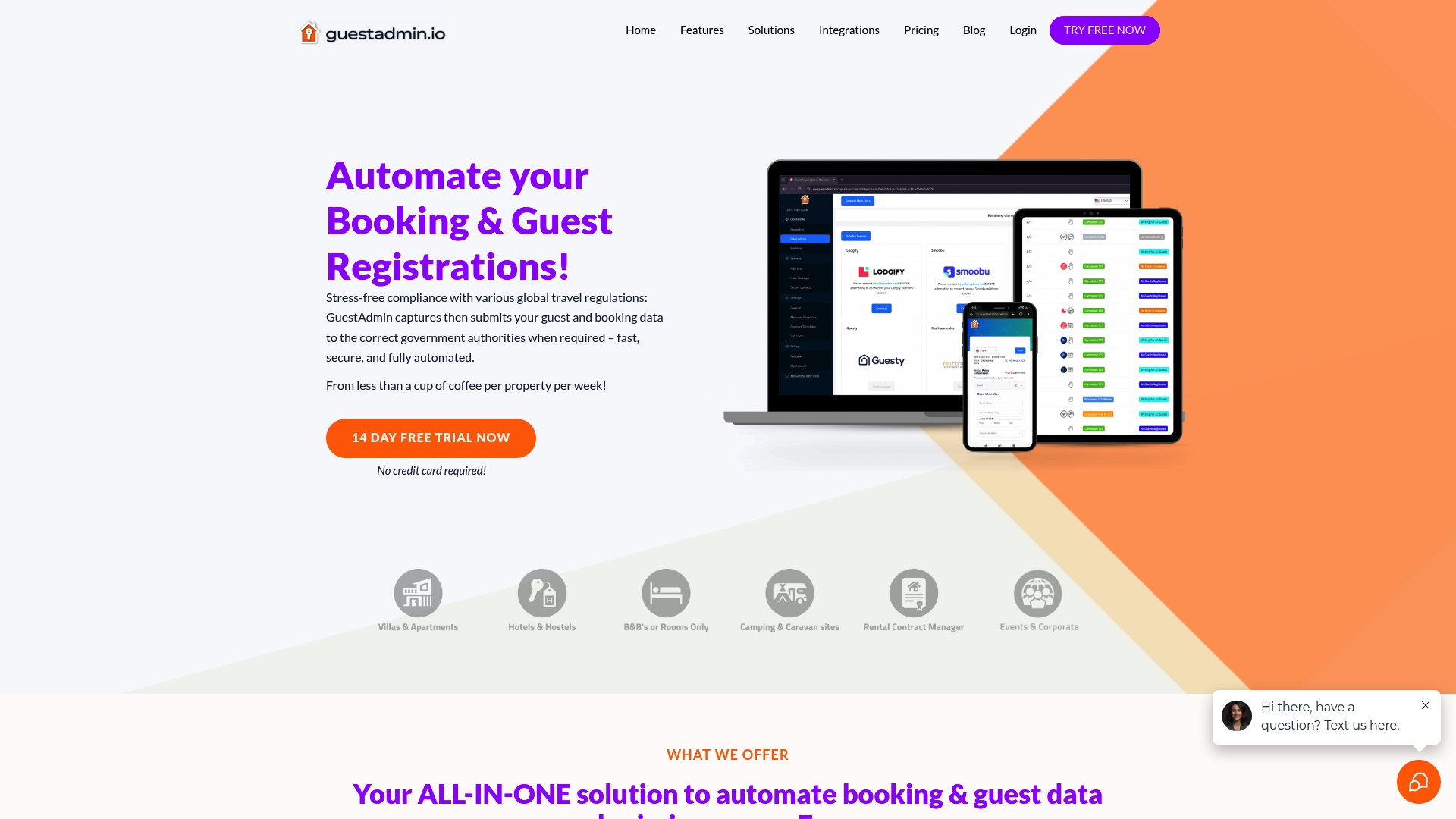
Whether you manage a single property or an extensive portfolio, GuestAdmin’s multi-property management features scale seamlessly. API integrations connect with leading PMS platforms, whilst automated workflows handle everything from initial booking to final data archiving. The system automates guest management for effortless rental compliance, cutting administrative time by up to 25 hours weekly.
Explore different property management software types to find solutions matching your operational needs and portfolio size. GuestAdmin’s approach combines regulatory expertise with practical automation, turning compliance from burden into competitive advantage.
Frequently asked questions about digital onboarding for property managers
How does digital onboarding reduce compliance risks for European property managers?
Digital systems validate guest data against regulatory requirements before submission, catching missing fields or incorrect formats that trigger fines. Automated submission ensures 24-hour deadlines are met consistently, whilst encrypted storage and audit trails provide proof of compliance if authorities investigate. This systematic approach eliminates human error that causes most compliance failures.
What cost savings can property managers expect from implementing digital onboarding?
Property managers typically save €500-€700 per unit annually through reduced labour, eliminated key management expenses, and faster turnover. Multi-property portfolios achieve 50% cost reductions by consolidating systems and eliminating duplicate data entry. Smart lock integration delivers ROI within three months, whilst reduced compliance violations avoid fines ranging from €100 to €30,000.
Which digital onboarding features matter most for multi-property managers?
Multi-certificate management, automated cancellation processing, and PMS integration via APIs prove essential for scale. GDPR-compliant encryption protects guest data across jurisdictions, whilst centralised dashboards provide visibility into all properties simultaneously. Predictive logic handling edge cases and automated validation reduce manual intervention as portfolio size grows.
How does digital onboarding improve guest satisfaction and reviews?
Contactless check-in via QR codes eliminates reception queues and enables flexible arrival times. Guests complete compliance requirements from their devices before arrival, reducing friction at check-in. Properties offering seamless digital experiences receive higher ratings for convenience and modernity, improving occupancy rates and enabling premium pricing.
What happens when European regulations change after implementing digital onboarding?
Quality platforms update regulatory templates automatically when requirements change, adjusting data collection forms and validation rules across all properties simultaneously. This eliminates manual reconfiguration and ensures continued compliance without operational disruption. Your legal compliance guide for 2026 stays current through automated updates rather than requiring constant monitoring.
17 Comments
levitra 20mg
levitra 20mg
levitra 20mg
doryx tablet
doryx tablet
doryx tablet
acticlate
acticlate
acticlate
cenforce 50 forum
cenforce 50 forum
cenforce 50 forum
viagra dosing schedule
viagra dosing schedule
viagra dosing schedule
super vidalista price
super vidalista price
super vidalista price
finasteride uses prostate
finasteride uses prostate
finasteride uses prostate
semaglutid nebenwirkungen haut
semaglutid nebenwirkungen haut
semaglutid nebenwirkungen haut
orlistat xenical reviews
orlistat xenical reviews
orlistat xenical reviews
liraglutide or semaglutide reddit
liraglutide or semaglutide reddit
liraglutide or semaglutide reddit
ketoconazole shampoo introduction
ketoconazole shampoo introduction
ketoconazole shampoo introduction
terbinafine nail fungus medical overview
terbinafine nail fungus medical overview
terbinafine nail fungus medical overview
minoxidil half‑life overview
minoxidil half‑life overview
minoxidil half‑life overview
minoxidil women’s effectiveness
minoxidil women’s effectiveness
minoxidil women’s effectiveness
vardenafil 10 mg dose details
vardenafil 10 mg dose details
vardenafil 10 mg dose details
how PDE5 inhibitors function
how PDE5 inhibitors function
how PDE5 inhibitors function
penicillin allergy medical guide
penicillin allergy medical guide
penicillin allergy medical guide