

TL;DR:
- PMS integration automates compliance, reduces workload, and increases revenue for short-term rental operators.
- Deep, API-based integrations ensure real-time data exchange, minimizing errors and regulatory risks.
- Proper integration is essential for EU compliance, automating guest registration and reporting to authorities.
Most property managers assume PMS integration is simply about keeping calendars in sync across booking platforms. It is not. PMS integrations automate compliance and prevent overbookings, but that barely scratches the surface of what a well-built integration can do. For short-term rental operators across Europe, PMS integration has become the backbone of both operational efficiency and legal compliance, particularly as Regulation (EU) 2024/1028 reshapes how guest data must be captured and reported. This guide explains what PMS integration actually involves, how it affects your day-to-day operations, and why getting it right is no longer optional.
Table of Contents
- What is PMS integration and how does it work?
- The impact of PMS integration on daily operations
- Automating EU compliance with PMS integration
- Risks, edge cases and what to look for in PMS integration
- Why deep PMS integration is the game changer for European rentals
- Streamline compliance and operations with PMS integration solutions
- Frequently asked questions
Key Takeaways
| Point | Details |
|---|---|
| Real-time PMS integration | Synchronises bookings, rates, and guest information instantly to eliminate double bookings and errors. |
| Automated EU compliance | Streamlines guest data reporting and regulatory submissions under Regulation (EU) 2024/1028 starting May 2026. |
| Operational efficiency gains | Reduces workload by up to 80%, increases revenue, and saves on management costs for short-term rental properties. |
| Risk mitigation | Prevents platform delisting and compliance flags with robust, deep integrations and error handling strategies. |
| Choosing the right PMS | Opt for full-featured API-driven integrations for resilience, speed, and flexibility in European property management. |
What is PMS integration and how does it work?
A property management system (PMS) is the central platform where bookings, guest records, pricing, and availability are managed. PMS integration refers to connecting that system with external platforms, such as online travel agencies (OTAs), channel managers, payment processors, and compliance tools, so that data flows automatically between them without manual input.
There are several integration types, each with different performance characteristics:
- API integration: A direct, real-time connection between two systems using application programming interfaces. Updates happen instantly in both directions.
- Webhook integration: Event-driven notifications sent automatically when something changes, such as a new booking or cancellation.
- iCal sync: A basic calendar feed that exports and imports availability. It is read-only and updates on a schedule, not in real time.
- Polling: One system periodically checks another for updates. This creates latency and leaves gaps between checks.
The difference in performance between these methods is significant. API-based integrations outperform polling by reducing booking overlaps, because data is exchanged the moment a change occurs rather than at the next scheduled check. For busy properties with multiple channels, that latency window in polling can be the difference between a clean operation and a double booking.
Here is a quick comparison to illustrate the key differences:
| Integration type | Update speed | Two-way sync | Compliance-ready | Best for |
|---|---|---|---|---|
| API | Real time | Yes | Yes | Multi-property, compliance |
| Webhook | Near real time | Yes | Yes | Event-driven workflows |
| iCal | 15 to 60 min delay | No | No | Basic calendar sharing |
| Polling | Periodic | Partial | Risky | Legacy systems |
Real-time synchronisation prevents double bookings by closing the availability window the instant a reservation is confirmed. For European short-term rental operators, this is foundational. You can also explore automation trends 2026 to understand how integration fits into the broader shift towards automated property management. A well-structured PMS integration guide will always prioritise API-first architecture for this reason.
The impact of PMS integration on daily operations
With an understanding of PMS integration mechanics, let us see how these translate into tangible operational gains.
The workload reduction from proper PMS integration is substantial. PMS integration reduces workload by up to 80%, freeing your team from repetitive manual tasks and allowing them to focus on guest experience and portfolio growth. That is not a marginal improvement. It is a structural change in how your operation runs.

On the revenue side, the numbers are equally compelling. PMS integration boosts revenue by up to 46% when dynamic pricing, availability management, and channel distribution work in sync. The reason is straightforward: fewer gaps, fewer errors, and faster response to market demand.
Here is a breakdown of tasks that integration automates across a typical short-term rental operation:
| Task | Manual process | With PMS integration |
|---|---|---|
| Booking confirmation | Manual entry across channels | Instant, automated |
| Cleaning schedules | Spreadsheet updates | Auto-triggered on checkout |
| Guest communications | Individual emails | Templated, timed messages |
| Pricing adjustments | Manual rate changes | Dynamic pricing sync |
| Compliance reporting | Manual data submission | Automated data capture |
The practical steps to achieving these gains follow a clear sequence:
- Audit your current tools and identify where manual input is still required.
- Select a PMS with open API architecture and proven OTA integrations.
- Connect your channel manager and ensure two-way sync is active.
- Automate guest communications using pre-built templates within the PMS.
- Link your compliance tool to capture and submit guest data automatically.
For a detailed look at how booking compliance automation fits into this workflow, it is worth reviewing the specific requirements for 2026. You can also review compliance best practices to ensure your operational setup meets current standards. The PMS integration booking guide offers additional context on sequencing these steps.
Pro Tip: When evaluating PMS platforms, ask specifically about ‘deep integration’ with your preferred OTAs. Shallow integrations may only sync availability, missing critical data like guest details, pricing rules, and compliance fields that are essential for full operational parity.
Automating EU compliance with PMS integration
Operational efficiency is important, but EU regulations make integration an absolute necessity.
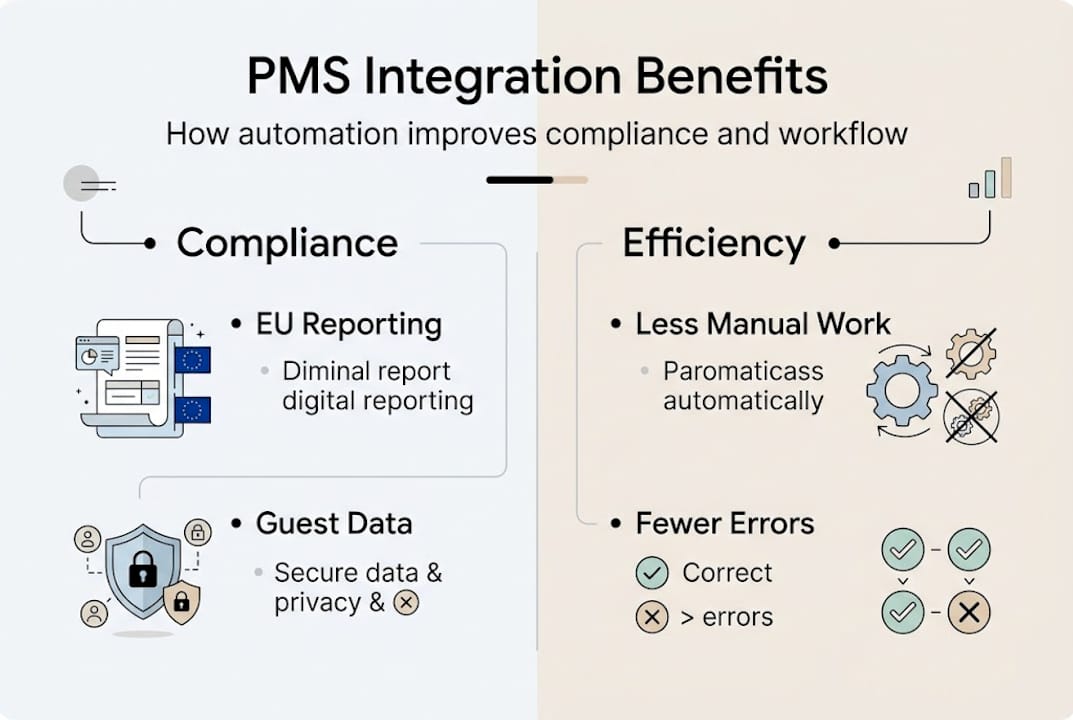
Regulation (EU) 2024/1028 is the short-term rental regulation that came into force across EU member states, requiring platforms and property managers to share guest registration data, occupancy statistics, and booking information with national authorities on a monthly basis. This is not a voluntary framework. Non-compliance can result in platform delisting, meaning your listings are removed from OTAs until compliance is restored.
PMS integrations automate required guest registration and reporting for EU regulation, removing the need for manual data entry and reducing the risk of submission errors. The key compliance tasks that integration handles include:
- Guest data capture: Automatically collecting name, nationality, document type, and arrival and departure dates at the point of booking.
- SDEP reporting: Monthly submission of statistical data to the Single Digital Entry Point (SDEP), the EU’s centralised reporting gateway.
- Digital registration: Automated guest registration with local authorities where required, such as in Spain, Italy, and Portugal.
- Audit trail maintenance: Secure archiving of all guest records for inspection by authorities if requested.
The regulation also mandates digital data sharing and government API support, meaning your PMS must be capable of connecting directly to government-facing APIs, not just OTA platforms. This is a technical requirement that many older or simpler systems cannot meet.
For a structured approach to meeting these obligations, the EU compliance checklist covers the key requirements by country. If you are unsure how to handle booking data submission under the new framework, that resource explains the process clearly. You can also review the API integration for managers guide for technical guidance on connecting to government systems.
Statistic: Property managers using automated compliance tools report significantly higher submission accuracy rates compared to those relying on manual processes, with some platforms achieving near-complete automation of monthly SDEP reporting cycles.
Risks, edge cases and what to look for in PMS integration
Compliance automation brings rewards, but it is vital to understand the risks and how to minimise them.
Even well-designed integrations can fail under specific conditions. Sync failures in peak periods and address mismatches cause compliance issues, and these are not rare edge cases. High-demand periods, such as summer or major local events, place the greatest stress on integration infrastructure precisely when accuracy matters most.
Common risks to be aware of include:
- Sync lag: Delays between a booking event and the update reaching all connected systems, creating a window for overbookings.
- Data mismatches: Inconsistent property addresses, guest name formats, or document types between the PMS and the reporting system.
- Compliance field gaps: Missing required data fields, such as nationality or document number, that cause submission rejections.
- Single point of failure: Relying on one integration method means any outage breaks the entire data flow.
The most effective mitigation strategy is a hybrid approach. Hybrid webhooks and polling mitigate sync gaps by combining real-time event triggers with periodic checks, so that even if a webhook fails, the polling layer catches the missed update. This redundancy is especially important for compliance-critical data.
Address mismatches are one of the most common triggers for human review by authorities and, in persistent cases, platform delisting. Ensuring your PMS stores the exact legal address of each property, matching the format required by local government systems, is a non-negotiable step in any compliance setup.
Pro Tip: When selecting a PMS, ask the vendor specifically about their error-handling protocols. A robust integration will include automatic retry logic, failure alerts, and a clear audit log so you can identify and resolve data issues before they reach a compliance deadline.
For a practical look at structuring your compliance workflow tips, that resource covers the operational steps in detail. The channel manager integration guide also addresses how to layer channel management on top of your PMS without introducing new sync risks.
Why deep PMS integration is the game changer for European rentals
Most conversations about PMS integration focus on features: which OTAs are supported, how fast the sync is, whether dynamic pricing is included. These are valid questions, but they miss the deeper point.
The real value of deep PMS integration in 2026 is not convenience. It is risk reduction. Unified PMS with open APIs eliminate blame games and latency that arise when multiple disconnected systems each claim the other is responsible for a missed submission or a compliance error. When your PMS, channel manager, and compliance tool operate as a single connected system, there is one source of truth and one point of accountability.
The all-in-one versus best-of-breed debate is real, but for European property managers operating under Regulation (EU) 2024/1028, the complexity of managing multiple vendor relationships is a genuine compliance liability. Flexibility sounds appealing until a sync gap causes a missed SDEP submission. For multi-property workflow compliance, a unified architecture is almost always the more resilient choice. Choose depth over breadth, and prioritise integration quality over the number of features listed on a pricing page.
Streamline compliance and operations with PMS integration solutions
Managing compliance across multiple properties, channels, and jurisdictions is genuinely complex. The good news is that the right tools make it manageable.
GuestAdmin.io is built specifically for European short-term rental operators who need reliable PMS integration, automated compliance reporting, and multi-property management explained in a single platform. Whether you are looking to automate guest management or need a structured approach to hotel compliance automation, GuestAdmin.io connects directly with your existing PMS and OTA setup to handle data capture, submission, and archiving automatically. Book a demo to see how it works for your portfolio.
Frequently asked questions
How does PMS integration prevent double bookings?
Real-time PMS integration eliminates overbooking risks by synchronising availability across all channels the moment a booking is confirmed, closing the gap that polling-based methods leave open between scheduled checks.
What compliance challenges does PMS integration solve for European rentals?
PMS integrations automate EU compliance reporting under Regulation (EU) 2024/1028, handling monthly guest data submissions, digital registration, and SDEP reporting without manual input from your team.
Is all-in-one PMS always better than best-of-breed for integration?
Unified PMS architecture outperforms siloed systems for European property managers by reducing latency and accountability gaps, though best-of-breed solutions can work well when deep integrations are in place.
What is a ‘deep’ PMS integration?
A deep integration ensures full feature parity across bookings, guest details, pricing, and compliance data, going well beyond basic calendar sync to support real operational and regulatory requirements.
2 Comments
Short Term Rental Compliance Software That Works - Guest Registration Services
[…] flow. A manager operating hundreds of units may need API access, webhooks and support for multiple PMS connections. Good software should support both without making the smaller operator pay for unnecessary […]
Webhook Booking Integration for Rental Compliance - Guest Registration Services
[…] For a host with one property, that means fewer late evenings spent checking booking emails against government portals. For a manager handling dozens of properties, it means a more reliable route from booking source to guest record, regardless of whether the reservation came from a direct website, an OTA or a property-management system. […]