

TL;DR:
- Understanding and correctly applying hospitality industry terminology is essential for European short-term rental compliance, as it influences data collection and legal submissions.
- Proper system configuration, staff training, and automated workflows ensure accurate guest categorization, data submission, and record retention, reducing risks of penalties or listing removals.
If you manage a short-term rental in Europe and have been ignoring hospitality industry terms as “hotel jargon,” you are likely already carrying compliance risk. The industry terminology in guest management is not a glossary for front-desk staff at large chains. It is the shared language that European regulations, property management systems, and local authorities all speak fluently. Knowing the difference between a primary guest and an accompanying guest, or understanding what a registration number actually means in legal terms, directly affects whether your submissions are accepted and whether your listing stays online.
Table of Contents
- Key guest management terms every rental owner must know
- How property management systems support compliance through terminology
- Regulatory terminology and their operational impact in Europe
- Practical workflows for guest management compliance
- Managing compliance risks through clear terminology and workflows
- A fresh look: why mastering terminology is your compliance superpower
- Streamline your guest management with automated compliance solutions
- Frequently asked questions
Key Takeaways
| Point | Details |
|---|---|
| Understand key terms | Knowing guest management terms like primary and accompanying guest is essential for compliance and smooth operations. |
| Leverage PMS features | Configure your property management system correctly to support regulatory requirements and data workflows. |
| Know EU regulations | Properly display registration numbers and meet data submission deadlines for legal compliance in Europe. |
| Follow practical workflows | Use best practices like mass check-in and registration card printing to streamline guest processing and compliance. |
| Prevent compliance risks | Avoid mixing terminology and ensure accurate data handling to reduce regulatory penalties and operational errors. |
Key guest management terms every rental owner must know
The guest management vocabulary used in European short-term rental compliance is more specific than most property owners expect. These are not interchangeable descriptions. They are precise categories that determine what data you collect, how you document it, and what you report to authorities.
Here are the core terms you will encounter regularly:
- Primary guest: The individual under whose name the reservation is booked. As Oracle OPERA Cloud documents, “primary guest” is the guest name under which the reservation is made and appears at the top of the guest list. In practice, this means the primary guest’s identification is the anchor record for all regulatory submissions.
- Accompanying guest: Any secondary guest added to the same reservation. Depending on local rules, accompanying guests may require their own identity verification and separate registration cards.
- Registration number: The EU-mandated property identifier that must be displayed on all online listings. This is not optional. It is the legal proof that your property is registered with the relevant authority.
- Registration card: A document containing the guest’s personal details, stay information, and signature, generated at check-in. Its content and format are often dictated by local law.
- Guest profile: The complete record associated with a guest, covering contact details, identity documents, nationality, and stay history. Regulators may request access to this data.
- Reservation folio: The financial record attached to a reservation, used internally but also relevant during audits.
Each term connects to a specific action in your compliance workflow. For example, if you mislabel an accompanying guest as a primary guest in your system, your submitted data will not match the booking reference, which can trigger a rejection from the authority portal. The short-term rental terminology guide from GuestAdmin covers how these distinctions play out specifically in European regulatory contexts.
How property management systems support compliance through terminology
Understanding the terms is only the first step. Your property management system (PMS) or hotel management system (HMS) must be configured to reflect those terms accurately. A PMS or HMS is the software that manages reservations, check-ins and check-outs, housekeeping coordination, and billing. It is the operational backbone of your compliance workflow.
One feature that directly affects compliance is the age threshold setting. Oracle OPERA Cloud documentation describes how compliance-relevant terminology can be operationalised via configuration options such as an “Age Threshold to Print Registration Card.” This determines which guests are categorised as requiring full documentation. Set it incorrectly and children may be processed as adults, or vice versa, creating discrepancies in your submitted data.
Here is how to ensure your PMS supports compliance effectively:
- Audit your guest category settings. Verify that your system distinguishes correctly between primary and accompanying guests, and that the definitions match regulatory requirements in each jurisdiction where you operate.
- Configure age thresholds per destination. Different European countries have different rules about which guests require full identity documentation. Set these thresholds country by country, not globally.
- Map system fields to regulatory data fields. Every field in your PMS that captures guest data should correspond to a specific field in the authority’s submission form.
- Test with dummy reservations. Before peak season, run test check-ins with multiple guest types to confirm your system produces correct records.
- Integrate with your multi-property management workflow. If you manage several properties, ensure each property’s configuration is reviewed independently, as local rules may differ.
Pro Tip: Set a quarterly calendar reminder to audit your PMS configuration settings. Regulations change, and a configuration that was correct six months ago may now produce non-compliant records.
Regulatory terminology and their operational impact in Europe
European short-term rental regulations do not always use the same language as hospitality industry terms. This is where confusion most often causes compliance failures. The terminology for hotel management that appears in your PMS may look different from the terminology in a regulatory directive, but they often describe the same underlying requirement.
The registration number is the clearest example. EU regulations require all short-term rental units listed online to display a registration number and mandate monthly data submissions to a central Single Digital Entry Point. In practical terms, the “no registration code, no listing” rule means your property can be delisted from booking platforms if the number is missing or invalid.
The table below shows how regulatory terminology translates into operational requirements across different contexts:
| Regulatory term | Operational meaning | Property owner action |
|---|---|---|
| Registration number | Unique property identifier | Obtain, display on all listings |
| Guest data submission | Mandatory reporting to authorities | Submit within deadline after each check-in |
| Single Digital Entry Point | EU centralised data portal | Ensure your system formats data to accepted standards |
| eIDAS signature | Legally valid electronic signature | Use for rental contracts and digital check-in records |
| Data retention period | Minimum time to store guest records | Archive guest data for the required number of years |
Practical implications for property owners managing digital travel document management include:
- Always display your registration number on every listing channel.
- Submit guest identification data within the required timeframe after check-in (this varies by country, but is often 24 hours).
- Maintain archived guest records for the legally required retention period.
- Ensure your PMS outputs data in a format accepted by the relevant national authority portal.
For destination-specific guidance, the short-term rental registration guide covers country-level registration requirements across Europe in detail.
Practical workflows for guest management compliance
Knowing the terms and configuring your system correctly only delivers results when your daily workflows reflect them. Common phrases in guest relations such as “check-in,” “registration,” and “arrival” carry specific operational meaning when it comes to regulatory compliance.
A standard guest check-in compliance workflow looks like this:
- Confirm reservation details. Verify the primary guest name matches the booking confirmation and the identity document presented.
- Collect identity documents. Scan or photograph the guest’s passport or national ID, capturing all fields required by local regulations.
- Create or update the guest profile. Enter data into the PMS under the correct guest category (primary or accompanying).
- Generate and sign the registration card. Produce the registration card from your PMS and obtain the guest’s signature, either physical or electronic.
- Submit data to the authority portal. Transmit the required guest records within the prescribed deadline.
- Archive the records. Store the submitted data securely for the required retention period.
Mass check-in is particularly relevant if you manage a block of apartments or a multi-unit property. Mass check-in is a process that allows multiple reservations to be checked in for arrivals due on the property’s business date, with optional generation of room keys and registration cards. For large properties, this can process dozens of arrivals without individually opening each reservation, saving significant time on high-arrival days.
For groups or corporate bookings, understanding group and bulk check-in workflows is equally important, as the accompanying guest documentation requirements are often more extensive.
Pro Tip: Build your guest record fields around the exact data fields required by each authority submission form. If the authority requires “document issuing country” as a separate field, make sure your PMS captures it separately, not buried in a general notes field.
The guest registration methods available to short-term rental owners now range from manual paper forms to fully digital pre-arrival registration, and the right choice depends on your property type and guest volume.

Managing compliance risks through clear terminology and workflows
Collecting guest data is only half the job. Many property owners run into compliance problems not because they failed to collect data, but because the data was submitted incorrectly, late, or under the wrong guest category. Mixing internal hospitality terms with regulatory terms often leads to operational gaps and compliance failure.
The most common compliance pitfalls related to guest management terminology include:
- Confusing primary and accompanying guests in reports. A common error is listing all guests under the primary guest name rather than filing separate records for accompanying guests who require individual documentation.
- Using inconsistent terminology across platforms. If your PMS calls a field “guest type” but your submission portal calls it “guest category,” mismatches lead to rejected submissions.
- Missing submission deadlines. Guest experience language in your internal systems may refer to a “late check-in” but to the authority it is still a same-day arrival with a same-day submission deadline.
- Failing to maintain records for the full retention period. Deleting guest records after a guest departs may feel like good data hygiene, but it can constitute a legal violation.
- Inadequate staff training on terminology. When team members use terms interchangeably, errors compound across dozens of reservations before anyone notices.
“Accurate, timely submission of guest data is not a best practice. It is a legal obligation. The terminology you use internally must align precisely with what regulators expect to receive.”
Consistent terminology across your team, your systems, and your documents is what makes compliance audits straightforward rather than stressful. The tips for rental compliance from GuestAdmin cover the practical steps to build that consistency into your operation.
Routine training matters more than most property owners realise. Running a terminology refresher when regulations change, or when new staff join, is not an administrative chore. It is the activity that prevents fines.
A fresh look: why mastering terminology is your compliance superpower
Most guides treat guest management vocabulary as a reference list, something you look up when you are unsure. That framing understates its value significantly.
Mastering the common phrases in guest relations and the precise regulatory terms used across European jurisdictions does something more useful than keeping you compliant. It changes how you interact with every part of your operation, from the configuration conversations you have with your PMS provider to the way you brief seasonal staff. As Sue Tinnish, Ph.D., Dean of Hospitality Management at Kendall College, puts it, the purpose of hospitality terms is communication efficiency, making it easier for people to talk to each other.
When your whole team uses “primary guest” to mean exactly the same thing, errors at check-in drop. When your system fields and your submission portal fields use the same vocabulary, integrations work cleanly and submissions go through first time. When new regulations arrive (and they do arrive, regularly), a team already fluent in the underlying terminology adapts faster than one that has to relearn the language from scratch.
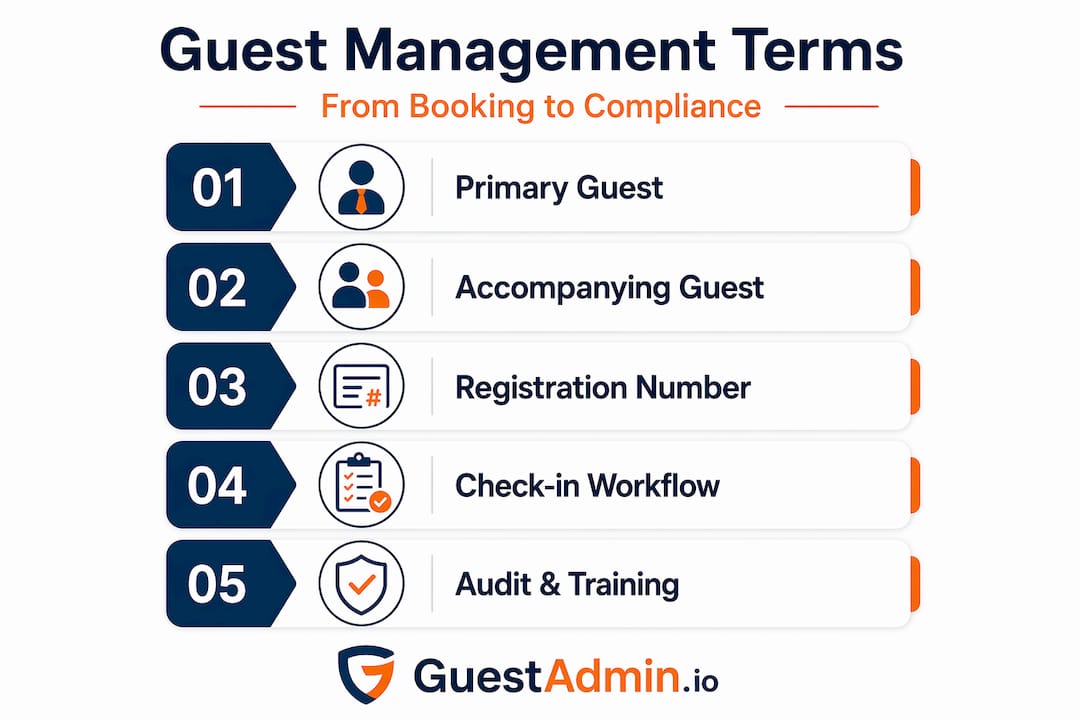
What is guest management terminology, at its core? It is a shared operating language. The property managers who treat it that way spend less time correcting errors, less time dealing with authority queries, and more time actually running their properties.
Pro Tip: Make terminology training a standard part of onboarding for every team member, not just front-of-house staff. A maintenance coordinator or cleaner who understands the distinction between a primary and accompanying guest can catch data errors before they reach submission.
The legal compliance for rentals landscape will keep evolving. Terminology mastery is how you stay ahead of it, rather than reacting to it.
Streamline your guest management with automated compliance solutions
Putting all of this into practice, across multiple properties, multiple jurisdictions, and a constant flow of arrivals, is where manual processes start to break down. Understanding industry terminology in guest management gives you the foundation, but automation turns that knowledge into reliable, consistent execution.
GuestAdmin.io is built to bridge the gap between understanding compliance requirements and actually meeting them every day. The platform automates guest compliance by capturing guest data at the point of check-in, processing it against the specific requirements of each jurisdiction, and submitting it to the relevant authority within 24 hours. Key features that directly support the workflows described in this article include:
- Automated ID capture and verification, mapped to the correct guest categories for each property.
- Automated guest registration with digital registration cards that satisfy EU eIDAS requirements.
- Real-time compliance dashboards showing submission status across all properties.
- Multi-jurisdiction configuration, so each property submits data in the format required by its local authority.
If you want to see the practical hotel compliance automation benefits for your operation, GuestAdmin offers a clear path from terminology understanding to fully automated, GDPR-compliant delivery.
Frequently asked questions
What is the difference between a primary guest and an accompanying guest?
The primary guest is the booking name under which the reservation is made, while accompanying guests are secondary guests added to the same reservation who may require separate identity documentation and individual registration cards depending on local regulatory rules.
Why is a registration number important for short-term rentals in Europe?
A registration number is a mandatory EU-wide identifier that must be displayed on every listing, and the “no registration code, no listing” rule means your property can be removed from booking platforms and face regulatory penalties if the number is absent or invalid.
How does mass check-in support compliance?
Mass check-in processes multiple reservations on the property’s current business date, generating registration cards and keys for each, which ensures accurate documentation for every guest arrival even during high-volume periods.
What signature type is needed for short-term rental contracts in the EU?
Short-term rental contracts require at least a Simple Electronic Signature (SES) to be legally admissible under eIDAS, the EU regulation that defines valid electronic signature levels for civil and commercial proceedings.