

TL;DR:
- Effective guest data management goes beyond legal compliance to improve operational efficiency and build guest trust.
- Maintaining a detailed RoPA, setting proper retention periods, and signing DPAs with third parties are essential GDPR practices for property owners.
Managing guest data is one of those responsibilities that most property owners treat as a legal obligation and little else. That framing misses the bigger picture. A well-structured guest data processing guide does more than keep you on the right side of GDPR. It helps you run a tighter operation, build genuine trust with guests, and avoid the administrative chaos that comes from scattered records across multiple systems. For European property owners and managers, the regulatory stakes are real, but so are the operational rewards of getting this right from the start.
Table of Contents
- Key takeaways
- What guest data processing actually covers
- Mapping your data: building a RoPA
- Day-to-day practices for compliant data handling
- Tools and integrations for better guest information management
- Cross-border transfers and data residency
- My perspective: compliance as an operational standard
- How Guestadmin makes this manageable
- FAQ
Key takeaways
| Point | Details |
|---|---|
| Know your data categories | Guest data spans personal, sensitive, and transactional types, each requiring different handling under GDPR. |
| Build a RoPA from day one | Mapping every system holding guest data is a legal requirement under GDPR Article 30 and a practical compliance tool. |
| Set retention periods clearly | Tax records require 6 to 10 years retention; marketing consent records should only be held while valid. |
| Use data processing agreements | Every third-party vendor handling guest data must have a signed DPA in place under GDPR Article 28. |
| Automate where possible | Cloud-based tools with encryption, audit trails, and automated consent management reduce risk and save time. |
What guest data processing actually covers
The phrase “guest data processing” is widely used in hospitality, but the formal term you will encounter in regulatory guidance is personal data processing. GDPR defines processing broadly: it covers collecting, storing, accessing, sharing, and deleting personal data. Any time your property management system (PMS) saves a guest’s name, or you send a booking confirmation, you are processing personal data.
Guest data typically falls into three categories:
- Personal data: Names, passport or ID numbers, addresses, email addresses, phone numbers, and nationality. This is the most common category and is collected at check-in or through booking platforms.
- Sensitive data: Health information (for accessibility requirements), or biometric data if you use digital ID verification. This category triggers stricter GDPR obligations and generally requires explicit consent.
- Transactional data: Booking dates, payment records, invoice history, and stay preferences. Transactional data is often subject to separate retention obligations, particularly for tax compliance.
Under GDPR, you need a lawful basis for every type of processing you carry out. For most guest interactions, the lawful basis is contract necessity: you need the data to fulfil the booking. For marketing, you will typically rely on consent. For fraud prevention or internal analytics, legitimate interest may apply, though you must document your reasoning. Local regulations across Europe also add layers. Spain’s LOPDGDD, Italy’s Codice della Privacy, and Germany’s BDSG each carry specific national provisions that sit alongside GDPR. If you operate across multiple jurisdictions, EU data compliance requirements will vary property by property.
Mapping your data: building a RoPA
Data mapping and documentation equivalent to GDPR Article 30 is standard practice for hospitality operations in Europe. Article 30 requires organisations to maintain a Record of Processing Activities (RoPA). Think of it as a live inventory of every system, every data type, and every processing purpose in your operation.
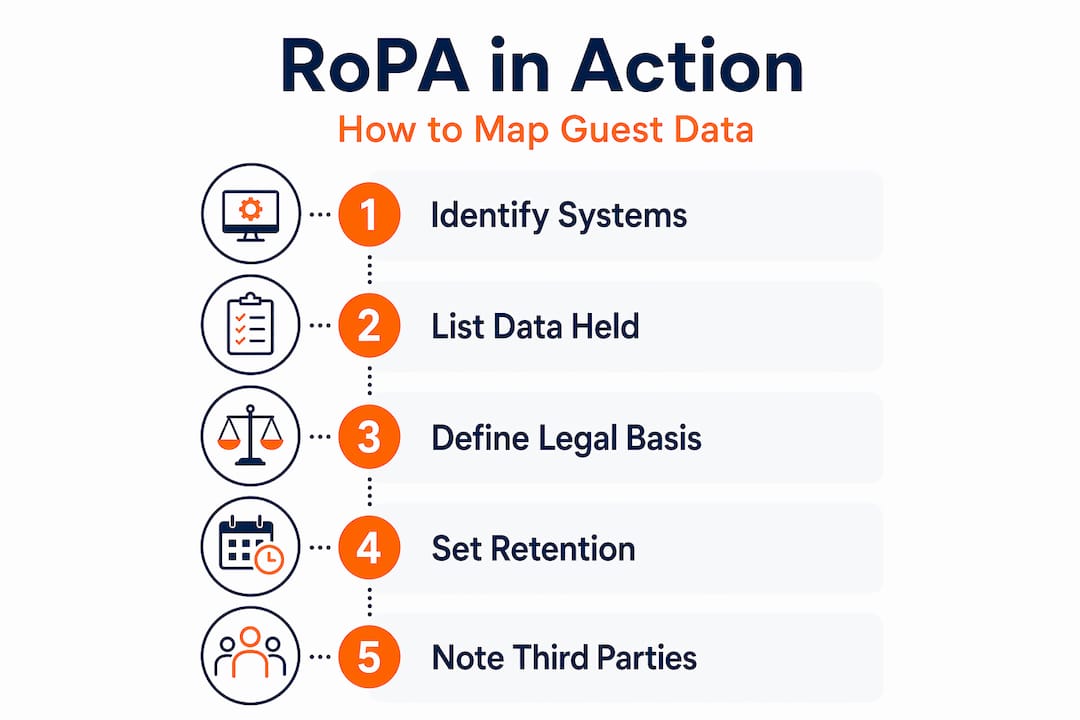
Here is what a typical RoPA for a short-term rental operation needs to document:
| Data system | Data held | Lawful basis | Retention period | Third parties |
|---|---|---|---|---|
| Property management system | Name, ID, booking details | Contract | 6 years (tax) | Booking platform |
| Email marketing tool | Email address, stay preferences | Consent | Until consent withdrawn | Email provider |
| Payment processor | Card details, transaction records | Contract | 7 years (financial) | Payment gateway |
| CCTV system | Video footage of common areas | Legitimate interest | 30 days | Security provider |
| Guest messaging app | Chat history, contact details | Contract | 12 months post-stay | Messaging vendor |
The table above shows how varied your data landscape already is, even for a modest operation. Each row in your RoPA must document the lawful basis, retention period, and any third-party processors involved.
Pro Tip: A well-structured spreadsheet can satisfy GDPR Article 30 requirements for smaller operations. Use one tab per system, and review the document every six months to capture new tools or changed processing purposes.
Maintaining your RoPA is not a one-time task. When you add a new booking channel, switch to a different messaging platform, or start using a guest analytics tool, your RoPA must be updated. Effective compliance documentation works best when it reflects your actual systems rather than an idealised version of them.
Day-to-day practices for compliant data handling
Getting your documentation in order is the foundation. How you handle guest data day to day is where compliance either holds or breaks down.

Retention periods must be set according to the purpose of collection. Tax records require retention for 6 to 10 years, while marketing consent records should only be retained while the consent remains valid. The common mistake is applying a single blanket retention period across all data types, which either results in deleting financial records too early or holding onto marketing data you no longer have grounds to keep.
Data processing agreements (DPAs) are mandatory under GDPR Article 28 with every third-party vendor who handles guest data on your behalf. DPAs must cover security measures, processing limitations, breach notification obligations, and contractual responsibilities. Most reputable vendors provide standard templates. The problem is that many property managers never actually sign them. If your booking software provider, channel manager, or payment processor does not have a signed DPA with you, you are exposed.
Handling guest data subject requests is the part that trips up even well-organised teams. When a guest submits a right-to-access or erasure request, here is the process to follow:
- Acknowledge receipt of the request in writing within 72 hours.
- Verify the guest’s identity before taking any action.
- Locate all instances of their data across every system in your RoPA.
- Prepare a structured response covering all personal data held.
- For erasure requests, check retention obligations (tax law, legal claims) before deleting.
- Action the request and delete or provide data within 30 days of verification.
- Document the request, your response, and the outcome for your audit records.
Subject access and erasure requests must be fulfilled within 30 days, and that clock starts from identity verification. Staff training is not optional here. Your team needs to know how to spot an incoming request and who to escalate it to.
Pro Tip: Automate your data deletion schedules inside your PMS or guest data platform wherever possible. Manual deletion is error-prone and easy to skip during busy periods. Automated deletion tied to retention rules is both safer and auditable.
Tools and integrations for better guest information management
Cloud-based guest data processing tools with secure integrations, encryption, and access controls make compliance measurable rather than aspirational. The difference between managing guest information in a combination of spreadsheets, email inboxes, and disconnected booking platform portals, compared to a unified platform, is significant from both a compliance and operational standpoint.
Modern guest data processing tools typically offer:
- Encryption at rest and in transit: Protecting guest personal data from interception or unauthorised access at every stage.
- Role-based access controls: Limiting which staff members can view sensitive data, reducing internal exposure.
- Automated consent management: Capturing and recording marketing preferences at the point of booking, with audit trails to demonstrate compliance.
- Breach detection and alerting: Notifying you quickly if unusual access patterns or potential data incidents are detected.
- Audit logs: Providing a timestamped record of who accessed or modified guest data, which is critical during regulatory investigations.
Integration is where guest data tools deliver the most practical value. When your PMS connects directly to your booking engine, channel manager, and payment processor, data flows consistently without manual re-entry. Manual re-entry is not just inefficient. It introduces transcription errors that can cause compliance failures, for example saving a guest’s nationality incorrectly on a registration submitted to local authorities.
Security and transparency in guest data management should be embedded in your operations, not added on as an afterthought. A good platform will prompt you to update consent records, flag expired data, and alert you when a vendor’s DPA requires renewal.
Cross-border transfers and data residency
For European property owners using cloud-based software, the question of where guest data is physically stored matters legally. Data residency refers to the geographic location of the servers where personal data is held. Under GDPR, transferring personal data outside the European Economic Area (EEA) without adequate safeguards is unlawful.
Data residency compliance requires hotels and property managers to understand where guest data is stored and to confirm that any cross-border transfers meet GDPR requirements.
Key points for managing this in practice:
- Check your vendor contracts: Ask every software provider where their servers are located and whether they use sub-processors in non-EEA countries.
- Standard Contractual Clauses (SCCs): For transfers to countries without an EU adequacy decision, SCCs and guest consent are the primary safeguards. Confirm your vendors have these in place.
- Data localisation expectations: Some EU member states have additional expectations around storing citizen data domestically. Spain and Germany, in particular, have local provisions worth checking if you operate there.
- Select EEA-based vendors where possible: The simplest way to reduce cross-border transfer risk is to prioritise vendors with EEA-based data centres.
Multi-property operators face the greatest exposure here because they are often working with a mix of local and international software tools. Conducting an annual review of your vendor stack against property data security requirements is a practical way to stay ahead of this.
My perspective: compliance as an operational standard
I have seen the same pattern repeat itself across the hospitality sector. Property managers build up their operations quickly, adding tools and platforms as they go, and the data picture becomes fragmented before anyone notices the risk. A PMS here, a messaging app there, a marketing tool added during a busy season. Suddenly you have six systems holding guest personal data, no signed DPAs for three of them, and no clear idea of your retention periods.
What I have found is that the managers who handle this best are not necessarily the ones with the most sophisticated systems. They are the ones who treat data protection as a normal operational standard rather than a compliance project they will get to eventually. They review their RoPA when they add a new tool. They train their staff annually. They automate deletion schedules and check their vendor agreements.
The guest trust angle is real too. Guests are increasingly aware of how their data is used. A property that handles guest data with transparency builds a reputation that is hard to quantify but easy to lose. Getting this right is not about avoiding fines. It is about running a professional operation that guests and regulators can rely on.
— Alex
How Guestadmin makes this manageable
If any part of this guide has highlighted gaps in your current setup, Guestadmin is built specifically to close them.
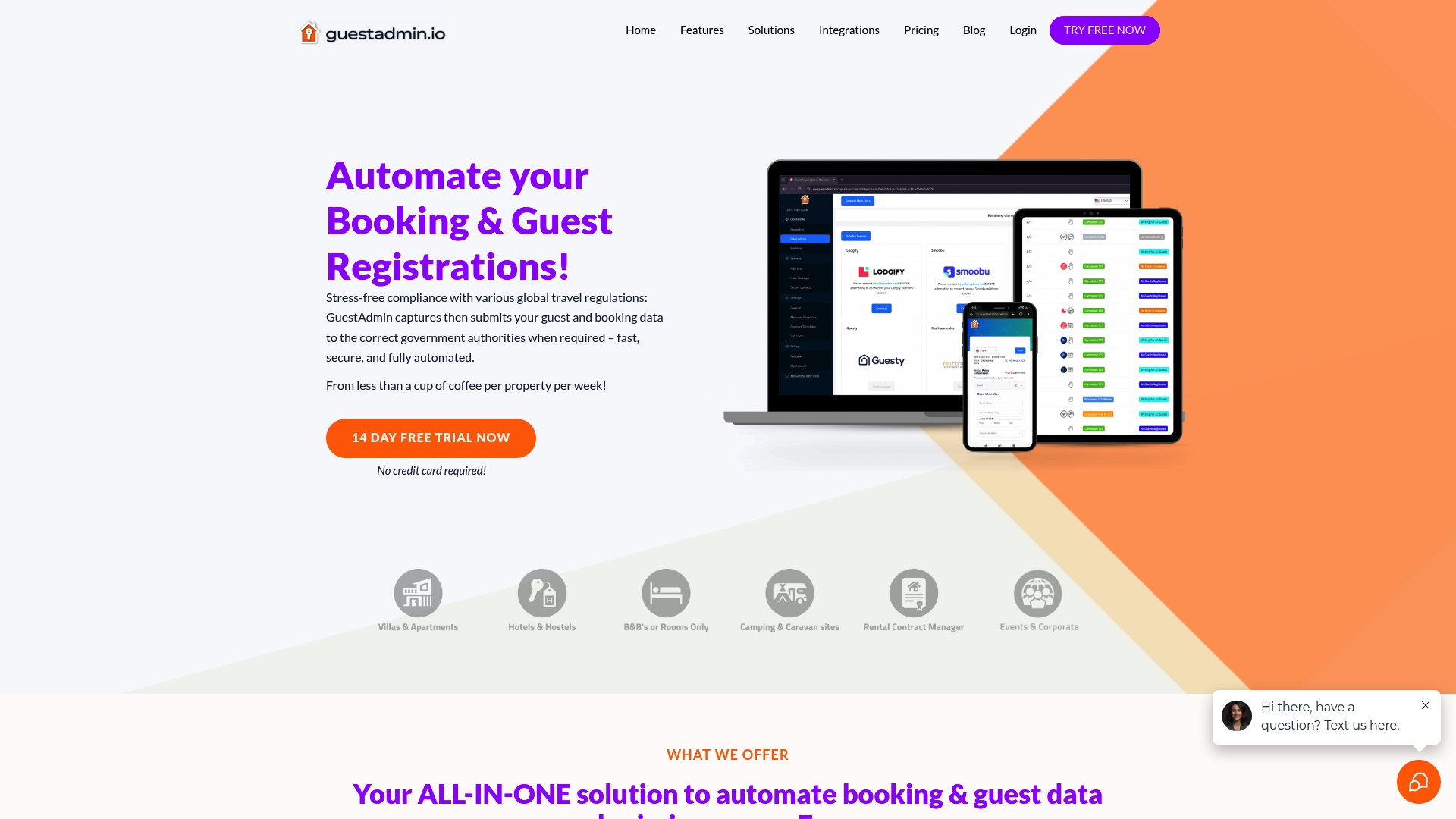
Guestadmin is a GDPR-compliant SaaS platform designed for short-term rental operators across Europe. It automates the capture, processing, and secure submission of guest registration data to relevant authorities, removing the manual effort that creates compliance risk. With real-time booking dashboards, multi-property management, and integrations with leading PMS and OTA platforms, it gives you a single, auditable view of your guest data. For those weighing their options, the top property management software comparison provides a clear breakdown of how platforms differ on compliance features, integrations, and pricing. If you manage multiple properties, Guestadmin’s multi-property compliance tools are built to handle the complexity without multiplying your administrative workload.
FAQ
What is a RoPA and do I need one?
A Record of Processing Activities (RoPA) is a document required under GDPR Article 30 that maps every system holding guest personal data, including the lawful basis, retention period, and third-party processors involved. Most property owners who process data regularly are required to maintain one.
How long should I keep guest data?
Retention periods depend on the purpose of collection. Financial and tax records typically require retention for 6 to 10 years, while marketing consent data should only be held for as long as the consent remains active.
What happens if a guest requests erasure of their data?
You must verify the guest’s identity, locate all instances of their data across every system, check whether any legal retention obligations apply (such as tax records), and complete the deletion within 30 days of receiving a valid, verified request.
Do I need a data processing agreement with my booking platform?
Yes. Under GDPR Article 28, a signed data processing agreement is mandatory with every third-party vendor that processes guest personal data on your behalf, including booking platforms, payment processors, and messaging tools.
What are Standard Contractual Clauses?
Standard Contractual Clauses (SCCs) are legal mechanisms approved by the European Commission that allow personal data to be transferred from the EEA to countries without an EU adequacy decision, while maintaining GDPR-level protections for that data.
4 Comments
How to report guest data: european compliance guide
[…] Guest data processing guide for European property owners […]
GDPR in hospitality: a compliance guide for property owners
[…] or assuming one covers the other, is one of the most common compliance errors in the sector. Your guest data processing guide should document each activity […]
Data security best practices 2026: protect your business
[…] and encrypted data handling built in. For managers with multiple properties, Guestadmin’s guest data processing tools centralise compliance across all locations, removing the manual burden of tracking regulatory […]
What is guest data reporting: a guide for property managers
[…] Guest data processing guide for European property owners […]