

TL;DR:
- Regulatory compliance for short-term rentals in Europe shifts to mandatory, automated data reporting under EU Regulation 2024/1028 starting in 2026. Operators must ensure data parity with local authorities, implement continuous audits, and respond rapidly to enforcement orders to avoid penalties. Automation and structured workflows are essential for meeting these strict, ongoing compliance demands.
Regulatory compliance for short-term rentals in Europe is defined by one overriding shift in 2026: mandatory, automated data reporting to government authorities under EU Regulation 2024/1028. The trends in hospitality compliance 2026 centre on three forces: structured data sharing via the Single Digital Entry Point (SDEP), data-driven enforcement replacing manual inspections, and the growing operational burden of maintaining accurate records across multiple listings. For property managers and owners across Europe, these changes are not theoretical. They are live, enforceable, and carrying real penalties for those who are not prepared.
How does EU Regulation 2024/1028 reshape compliance reporting?
EU Regulation 2024/1028 is the most significant hospitality compliance update in a decade. As of may 2026, it mandates that short-term rental platforms transmit monthly rental activity data to national Single Digital Entry Points. This applies across all EU member states and covers every listing on major platforms.
The data transmitted each month includes:
- Registration numbers linked to each listing
- Listing URLs for identification and audit purposes
- Nights rented during the reporting period
- Guest counts per booking cycle
This level of reporting detail gives local authorities a real-time picture of rental activity in their jurisdictions. The practical implication is that any discrepancy between what a host reports and what a platform submits becomes immediately visible to regulators.
The regulation also empowers local authorities to improve transparency and enforce local housing laws without imposing direct rental caps. This is a subtle but important distinction. Authorities do not need to ban rentals outright. They simply use the data flow to identify non-compliance and act accordingly.

For hospitality professionals managing listings across multiple European cities, the scope of this regulation demands a structured approach to data governance. A single incorrect registration number across a portfolio of 20 properties can trigger an investigation into all 20.
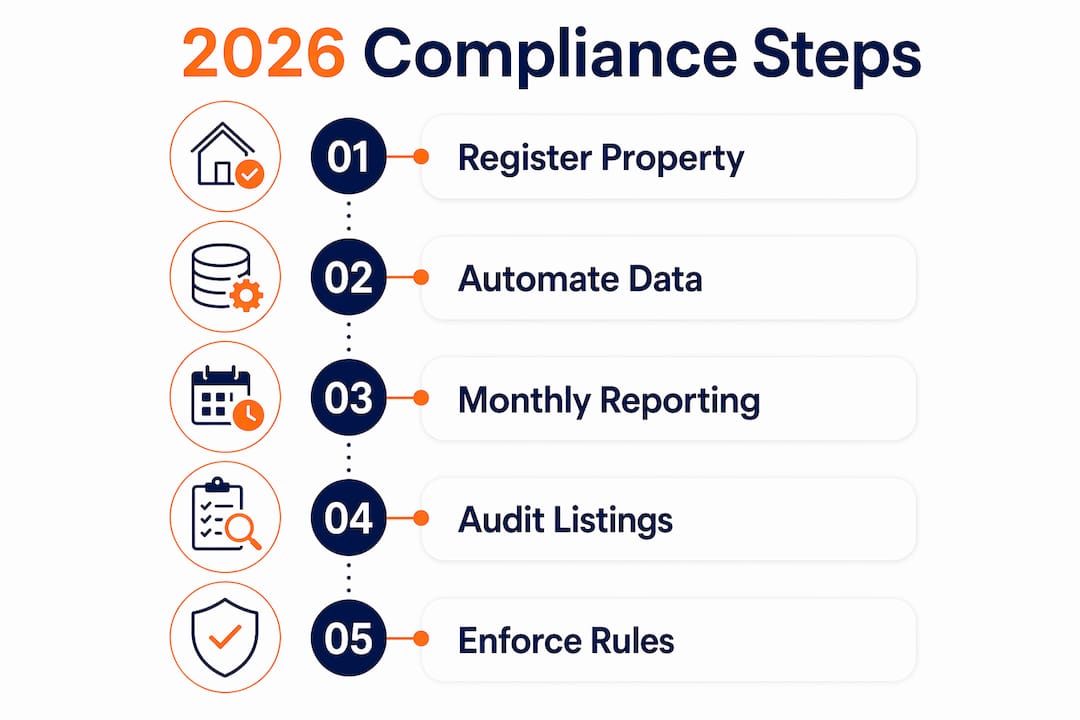
Pro Tip: Review every listing’s registration number against the relevant national SDEP before the next monthly reporting cycle. One invalid entry can flag your entire portfolio for review.
What operational challenges does data compliance create in 2026?
Data parity between your Property Management System and the SDEP is the largest operational bottleneck facing hospitality professionals in 2026. Successful operators treat it as a core business metric, not a background IT task. The distinction matters because the consequences of getting it wrong are immediate and public.
Here are the four most common data compliance failures and their consequences:
- Address mismatches. A listing address in your PMS must match the registered address exactly, including unit numbers and floor details. Even a formatting difference can trigger a flag.
- Expired registration numbers. Registration number validity checks are random and mandatory in stricter markets. An expired number that passes one month may fail the next.
- Night cap breaches. If your data shows a listing has exceeded its permitted nights, authorities receive that information automatically in the next monthly report.
- Listing removal delays. Serious violations require listing removal within 48 hours of an enforcement order. Less severe cases allow up to 10 working days. Missing either deadline compounds the original offence.
The 48-hour removal window is the detail most operators underestimate. In practice, it means you need a compliance workflow that can respond to an enforcement order within the same business day. Manual processes cannot reliably achieve this at scale.
Auditing your listings against local night caps and registration validity is not a quarterly task in 2026. It is a monthly discipline. The short-term rental regulations across Europe vary significantly by city and country, and the frequency of rule updates has increased in 2026. What was compliant in january may not be compliant in june.
Pro Tip: Build a monthly compliance audit into your operational calendar. Cross-reference each listing’s reported nights against the applicable municipal cap before the platform submits its monthly data.
How are enforcement practices evolving in 2026?
Enforcement in the European short-term rental market has shifted from reactive and manual to automated and data-driven. Authorities no longer need to conduct physical inspections or rely on complaints to identify non-compliant listings. The monthly data feed from platforms does that work for them.
The practical effect of this shift is significant:
- Faster enforcement orders. Authorities can issue removal orders as soon as non-compliance appears in monthly reports, bypassing traditional inspection timelines entirely.
- Municipal night cap enforcement. Paris enforces a 90-night annual limit, and Amsterdam is moving towards a 15-night limit. Both cities now use monthly platform data to identify breaches automatically.
- Cross-border visibility. Because SDEP data is standardised across the EU, a property manager operating in both Barcelona and Berlin faces consistent reporting scrutiny in both markets simultaneously.
- Reduced margin for error. When enforcement was manual, an operator might have months before a breach was detected. With automated data review, the window between a breach and an enforcement order can be as short as one reporting cycle.
This change in enforcement culture is the most consequential of all the 2026 hospitality law changes. The compliance risk is no longer about whether you will be inspected. It is about whether your data will pass automated review every single month. That requires a fundamentally different approach to how you manage and verify listing information.
What tools and practices help meet 2026 compliance requirements?
The most effective response to the 2026 compliance environment is a combination of automation, regular auditing, and updated contractual arrangements with property owners. No single tool solves every problem, but the right combination reduces both risk and administrative overhead considerably.
| Approach | What it does | When to use it |
|---|---|---|
| Automated guest data submission | Captures and submits guest and booking data to authorities within 24 hours | Every booking, across all properties |
| PMS and OTA integration | Syncs listing data across platforms to maintain address and registration consistency | On listing creation and after any update |
| Registration number verification | Pings SDEP to confirm registration validity before monthly reporting | Monthly, before the reporting deadline |
| Booking dashboard monitoring | Provides real-time visibility of nights rented per listing against municipal caps | Weekly review for high-volume properties |
| Compliance audit workflow | Structured checklist review of all listings against current local regulations | Monthly, aligned with reporting cycles |
Automated guest registration tools are particularly valuable for operators managing more than five properties. Manual data entry at scale is where errors accumulate. A platform that captures guest data at check-in and routes it directly to the relevant authority removes the human error risk from the most critical step in the compliance chain.
Contract updates are also overdue for many operators. Under EU Regulation 2024/1028, liability for inaccurate data sits with the platform and, in some cases, the host. Property management agreements should clearly define who is responsible for maintaining accurate registration numbers and who bears the cost of enforcement action. Many existing contracts predate this regulatory framework entirely.
Pro Tip: When reviewing your compliance workflow, add a specific step for verifying that your PMS address fields match the registered address format required by each country’s SDEP. This single check prevents the most common trigger for enforcement investigations.
Key takeaways
Hospitality compliance in 2026 is defined by automated data reporting under EU Regulation 2024/1028, and operators who treat data parity as a core business metric will avoid the enforcement consequences that manual processes cannot prevent.
| Point | Details |
|---|---|
| EU Regulation 2024/1028 is live | Monthly data transmission to national SDEPs is mandatory from may 2026 for all short-term rental platforms. |
| Data parity is a business metric | Mismatches between PMS records and SDEP submissions trigger enforcement investigations, not just IT flags. |
| Enforcement is now automated | Authorities use monthly platform data to issue removal orders without physical inspections. |
| Night cap breaches are auto-detected | Cities like Paris and Amsterdam enforce annual night limits using monthly data feeds, with no manual audit required. |
| Automation reduces compliance risk | Automated guest data submission and registration verification are the most reliable defences against enforcement action. |
Why I think most operators are still underestimating 2026 compliance
Having worked closely with property managers across Europe through multiple regulatory cycles, I can say with confidence that the shift brought by EU Regulation 2024/1028 is categorically different from anything that came before it. Previous regulations required operators to respond to inspections. This one requires you to be correct every month, automatically, before anyone asks.
The operators I see struggling most are those who treat compliance as a periodic task rather than a continuous process. They do a registration check in january and assume it holds for the year. It does not. Registration validity, night cap calculations, and address formatting requirements can all change within a single reporting cycle.
The uncomfortable truth is that the compliance burden in 2026 is not primarily about understanding the rules. Most experienced operators know the rules. The burden is operational: maintaining accurate data across every listing, every month, without fail. That is a systems problem, not a knowledge problem. And systems problems require systems solutions. Operators who have not yet invested in automating their booking compliance are carrying a risk that grows with every property they add to their portfolio.
— Alex
How Guestadmin helps you stay compliant in 2026
Managing the 2026 compliance requirements across multiple short-term rental properties is a significant operational challenge. Guestadmin is built specifically for European property managers who need to meet these demands without adding headcount or manual processes.

Guestadmin automates guest data capture, processes submissions within 24 hours, and integrates directly with your PMS and OTA platforms to maintain data consistency across every listing. The platform’s real-time booking dashboard gives you immediate visibility of nights rented per property, so you can identify potential night cap breaches before they appear in a monthly report. Explore how property management automation can reduce your compliance workload, or review the practical steps to avoid fines and save time under the new EU framework.
FAQ
What does EU Regulation 2024/1028 require from short-term rental hosts?
EU Regulation 2024/1028 requires short-term rental platforms to transmit monthly data to national Single Digital Entry Points, including registration numbers, listing URLs, nights rented, and guest counts. Hosts must maintain accurate registration details to avoid triggering enforcement investigations.
How quickly must a non-compliant listing be removed after an enforcement order?
Serious violations require removal within 48 hours of an enforcement order. Less serious cases allow up to 10 working days, but missing either deadline compounds the original compliance failure.
Which European cities have night caps that affect short-term rentals?
Paris enforces a 90-night annual limit, and Amsterdam is moving towards a 15-night limit. Both cities use monthly platform data to identify breaches automatically, without requiring a physical inspection.
What is data parity and why does it matter for compliance?
Data parity means that the information in your Property Management System matches exactly what is submitted to the SDEP. Mismatches flag listings for enforcement investigation, making it a critical compliance metric rather than a routine administrative check.
How do registration number checks work under the new EU rules?
Platforms are required to verify registration numbers by pinging the relevant government SDEP. In stricter markets, these checks are random and mandatory, meaning an expired or invalid number can be flagged at any point in the reporting cycle.
One Comment
What is travel compliance for short-term rentals?
[…] follows the same logic: build systems that make compliance automatic, not optional. Monitoring EU compliance trends and integrating updates into your process as they happen keeps you ahead of regulatory changes […]