

TL;DR:
- Guest data is essential for smooth operations and legal compliance in property rentals.
- Secure, automated processing reduces errors, ensures regulatory adherence, and protects against breaches.
- Leading managers prioritize continuous data security practices for trust and long-term business sustainability.
Guest data sits at the heart of every property booking, and the stakes for mishandling it have never been higher. Recent data breaches at major travel platforms have exposed just how vulnerable poorly protected booking information can be, leaving guests open to sophisticated fraud and landlords facing serious legal consequences. For property owners and managers across Europe, understanding precisely what booking data processing involves, why it demands rigorous security, and how to automate it compliantly is no longer optional. This guide walks you through every step, clearly and practically.
Table of Contents
- What is booking data processing?
- Why secure and compliant booking data processing matters
- How automated solutions streamline booking data processing
- Best practices for booking data processing in Europe
- A fresh perspective: secure processing isn’t a luxury, it’s survival
- Streamline compliance with automated booking data solutions
- Frequently asked questions
Key Takeaways
| Point | Details |
|---|---|
| Booking data essentials | Booking data includes personal guest information, booking details, and regulatory records. |
| Security and compliance | Staying compliant with GDPR and local law protects your business from serious risks. |
| Automation advantages | Automated systems greatly reduce errors, manual work, and compliance worries for managers. |
| Best practice focus | Following practical booking data protection steps keeps your property safe and guests confident. |
What is booking data processing?
Booking data processing refers to the full cycle of collecting, organising, storing, and using all information related to a property booking and the guests who make it. It sounds straightforward, but in practice it touches nearly every aspect of running a short-term rental or hospitality business. Every time a guest books your property, a stream of data is generated and must be handled correctly from that first click to the final checkout.
Guest booking information is managed and stored by hospitality businesses to support operations, reporting, and the guest experience. The scope of this data is broader than many property managers initially assume. It extends well beyond a name and a booking date.
What data is typically involved?
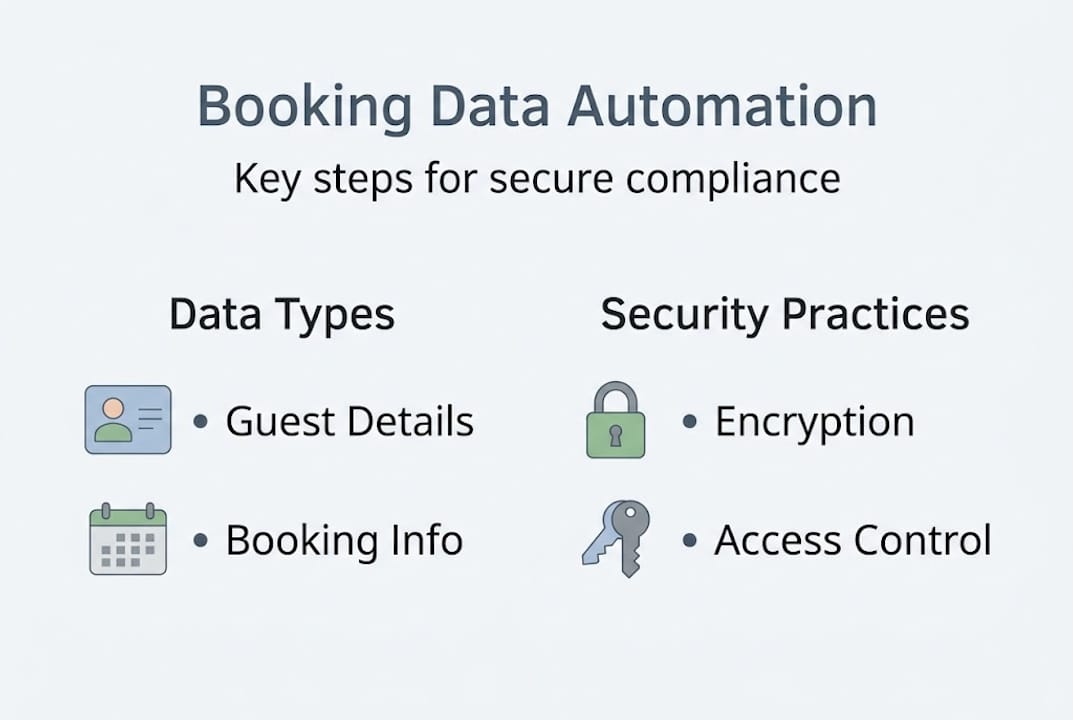
The following categories of data are usually captured and processed during a typical booking lifecycle:
- Personal identifiers: Full name, date of birth, nationality, and passport or ID number
- Contact details: Email address, phone number, and home address
- Booking details: Arrival and departure dates, number of guests, room or property type, and special requests
- Payment information: Card details or bank reference numbers, often handled via a secure payment gateway
- Compliance records: Copies of identity documents, signed terms and conditions, and any declarations required by local authorities
- Stay history: Previous bookings, preferences, and communication records used for guest experience improvements
The table below gives a quick overview of the main data types and their primary use:
| Data type | Primary use |
|---|---|
| Personal identifiers | Guest registration and government reporting |
| Contact details | Pre-arrival communication and emergency contact |
| Booking details | Reservation management and pricing |
| Payment information | Invoicing and fraud prevention |
| Compliance records | Legal reporting and audit trail |
| Stay history | Analytics and repeat guest experience |
This data underpins almost every business function. It supports smooth check-in and checkout, feeds booking data best practices across your portfolio, enables accurate government reporting, and informs the business insights that help you grow. Without reliable data processing, even a well-run property quickly runs into operational and legal trouble.
It is also worth noting that European regulations, particularly those governing short-term rentals, require property managers to submit specific guest details to local authorities within defined timeframes. In Spain, Italy, Portugal, and several other EU countries, failure to report guest data correctly can result in significant fines. Booking data processing is therefore not just an administrative task. It is a legal obligation with real consequences.
Why secure and compliant booking data processing matters
Understanding what booking data is gets you halfway there. The next step is recognising why handling it securely and compliantly is so critical. The risks operate on two levels: security threats and legal obligations. Both can cause serious damage if ignored.

The security risk
Data breaches are not a distant concern for the hospitality industry. Insecure data handling creates direct exposure to fraud, identity theft, and reputational harm. When booking data is compromised, guests become targets for phishing attacks and travel scams that are increasingly difficult to detect. For the property manager, the consequences extend further.
Consider what a breach can cost:
- Financial penalties: Regulators can impose fines reaching millions of euros under GDPR
- Reputational damage: Negative press and guest reviews can take years to recover from
- Operational disruption: Investigations, legal proceedings, and system overhauls consume enormous time and resource
- Loss of business licences: Local authorities may suspend operating permissions pending investigation
The comparison below illustrates the difference between secure and insecure data handling:
| Factor | Insecure handling | Secure handling |
|---|---|---|
| Data storage | Spreadsheets, unsecured email | Encrypted, access-controlled PMS |
| Submission method | Manual, prone to error | Automated, validated, timestamped |
| GDPR status | High risk of non-compliance | Fully compliant by design |
| Audit trail | Incomplete or absent | Complete and retrievable |
| Response to breach | Reactive, slow | Monitored, alert-based, fast |
The compliance obligation
GDPR sets the overarching framework for how personal data must be collected, stored, and processed across the EU and UK. But it is not the only rule you need to follow. National and regional travel regulations layer on top of GDPR, creating a complex web of obligations that varies from country to country.
“Compliance is not a one-time event. It is an ongoing commitment that requires regular review, updated policies, and systems capable of adapting to regulatory change.”
Maintaining data security in Europe demands that property managers implement access controls, use encrypted storage, maintain clear privacy policies, and ensure data is only retained for as long as legally required. Understanding booking data regulations across your operating jurisdictions is equally important, as what is required in France may differ substantially from what is required in Greece or Croatia.
Pro Tip: Always verify that your property management system (PMS) uses end-to-end data encryption and role-based access controls before onboarding it. Ask your provider for documentation of their GDPR compliance status and data processing agreements.
Secure, automated processing solutions significantly lower your exposure. They reduce manual errors, create reliable audit trails, and ensure that submissions reach the correct authorities within required timeframes. That peace of mind has real commercial value.
How automated solutions streamline booking data processing
Given the scale of the risks and the complexity of the obligations, it is clear why manual approaches to booking data processing are no longer adequate for most property managers. Automation changes the entire equation.
The core workflow
A well-designed automated booking data system follows a consistent, repeatable workflow:
- Data capture at booking: The guest submits their details through a digital check-in form or OTA integration. The system captures all required fields automatically.
- Validation: The platform checks the data for completeness and accuracy, flagging any missing or incorrect information immediately rather than hours or days later.
- Encrypted storage: Validated data is stored securely in a GDPR-compliant environment, with access restricted to authorised users only.
- Automated compliance reporting: The system generates and submits the required guest registration report to the relevant government authority, within the legally required timeframe, without manual intervention.
- Archiving and audit trail: All submissions are logged, timestamped, and retrievable for audit purposes, protecting you in the event of an inspection.
This workflow eliminates the most common failure points in manual processing. No more forgotten submissions, incomplete forms, or data sitting in an unencrypted email inbox.
Insecure or manual data practices remain a persistent vulnerability across the hospitality sector. Automating the process removes human error from the equation and replaces it with consistent, validated, documented outputs.
Key benefits of automation
Optimising booking data workflows through automation delivers measurable advantages:
- Time savings: Hours spent on manual data entry are replaced by minutes of review
- Error reduction: Automated validation catches mistakes before they become compliance failures
- Scalability: Whether you manage two properties or two hundred, the same system handles the load
- Real-time visibility: Dashboards give you an instant overview of submission status across your entire portfolio
- Regulatory agility: Built-in compliance updates mean the platform adapts to new legal requirements without you having to track every change
For those managing multi-property bookings, automation is not a convenience. It is a necessity. Keeping track of different reporting deadlines, authority portals, and data requirements across multiple jurisdictions manually is simply not sustainable.
Pro Tip: Choose an automated solution that includes built-in compliance updates as part of the service. Regulations across European countries change regularly, and a platform that does not stay current will create gaps in your compliance coverage without you even realising it.
Best practices for booking data processing in Europe
Automation provides the foundation, but good practice on top of that foundation is what keeps you genuinely protected. The following steps represent the standard that leading property managers hold themselves to across Europe.
Keep guests informed
Every guest has the right to know how their personal data will be used. Your privacy policy should clearly explain what data you collect, why you collect it, how it is stored, and how long it is retained. This is a basic GDPR requirement, but it also builds trust. Guests who understand their data is handled responsibly are more likely to return and recommend your property.
How guest booking information is communicated and presented to guests directly affects their confidence in your business. A short, clear privacy notice at the point of booking is both a legal requirement and a positive experience touchpoint.
Use encrypted, access-controlled systems
Do not store booking data in spreadsheets, shared drives, or email threads. These methods are inherently insecure and almost impossible to audit reliably. Use a dedicated PMS or guest registration platform that:
- Encrypts data both in transit and at rest
- Restricts access by user role, so only the right people see sensitive information
- Logs all access and changes for audit purposes
- Operates from secure, EU-based servers to satisfy data residency requirements
Audit your data handling regularly
Regulations evolve. What was compliant last year may not meet this year’s standards. Schedule a formal review of your data handling practices at least twice a year. Check that your current processes align with the latest guidance from national data protection authorities in every country where you operate.
GDPR compliance is an ongoing process, not a box you tick once at launch. Treat it as a routine part of your business operations, in the same way you would review insurance cover or fire safety procedures.
Retain data only as long as required
One of the most commonly overlooked best practices is data minimisation and retention limits. GDPR requires that personal data is not kept longer than necessary for the purpose for which it was collected. For most European jurisdictions, guest records must be retained for a set statutory period, often one to five years, then securely deleted. Your system should handle this automatically, flagging data that has reached its retention limit.
- Set clear retention periods for each data category
- Automate deletion workflows where possible
- Document your retention policy and make it available to guests on request
Reviewing booking data management tips periodically ensures your retention schedule stays aligned with current legal requirements.
Pro Tip: Periodically run a compliance checklist with your platform provider. Ask specifically about how they handle regulatory updates, data deletion, and breach notification procedures. A provider that cannot answer these questions clearly is a risk you should not take.
A fresh perspective: secure processing isn’t a luxury, it’s survival
Most conversations about booking data compliance focus on avoiding fines. That framing is too narrow. The real issue is whether your business is genuinely trustworthy, and whether you will still be operating in five years.
Conventional wisdom tends to treat data security as a cost of doing business, something to minimise and manage reactively. But the pace of threats has accelerated well beyond what reactive approaches can handle. Data breaches at major platforms are no longer rare events. They are part of the landscape. Property managers who wait for a breach to motivate action are, in effect, gambling with their guests’ safety and their own livelihood.
The properties that will thrive are those that treat secure, automated data processing as a baseline standard, not an upgrade. Guests increasingly ask about data practices before they book. They read reviews that mention privacy concerns. They trust brands that communicate openly. Data security has quietly become a market differentiator.
Exploring property data security lessons from across the industry makes one thing clear: the leaders do not just comply. They monitor, update, and improve continuously. That posture is what separates sustainable businesses from those that face avoidable crises. Start treating compliance as infrastructure, not administration.
Streamline compliance with automated booking data solutions
If this article has made one thing clear, it is that effective booking data processing requires more than good intentions. It requires the right systems working reliably in the background, every single day.

GuestAdmin.io is built precisely for this challenge. It automates the capture, validation, and submission of guest data to European authorities, handles GDPR-compliant archiving, and gives you a real-time dashboard across all your properties. No more juggling portals, spreadsheets, and paperwork. Explore our automated compliance solutions to see how straightforward compliant operations can be, or read more about automated guest registration to understand exactly how the process works in practice. Your next step towards stress-free compliance starts here.
Frequently asked questions
What types of booking data must property managers process for compliance?
Property managers must collect guests’ personal details, booking dates, payment information, and any documents required by local authorities, as defined by how booking information is managed across the hospitality sector.
How does automation reduce booking data mistakes?
Automation tools capture and validate data at each booking step, minimising human error and avoiding missed reporting deadlines, removing the inconsistency that manual data handling routinely introduces.
What laws affect booking data processing in Europe?
Managers must follow the General Data Protection Regulation (GDPR) alongside any country-specific guest registration rules, as outlined in the GDPR policy frameworks that apply across EU and UK jurisdictions.
What’s the risk of not properly securing booking data?
Fines, lost guest trust, and the possibility of business closure all result from inadequate data security, with insecure platforms demonstrating how quickly guest data can be exploited when proper protections are absent.
One Comment
Booking dashboard benefits for European rental managers
[…] to automate booking compliance from the point of data collection, and understand best practices for secure booking data processing before committing to a […]