

TL;DR:
- Non-compliance with European short-term rental regulations can result in fines up to €600,000 and listing removal.
- Hosts must register properties, submit monthly data, and ensure platform verification under EU Regulation 2024/1028, effective May 2026.
Non-compliance with short-term rental regulations across Europe can now cost you up to €600,000 in fines, yet many property owners still treat compliance as nothing more than a box-ticking exercise. The reality is far more demanding. EU Regulation 2024/1028 introduces a harmonised framework for short-term rental data collection and sharing, effective May 2026, with strict registration, reporting, and data obligations that affect every rental owner and manager operating in Europe. Whether you manage one apartment or a large portfolio, understanding exactly what these rules require is no longer optional.
Table of Contents
- What does legal compliance mean for short-term rentals?
- Key regulations and registration requirements in Europe
- Common pitfalls and how to avoid them
- Streamlining legal compliance with technology
- What most rental managers miss about compliance
- Streamline compliance with effortless guest management
- Frequently asked questions
Key Takeaways
| Point | Details |
|---|---|
| Registration numbers required | EU law now obliges hosts to obtain verified registration numbers for short-term rental listings wherever local schemes apply. |
| Severe penalties possible | Non-compliance can lead to fines from €500 right up to €600,000 and even removal from listing platforms. |
| Monthly activity reporting | From May 2026, platforms must submit monthly data via national digital entry points to comply with EU rules. |
| Technology reduces risk | Automation tools and SaaS software help property managers streamline compliance and avoid common pitfalls. |
| Continuous compliance needed | Staying compliant is an ongoing effort, not a single task—especially as rules evolve across Europe. |
What does legal compliance mean for short-term rentals?
Legal compliance in the context of short-term rentals is not simply about filling out forms. It covers a broad set of responsibilities: registering your property with the appropriate authorities, collecting and securely managing guest data, respecting local night caps and occupancy limits, and reporting booking activity on time. Get any one of these wrong, and the consequences can be serious.
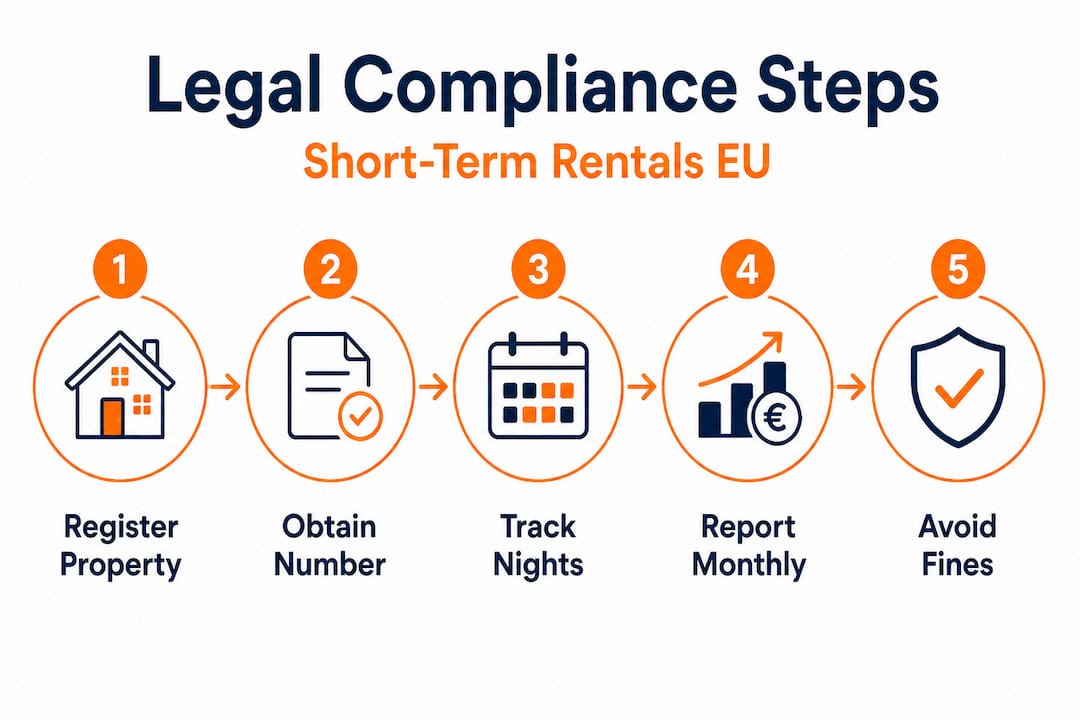
For European operators, compliance sits at two levels. First, there are national rules, which vary significantly from country to country. Italy, Spain, Portugal, France, and the Netherlands each have their own registration requirements, tax obligations, and local restrictions. Second, there is now a unified EU framework that sits above national rules and requires all member states to align their systems accordingly.
Under EU Regulation 2024/1028, hosts must obtain unique registration numbers where local schemes exist, and online platforms are required to verify those numbers before listings go live. This is a significant shift. Previously, platforms had little obligation to police the accuracy of host information. Now they share responsibility for ensuring compliance.
Key areas your compliance obligations cover:
- Property registration: Obtaining and displaying a valid registration number where required
- Guest data collection: Gathering accurate identification and stay details from every guest
- Activity reporting: Submitting monthly booking data to national authorities
- Local rule adherence: Respecting night caps, zoning restrictions, and licensing conditions
- Data protection: Handling all guest information in line with GDPR requirements
“Compliance is not a one-time task. It is an ongoing operational responsibility that affects your listing status, your legal standing, and ultimately your reputation as a host.”
The risk of misunderstanding these obligations is real. Hosts who assume that registration is only required in certain cities, or that platforms will handle reporting automatically on their behalf, often find themselves facing fines or sudden delisting. Our legal compliance guide Europe offers a detailed breakdown of what each obligation means in practice, and our short-term rental compliance explained resource sets out exactly where hosts most commonly go wrong.
Pro Tip: Even if your local authority has not yet activated a formal registration scheme, you should prepare your processes now. The EU framework expects all member states to be fully operational by May 2026, and the transition window is short.
Key regulations and registration requirements in Europe
Understanding compliance means knowing the specific rules that apply to you. The EU regulatory landscape for short-term rentals has shifted considerably, and the changes brought in by EU Regulation 2024/1028 are among the most significant in the sector’s history.
The regulation, effective from May 2026, requires monthly activity data sharing via Single Digital Entry Points, known as SDEPs. These are national portals through which platforms must submit data about every listing’s booking activity, including the number of nights let and the number of guests hosted. This is not voluntary. Platforms that fail to comply face penalties, and hosts who do not have valid registration numbers will find their listings blocked or removed.
Fines for non-compliance range from €500 to €600,000, with property delisting also on the table for serious or repeated violations. The exact level of penalty depends on the member state and the nature of the breach.

Country-specific registration requirements: A comparison
| Country | Registration required? | Night cap (where applicable) | Monthly reporting? |
|---|---|---|---|
| Italy | Yes, national CIN code | Varies by region | Yes |
| Spain | Yes, regional licence | Varies by municipality | Yes |
| France | Yes, in major cities | 120 nights per year | Yes |
| Portugal | Yes, ALOJAMENTO LOCAL | Varies by area | Yes |
| Netherlands | Yes, in Amsterdam | 30 nights per year | Yes |
| Germany | Yes, in Berlin | 90 nights per year | Yes |
Our registration guide for Europe walks through each country’s requirements in detail. If you manage properties in Italy specifically, our guide to Italy rental rules covers the national CIN code requirement and regional variations.
The steps to comply with EU and national registration requirements are:
- Identify which local registration scheme applies to each of your properties based on location and property type
- Submit your registration application to the relevant local or national authority, providing all required documentation
- Obtain and display your unique registration number on all listings across every platform
- Ensure platforms can verify your number by keeping registration details accurate and current
- Set up a process for monthly reporting, either manually through each SDEP portal or via an automated compliance platform
- Review your registration status regularly, particularly if you operate across multiple jurisdictions where rules evolve at different speeds
The level of complexity increases substantially when you manage multiple properties across different countries. Each market has its own regulatory timeline, its own SDEP, and its own interpretation of night caps. Our guide to navigating European regulations provides practical guidance for multi-market operators.
Key regulatory statistic: Night caps in Amsterdam sit at just 30 nights per year, meaning a property that is let for more than 30 nights annually is in breach of local rules, regardless of how well-registered it is.
Common pitfalls and how to avoid them
Even experienced property managers fall into compliance traps. The regulations are complex, the deadlines are tight, and local rules change more frequently than most managers realise. Knowing the most common mistakes is your first line of defence.
The most frequent pitfalls include:
- Missing monthly reporting deadlines: Many managers are not aware that data must be submitted monthly, not annually. Missing even one reporting cycle can trigger warnings or fines.
- Using outdated registration details: Registration numbers expire or need updating. A number that was valid last year may not be today.
- Failing to update listings after rule changes: When a municipality tightens its night cap or introduces a new data requirement, listings must be updated promptly.
- Ignoring guest data collection obligations: Some hosts collect minimal guest information, not realising that local police registration rules and GDPR both require specific data points for each guest.
- Assuming platforms handle everything: Airbnb, Booking.com, and other platforms verify registration numbers, but they do not submit activity data on your behalf in every jurisdiction. The responsibility often remains with the host.
- Managing compliance manually across multiple properties: Spreadsheets and manual reminders cannot scale. The more properties you manage, the greater the risk of human error.
Platforms can be fined for failing to remove non-compliant listings, and hosts face penalties for exceeding night caps or lacking proper registration. This shared liability model means platforms are increasingly proactive about removing listings that fall short of requirements.
To sidestep these pitfalls, focus on building a structured compliance calendar. Set fixed dates each month for reporting, schedule registration renewal reminders at least 60 days in advance, and audit your guest data collection process quarterly. Our top tips to stay compliant article offers a practical checklist, and if you want to see how compliance links directly to your occupancy rates, our tips to boost bookings guide makes the connection clear.
Pro Tip: If you manage properties in more than three locations, manual compliance tracking becomes unsustainable very quickly. Investing in automated tools at the three-property mark will save you considerably more time and money than waiting until a problem arises.
Streamlining legal compliance with technology
Avoiding pitfalls is much easier with the right tools in place. Technology has transformed what is possible for property managers who want to stay compliant without spending hours each week on administration.
Platforms must verify registration numbers and share activity data monthly in line with EU Regulation. The good news is that SaaS platforms designed for the short-term rental sector can handle a significant portion of this work automatically.
The core ways technology supports compliance are:
- Automated guest data capture: Digital check-in tools collect name, nationality, document number, and stay dates from every guest, with the data stored securely and ready for submission.
- Deadline tracking and reminders: Compliance dashboards flag upcoming reporting windows so you never miss a deadline, even across multiple jurisdictions.
- Secure data submission: Integrated platforms submit guest and booking data directly to national authorities via official SDEP portals, reducing the risk of errors or delays.
- Multi-property management: A single dashboard allows you to oversee compliance status for every property in your portfolio, flagging issues before they become violations.
- Audit trail maintenance: Every submission is logged and timestamped, providing a clear record if authorities request verification.
Technology features that support compliance
| Feature | Manual process | Automated solution |
|---|---|---|
| Guest data collection | Paper forms, manual entry | Digital check-in, auto-stored |
| Monthly activity reporting | Spreadsheet, manual portal submission | Auto-submission via SDEP integration |
| Registration renewal tracking | Calendar reminders, manual checks | Dashboard alerts, deadline tracking |
| Multi-property oversight | Separate spreadsheets per property | Unified compliance dashboard |
| GDPR-compliant data storage | Local file storage, variable security | Encrypted cloud storage, access controls |
Our guide to property management SaaS explains what to look for when evaluating platforms, and our overview of automation in rentals compliance shows exactly how automation reduces error rates across the reporting cycle.
For property managers with portfolios spanning multiple countries, the benefits of automation are particularly significant. Rather than logging into five different national portals every month, a well-integrated SaaS platform consolidates submissions into a single workflow, cutting administration time dramatically.
What most rental managers miss about compliance
Most conversations about compliance focus on the mechanics: get the registration number, submit the data, avoid the fine. That framing is not wrong, but it misses something important.
Compliance is a continuous operational process, not a task you complete once and forget. The managers who treat it as a one-off exercise are the same ones who get caught out when rules change mid-season or when a new local restriction applies retrospectively. Regulations in this sector are evolving every year, and the direction of travel is consistently towards greater scrutiny, not less.
There is also a less obvious cost to non-compliance that rarely gets discussed: the impact on trust. Guests increasingly check reviews and listing details carefully. A property that is suddenly delisted mid-booking cycle, or that appears on a platform without a valid registration number, raises immediate concerns. Repeat bookings and direct referrals depend on your reputation as a reliable, professionally managed host. A compliance failure does not just generate a fine. It can cause cancellations, negative reviews, and lasting damage to your standing.
On the positive side, hosts who invest in structured compliance processes often discover unexpected benefits. Automated guest data management, for example, produces detailed records that can inform pricing decisions, occupancy analysis, and seasonal planning. The essential compliance types that affect your property are also a useful framework for thinking about risk across your whole operation, not just the regulatory reporting piece.
The mindset shift we encourage is this: treat compliance as part of your service quality, not as a cost or a burden. Guests who have a smooth, professional check-in experience, who receive correct documentation, and who stay in a property that is properly registered and insured, are more likely to return and to recommend you to others. The operational rigour that compliance demands is, in many ways, the same rigour that produces excellent guest experiences.
Streamline compliance with effortless guest management
If the regulatory landscape feels complicated, the right software makes a genuine difference. GuestAdmin.io is built specifically for property owners and managers operating in Europe’s short-term rental market, with tools that automate guest data capture, registration tracking, and monthly reporting across all major platforms.
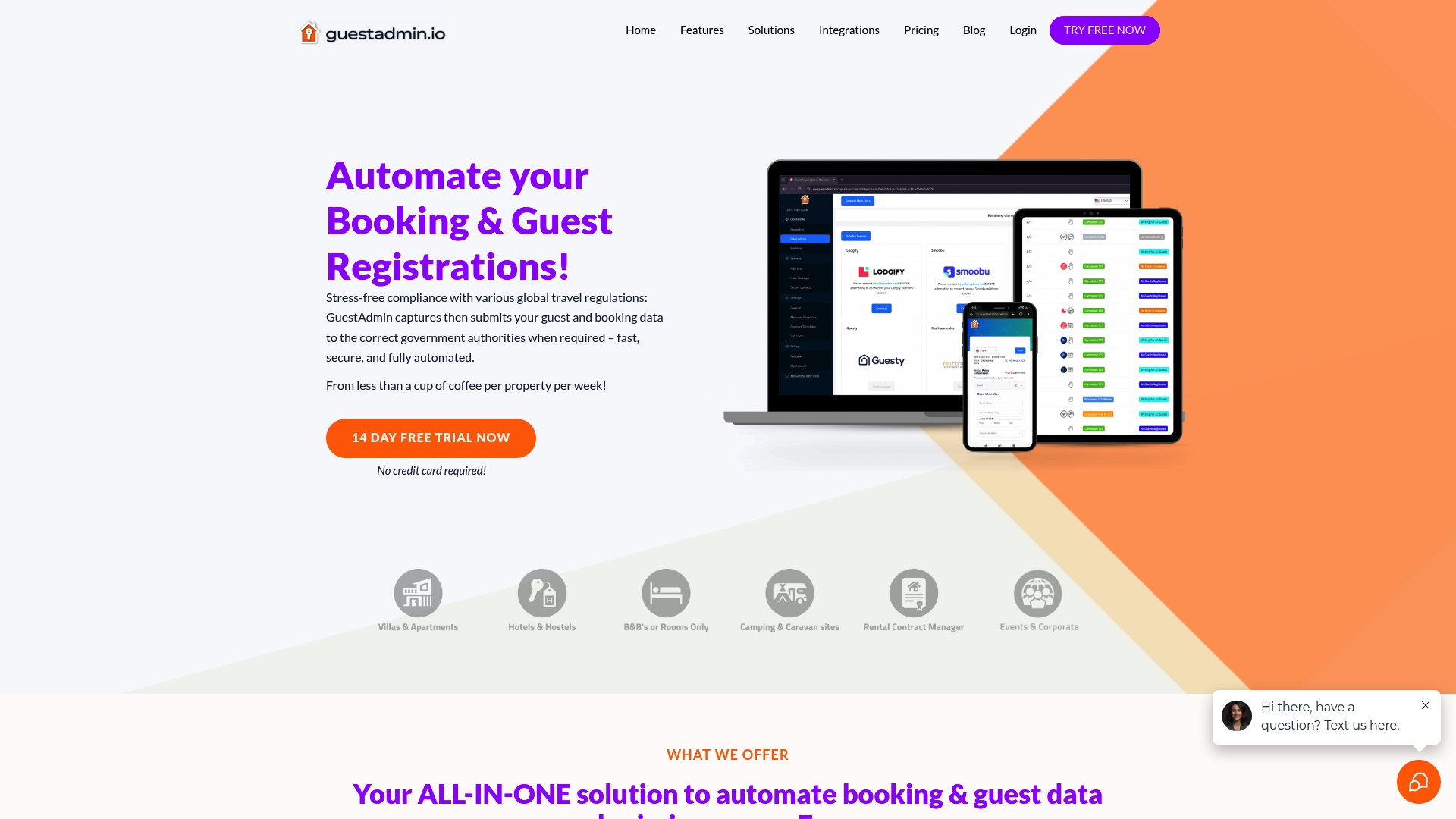
Whether you manage a single apartment or a multi-country portfolio, GuestAdmin.io removes the administrative burden of compliance without removing your control. You can avoid fines with compliance tips built into the platform, and use our full suite of tools to automate guest management from digital check-in through to secure SDEP data submission. With AI-powered processing, real-time dashboards, and GDPR-compliant data storage, staying compliant in 2026 does not have to mean spending hours on administration every month.
Frequently asked questions
What fines can short-term rental owners face for non-compliance?
Short-term rental owners can face fines ranging from €500 to €600,000, depending on the severity of the violation and local enforcement rules, with property delisting also a possible outcome.
Do all European countries require registration numbers for short-term rentals?
Registration numbers are required where local registration schemes exist, as mandated under EU Regulation 2024/1028, though implementation timelines vary by member state.
What is a Single Digital Entry Point (SDEP) in EU compliance?
An SDEP is a national portal through which platforms must submit monthly activity data for all short-term rental listings as required under EU Regulation 2024/1028, effective May 2026.
How can property managers automate compliance tasks?
Property managers can use dedicated SaaS platforms and automation tools to handle guest data collection, registration tracking, and monthly reporting efficiently, reducing both administrative burden and the risk of human error.
Can platforms such as Airbnb be fined for hosting non-compliant listings?
Yes. Platforms can be fined if they fail to remove non-compliant listings as required under EU Regulation 2024/1028 and applicable national rules, which is why platforms are increasingly strict about verifying registration numbers before listings go live.
One Comment
Your essential short-term rental compliance checklist for Europe
[…] cornerstone of legal compliance for rental owners in 2026 is EU Regulation 2024/1028. This regulation creates a harmonised framework across member […]