

TL;DR:
- European short-term rental managers face stricter regulations under EU law, requiring automated data capture and compliance tracking. AI tools help automate guest registration, data reporting, and registration management, reducing errors and saving time. Regional enforcement varies, but automation remains a legal necessity across European markets, offering a competitive edge.
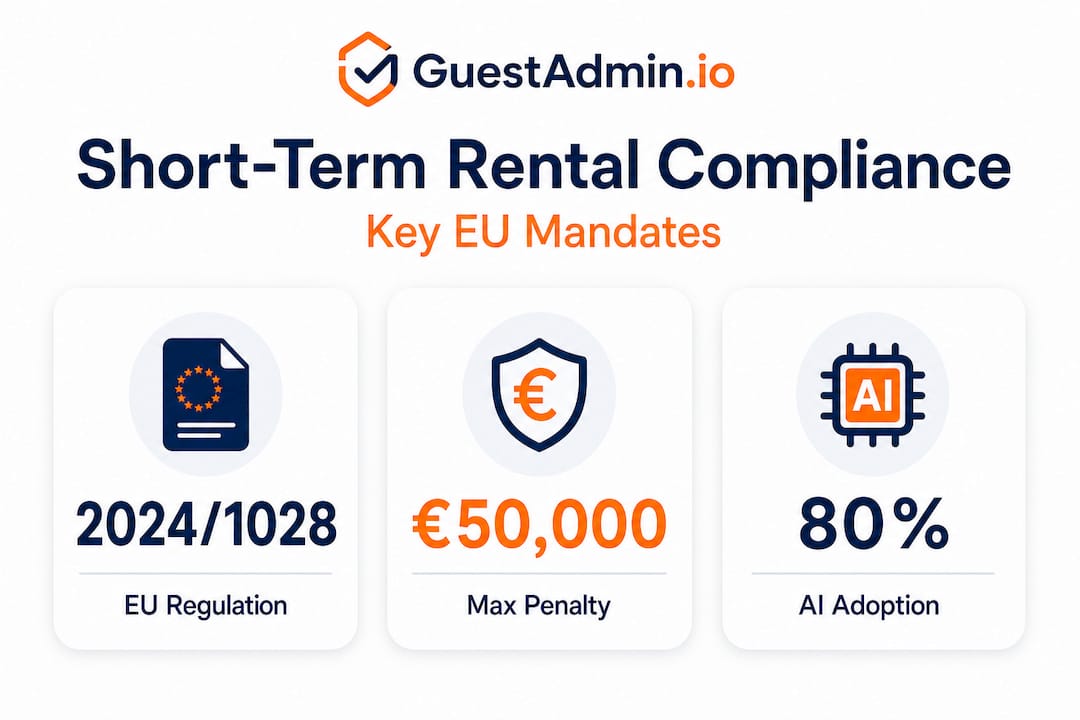
European short-term rental managers are operating under more scrutiny than ever before. Regulation (EU) 2024/1028 now mandates digital guest registration, unique property registration numbers on listings, monthly data sharing via Single Digital Entry Points (SDEPs), and platform verification, with penalties reaching €50,000 for non-compliance. Many property owners assume that full automation is either prohibitively expensive or technically out of reach. The reality is quite the opposite. AI tools are already transforming how managers handle compliance, and this guide explains exactly how you can put them to work.
Table of Contents
- Understanding the compliance landscape for short-term rentals
- How AI automates guest registration and data reporting
- GDPR and AI: Navigating privacy and data protection
- Regional adoption and barriers: What property managers must know
- The overlooked realities of AI-powered compliance
- Tools to make compliance and guest registration effortless
- Frequently asked questions
Key Takeaways
| Point | Details |
|---|---|
| New EU compliance rules | Digital guest registration and data sharing are now required for short-term rentals, with significant penalties for non-compliance. |
| AI adoption is mainstream | Over 60% of managers use AI tools to automate guest management and compliance tasks. |
| GDPR requires careful AI choices | Choose AI tools that minimise personal data, document processing, and handle breach notification to stay GDPR compliant. |
| Enforcement varies by region | Some countries enforce digital compliance and AI standards more strictly, so know your local rules. |
| AI is not just automation | Human oversight and tailored workflows are still essential for genuine compliance, not just technology adoption. |
Understanding the compliance landscape for short-term rentals
The rules governing short-term rentals across Europe have shifted considerably. Regulation (EU) 2024/1028 is the clearest signal yet that digital compliance is no longer optional. It applies to property owners, managers, and the platforms listing their properties, creating a chain of shared accountability that you need to understand thoroughly.
Understanding EU compliance terminology is the first practical step for anyone new to these regulations. The regulation introduces several core requirements that affect daily operations.
Key compliance requirements under Regulation (EU) 2024/1028:
- Digital guest registration: All guest data must be captured and stored digitally, replacing paper-based systems entirely.
- Unique registration numbers: Each short-term rental property must have a unique identifier displayed on all listings across platforms.
- Monthly data submissions: Hosts and platforms must share booking and guest data with national authorities via SDEPs on a monthly basis.
- Platform verification: Online platforms are required to verify that listed properties hold valid registration numbers before accepting bookings.
The consequences for falling short are not theoretical. Non-compliance penalties include fines of up to €50,000, delisting from major booking platforms, and suspension of your registration number, which effectively halts your rental business.
| Compliance requirement | Who is responsible | Deadline/frequency | Potential penalty |
|---|---|---|---|
| Digital guest registration | Property owner/manager | Per booking | Fines, legal action |
| Unique registration number | Property owner | At registration | Delisting |
| Monthly SDEP data sharing | Owner and platform | Monthly | Fines up to €50,000 |
| Platform verification | OTA/booking platform | Ongoing | Platform suspension |
It is also worth noting that enforcement varies considerably by country. Spain and Italy have been active in pursuing compliance breaches, whereas some northern European countries are still developing their enforcement infrastructure. That fragmentation does not reduce your risk. Even if local enforcement is light today, the regulatory framework exists and obligations are live.
Remember: Regulation (EU) 2024/1028 creates obligations for property owners and platforms simultaneously. If your listing is on a non-compliant platform, your registration number could still be affected.
Being clear on owner responsibilities in 2026 means understanding that compliance is ongoing, not a one-time task. Monthly submissions, renewed registrations, and accurate guest data capture all require consistent attention throughout the year.
How AI automates guest registration and data reporting
With the regulatory stakes clarified, let’s explore how AI is addressing these challenges directly and concretely.
AI adoption in short-term rentals currently sits at 60 to 70% among property managers overall, climbing above 80% for those managing portfolios of 50 or more properties. The tools being used span pricing engines, automated messaging, and increasingly, compliance and guest registration workflows.
AI handles several key tasks that would otherwise consume significant staff time.
Tasks commonly automated by AI in short-term rental compliance:
- Digital check-in: Guests receive automated pre-arrival links to submit identification documents, contact details, and travel information before they arrive.
- Identity verification: AI-powered systems cross-check submitted documents against booking data, flagging discrepancies for human review.
- Data formatting and upload: Guest data is automatically structured in the format required by national authorities and submitted to the relevant SDEP portal on schedule.
- Registration number management: AI tools can monitor registration status, alert managers to renewals, and ensure registration numbers appear correctly on all active listings.
- Booking data aggregation: Where managers operate multiple properties across different platforms, AI consolidates data from all sources into a single compliant record.
The workflow change is significant. A property manager running 20 apartments across Lisbon, Barcelona, and Rome would previously have needed to manually log into three separate government portals, format three different data sets, and track three renewal calendars. AI removes the repetition entirely.
Here is a practical example of how AI-powered compliance works step by step:
- Guest books via an OTA platform.
- An automated message requests identity documents and travel details.
- AI verifies the submitted information and flags issues if found.
- Guest data is stored in a GDPR-compliant archive.
- At month end, the system compiles all required fields and submits data to the relevant SDEP automatically.
- A confirmation record is saved for audit purposes.
Thinking carefully about data security in rentals is essential here. Automating data collection does not reduce your responsibility for how that data is stored and protected. It simply shifts where attention needs to be focused, from manual entry to oversight and security configuration.
Pro Tip: Integrate your AI compliance tool directly with local authority portals rather than exporting and uploading files manually. Most modern platforms support API connections that handle submissions without any manual intervention, significantly reducing the risk of missed deadlines or formatting errors.
Understanding GDPR automation is equally important when setting up these workflows, because the data you collect is personal data, and the rules around how it must be handled are strict.
GDPR and AI: Navigating privacy and data protection
As AI tools grow in rental operations, it is vital to address the legal and privacy responsibilities they trigger. GDPR does not disappear when you automate. If anything, AI processing of personal data makes GDPR compliance more important to get right from the start.
Key GDPR obligations when using AI for guest data:
- Data minimisation: Collect only the guest data you genuinely need for registration and legal compliance. Do not retain unnecessary fields.
- Lawful basis: Document the legal basis for each category of data you process. For guest registration, this is typically a legal obligation under national or EU law.
- Data Protection Impact Assessment (DPIA): When using AI to process personal data at scale, a DPIA is required to assess and mitigate privacy risks.
- 72-hour breach notification: If guest data is compromised, you must notify the relevant supervisory authority within 72 hours of becoming aware of the breach.
- Right to erasure: Guests can request that their data be deleted after the legal retention period ends. Your AI system must be able to action these requests.
A key question for many managers is whether to use a cloud-based AI solution or an on-premise system. Both have genuine trade-offs.
| Factor | Cloud AI | On-premise AI |
|---|---|---|
| Sub-processor exposure | Higher; data passes through third-party infrastructure | None; data remains on your own servers |
| Setup complexity | Low; typically SaaS onboarding | High; requires IT infrastructure |
| Maintenance | Managed by provider | Managed in-house |
| Scalability | High; scales with bookings | Limited by hardware |
| Cost | Subscription-based | Higher upfront investment |
| GDPR compliance effort | Requires robust DPA agreements with providers | Simpler data flow to document |

Cloud AI increases sub-processor risks compared to on-premise solutions where no sub-processors handle your data. For most small to medium property managers, cloud solutions remain the practical choice, provided you sign proper Data Processing Agreements (DPAs) with every third-party tool involved.
Pro Tip: Maintain a clear, written record of your data flows. Map every system that touches guest data, from booking platform to ID verification tool to government portal. This document is essential if you face a GDPR audit or a data breach investigation.
Overlooking data security in favour of speed is one of the most common mistakes managers make when implementing AI tools. Automation should speed up compliant processes, not bypass necessary safeguards.
Regional adoption and barriers: What property managers must know
With privacy and compliance foundations set, let’s look at regional enforcement and practical adoption across Europe.
Enforcement of digital guest registration is not uniform. Spain and Italy lead enforcement in digital guest registration compliance, with established government portals and active inspection regimes. France, Portugal, and Greece are advancing quickly. In contrast, some eastern and northern European markets are still building the administrative infrastructure needed to receive and process digital submissions consistently.
This fragmentation matters practically because the SDEP portal you submit data to, the format required, and the frequency of reporting may all differ depending on the country where your property sits.
| Region | Enforcement maturity | AI tool adoption (estimated) | Main barriers for small operators |
|---|---|---|---|
| Spain | High | High | Technical setup, language barriers |
| Italy | High | Medium to high | Legacy processes, documentation requirements |
| France | Medium to high | Medium | Platform integration complexity |
| Portugal | Medium | Medium | Smaller operator awareness |
| Germany | Medium | Medium | Data privacy concerns |
| Eastern Europe | Low to medium | Low to medium | Limited SDEP infrastructure |
For smaller operators, the primary barrier is not cost. It is the initial technical setup required to connect booking platforms, configure data fields correctly, and test submissions against government portals. Many smaller managers also lack dedicated IT or compliance staff, meaning the person configuring the system is also the person managing bookings, cleaning rosters, and guest communications.
Common barriers to AI adoption for smaller property managers:
- Limited time for initial platform configuration
- Unfamiliarity with API integrations and webhooks
- Uncertainty about which data fields satisfy national requirements
- Concerns about storing sensitive guest data securely
- Budget constraints around subscription fees for compliance software
This is where purpose-built platforms genuinely earn their value over generic tools. A compliance-specific solution arrives pre-configured for the most common national submission formats, significantly reducing the setup burden.
Worth knowing: Even if your local authority does not yet actively enforce monthly SDEP submissions, your listing platforms are themselves subject to verification requirements. Non-compliant listings can be removed by the platform before any government action occurs.
Investing in guest experience technology alongside compliance tools also pays dividends, as guests increasingly expect seamless digital check-in and communication as a standard part of the short-term rental experience.
Reviewing compliance examples from comparable operations can help you benchmark where your current workflows stand and identify the specific gaps that need addressing before enforcement in your region intensifies.
The overlooked realities of AI-powered compliance
There is a genuine risk that the excitement around AI leads property managers to over-rely on tools and under-invest in the knowledge and processes that make those tools work properly.
AI does not replace staff knowledge. It amplifies it. A system configured by someone who does not understand the underlying regulatory requirements will produce automated errors at scale rather than manual ones. That is a worse outcome, not a better one. The managers who gain the most from AI compliance tools are those who have first invested in understanding what the regulation actually requires, and then configured the tools to match.
Custom configuration matters more than most vendors acknowledge. Default settings may satisfy the most common compliance scenario but miss national quirks. Italy requires specific document types for non-EU guests. Spain’s rental portal uses a particular XML format that differs from the general SDEP specification. Portugal has distinct obligations for seasonal versus year-round rentals. These details do not emerge from a standard software demo. They emerge from operating in the market, reading the regulation carefully, and testing submissions against the actual portal.
Employee training is the other underrated variable. If your team does not know why the AI is flagging a particular booking or what to do when a guest’s ID fails verification, the system stalls. Automation handles routine cases well. It is the edge cases that require human judgement, and those edge cases are common enough to matter.
The managers who treat AI as a shortcut to compliance without investing in workflow design and ongoing oversight will find themselves exposed. Those who treat AI as an enabler for a well-designed compliance process will find real competitive advantage in the form of fewer errors, lower administrative costs, and stronger relationships with the platforms and authorities they report to.
Boosting bookings through compliance is a genuine outcome for well-run operations, because platforms prioritise verified, compliant listings in their search results. Compliance is not just a legal obligation. It is a commercial advantage when done consistently and well.
Tools to make compliance and guest registration effortless
If you are managing short-term rentals across Europe and still juggling portals, spreadsheets, and manual submission reminders, the tools exist to change that entirely.

GuestAdmin.io is purpose-built for European compliance, designed specifically to handle the digital guest registration, data archiving, and monthly SDEP submissions that Regulation (EU) 2024/1028 requires. It connects with the booking platforms and PMS tools you already use, processes guest data automatically, and ensures submissions reach national authorities within 24 hours. You can learn more about how to avoid fines and save time through automated processes. The platform’s automated guest registration capability handles identity capture, verification, and archiving without manual input from your team. For managers ready to automate guest management across multiple properties, a free demo is available to walk you through the full workflow.
Frequently asked questions
What are the penalties for failing to digitise guest registration in Europe?
Penalties under Regulation (EU) 2024/1028 can include fines of up to €50,000, removal of listings from booking platforms, and suspension of your property’s registration number, effectively preventing new bookings.
Is AI adoption only for large property management companies?
No. While adoption exceeds 80% for managers with portfolios of 50 or more properties, the overall adoption rate across all managers currently sits at 60 to 70%, including many smaller operators who use AI tools for routine operational tasks.
How can I ensure GDPR compliance when using AI for guest data?
Practise data minimisation, document your lawful basis for processing, complete a DPIA before deploying AI at scale, ensure 72-hour breach notifications are built into your incident response plan, and evaluate on-premise options if sub-processor exposure is a concern.
Which European countries are most advanced in enforcing digital guest registration?
Spain and Italy are currently ahead in terms of enforcement maturity and established digital submission infrastructure, with France and Portugal following closely behind in building out their compliance frameworks.