

TL;DR:
- Many property managers misuse PMS as a simple booking tool, leading to costly operational gaps. Properly configured PMS systems unify reservations, billing, housekeeping, and compliance reporting, ensuring efficient and accurate workflows across Europe. Automation with a dedicated PMS like GuestAdmin.io safeguards licenses, streamlines guest registration, and prepares managers for upcoming regulations.
Many property managers treat their property management system (PMS) as little more than a booking inbox or guest messaging tool. That misunderstanding is costly. The role of PMS in hospitality is far broader: it connects reservations, billing, housekeeping, guest data, and regulatory reporting into one coordinated workflow. For short-term rental managers operating across Europe, where compliance requirements are tightening rapidly, a well-configured PMS is the difference between confident operations and constant firefighting. This guide explains exactly what PMS does, why it matters for EU compliance, and how to use it as a genuine operational foundation.
Table of Contents
- How property management systems unify hospitality operations
- PMS and compliance with European short-term rental regulations
- Navigating guest data management and registration with PMS
- Multi-property management challenges and PMS solutions
- Benefits of PMS automation for property managers
- Why PMS is the unsung hero of compliant hospitality management
- Streamline your hospitality compliance with GuestAdmin.io
- Frequently asked questions
Key Takeaways
| Point | Details |
|---|---|
| Central role of PMS | A property management system is the operational backbone connecting all hotel workflows in real time. |
| Compliance automation | PMS assists in meeting EU rental regulations by automating standardized monthly data reporting to authorities. |
| Separate registration step | Distinguishing guest check-in from legal registration improves data accuracy and reduces audit risks. |
| Multi-property complexity | Managers must map PMS data fields to diverse national requirements to ensure compliance across countries. |
| Operational efficiency | Automation with PMS cuts errors, saves staff time, and turns compliance into proactive business practice. |
How property management systems unify hospitality operations
In hospitality operations, a PMS acts as the central operating system for day-to-day workflows including reservations, front desk, housekeeping, billing, and reporting. That single sentence carries more weight than it might first appear. When each of those functions lives in a separate tool or spreadsheet, data drifts out of sync. Overbookings happen. Invoices go out with wrong figures. Cleaning teams work from yesterday’s information.
A well-configured property management SaaS platform eliminates that fragmentation. Here is what each layer of unification looks like in practice:
- Reservations: Bookings from direct channels, OTAs, and phone calls feed into a single availability calendar, so what you see is always what guests can book.
- Front desk: Check-in and check-out processes are managed from one dashboard, with automated notifications reducing the need for manual handoffs.
- Housekeeping: Room or unit status updates in real time as check-outs are recorded, giving cleaning teams accurate task lists without phone calls.
- Billing: Automated invoice generation tied to booking details reduces arithmetic errors and speeds up payment collection.
- Reporting: All activity is logged centrally, making it straightforward to produce occupancy reports, revenue summaries, and compliance-ready data exports.
| Operational area | Without PMS | With PMS |
|---|---|---|
| Availability management | Manual updates across channels | Automated real-time sync |
| Guest data capture | Scattered across forms and emails | Centralised and searchable |
| Housekeeping coordination | Phone calls and paper lists | Live status dashboard |
| Billing accuracy | Prone to manual errors | Automated from booking data |
| Compliance reporting | Ad hoc and time-consuming | Structured and exportable |
Pro Tip: Before evaluating any PMS, map out every manual task your team currently performs around a guest stay, from booking confirmation to post-checkout reporting. That list reveals exactly which integrations and automations you need, and saves you from buying a system that solves the wrong problems.
PMS and compliance with European short-term rental regulations
Understanding how PMS powers operations leads naturally to its critical role in automating regulatory compliance for rentals across Europe. The regulatory landscape has changed significantly. Regulation (EU) 2024/1028 creates the EU Single Digital Entry Point (SDEP), requiring standardised data collection and monthly activity reporting, with full effect from May 2026.
The SDEP is essentially a shared reporting infrastructure that connects national authorities across all EU member states. Instead of filing separate reports with different portals in different formats, property managers will eventually submit standardised data through one framework. But the data must still be accurate, timely, and correctly formatted for each country’s requirements. That is where PMS plays a decisive role.
A PMS configured for European rental compliance can handle the following automatically:
- Pull booking and guest data from all connected channels after each stay.
- Format that data according to the required national or SDEP schema.
- Generate monthly activity reports without manual compilation.
- Store registration numbers and licence identifiers alongside the relevant property records.
- Flag missing or incomplete guest data before submission deadlines.
The penalty for late or incorrect filing varies by country, but in several EU jurisdictions, repeated non-compliance can result in licence suspension. Automation does not just save time; it actively protects your operating licence.
Pro Tip: Check whether your current PMS allows you to export guest data in a structured format such as JSON or XML. If it only offers CSV exports, you may face additional manual formatting work to meet SDEP-compatible data standards.
Navigating guest data management and registration with PMS
With compliance needs clarified, focus shifts to how PMS specifically manages the crucial guest data and registration steps. There is a distinction that many property managers overlook, and it causes real compliance problems: check-in and registration are not the same thing.
Check-in is the physical process of a guest arriving and receiving access to the property. Registration is the formal legal act of submitting guest identity data to the relevant authority within the required timeframe. Conflating the two leads to errors because separating check-in from registration reduces errors, since registration data timestamp and completeness are what regulators actually evaluate.
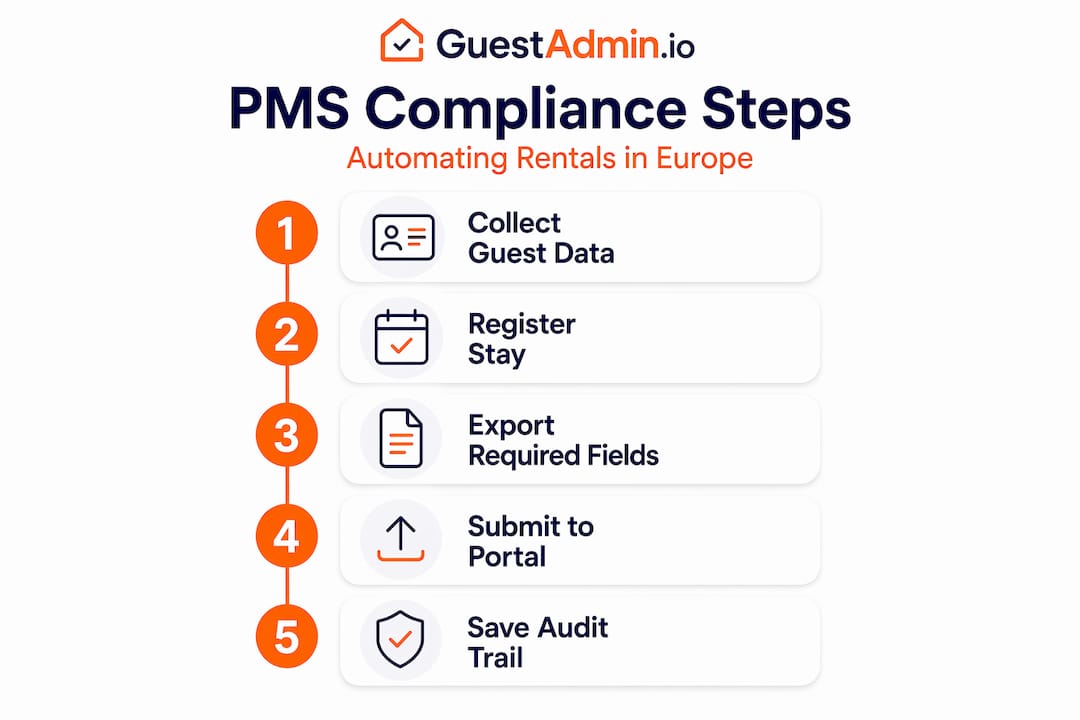
Here is how a properly configured PMS handles both steps:
- ID capture at booking or arrival: Guest identity documents are collected digitally, either during online check-in or at arrival, and stored securely within the PMS.
- Data validation: The system checks for required fields such as nationality, document type, document number, and date of birth before allowing submission.
- Timestamped submission: Registration data is sent to the relevant authority within the legally required window, with the exact timestamp recorded in the PMS audit log.
- Confirmation storage: The authority’s confirmation or reference number is saved against the guest record for future retrieval.
- Audit trail maintenance: Every action taken on that guest record is logged, so you can demonstrate compliance during an inspection without scrambling for paperwork.
For guest data compliance, the audit trail is arguably more important than the submission itself. Authorities do not just want to know that you filed; they want to see when you filed and what data you submitted. A PMS that logs this automatically turns a potential inspection headache into a five-minute task.
Pro Tip: Set up automated reminders within your PMS for any guest registration that has not been completed within two hours of check-in. That buffer catches missing data before it becomes a compliance issue, without requiring manual monitoring.
Multi-property management challenges and PMS solutions
Having outlined guest data processes, it is worth examining the specific complexity that comes with managing multiple properties across different European countries. Each EU country demands slightly different guest data fields, formats, and submission windows. Multi-property operators face data mapping issues because country portals have differing guest ID, nationality, and address schemas, and PMS platforms must be tested for jurisdiction-specific compatibility.

The most common mistake is assuming that a single data export template will satisfy all national portals. It will not. Spain requires a parte de viajeros (traveller report) with specific fields. Italy requires guest registration through the Alloggiati Web portal with its own format. Portugal, France, and the Netherlands each have distinct requirements. A generic export fails at least one of them.
| Country | Primary reporting portal | Key specific requirement |
|---|---|---|
| Spain | Ministerio del Interior system | Parte de viajeros format, including document type code |
| Italy | Alloggiati Web | Specific nationality codes and document type taxonomy |
| Portugal | SEF/AIMA system | Submission within three days of check-in |
| Netherlands | Municipalities directly | Overnight stay registration with tax reporting |
| Germany | Meldegesetz (local) | Registration form varies by municipality |
A multi-property management workflow that works across these jurisdictions requires a PMS with per-country data mapping, meaning you define the field relationships between your PMS data structure and each country’s submission requirements. It also requires testing. Do not assume mapping is correct until you have run a test submission and confirmed that the receiving portal accepted the data without errors.
- Use a PMS that allows custom field mapping per property or jurisdiction.
- Maintain a separate compliance checklist for each country where you operate.
- Test integrations after any PMS update, because software changes can break field mappings silently.
- Audit your OTA data feeds regularly, as platforms sometimes change how they pass guest information to connected systems.
Benefits of PMS automation for property managers
After exploring complex compliance workflows, it is useful to see how PMS automation improves daily outcomes across the board, not just at compliance deadlines.
- Fewer manual errors: Every field that a human no longer types is a field that cannot be mistyped. Automated data flows from booking to registration to reporting eliminate the most common source of compliance failures.
- Time recovered for guest experience: Property managers who spend less time on data entry and report compilation spend more time on the work that actually influences reviews and repeat bookings.
- Real-time data consistency: When a booking is modified or cancelled, the change propagates across all connected systems instantly. Guest-facing communications, housekeeping schedules, and compliance records all reflect the same current state.
- Proactive compliance rather than reactive panic: Automation readiness is the practical milestone for May 2026, requiring accurate identifiers and SDEP-compatible monthly data feeds. Managers who automate now will meet that deadline without disruption.
“Effective systems maintain auditable submission trails that transform compliance into retrievable proof during inspections.”
Compliance logs also have a secondary benefit that many managers do not consider until they need it: they are evidence in disputes. If a guest claims they were not registered, or an authority questions whether a report was filed, a timestamped audit trail resolves the matter quickly. Without it, you are relying on memory and email threads.
The shift from reactive to proactive compliance is perhaps the most significant property management automation trend of the current period. Managers who treat compliance as a monthly crisis will struggle as requirements become more frequent and more standardised under the SDEP framework.
Why PMS is the unsung hero of compliant hospitality management
There is a tendency in the short-term rental industry to treat technology investments as tactical purchases: a tool for messaging, a tool for pricing, a tool for cleaning schedules. PMS gets categorised alongside those point solutions, which severely underestimates what it actually does.
The key insight is that a PMS is the single source of truth connecting reservations, billing, housekeeping, and guest profiles for confident compliance workflows. That is not a feature; it is an architectural advantage. When all your operational data originates from one place, compliance becomes a byproduct of good operations rather than a separate workstream.
Most managers who underinvest in PMS do so because the cost of a good system feels significant compared to doing things manually. But the true cost of manual compliance is spread across dozens of hours each month, across every error that triggers a fine, and across every audit that requires reconstructing records from multiple sources. Innovative IT solutions for hospitality consistently show that the return on investment from proper system integration far outweighs the upfront configuration cost.
For managers running multi-property portfolios, the case is even clearer. The operational complexity of ten properties across three countries cannot be managed with spreadsheets and manual submissions. It requires a system that holds all property records, guest data, and compliance logs in one place, with the flexibility to adapt to each jurisdiction’s requirements. That is what a properly deployed PMS provides. Treating it as anything less is leaving operational risk on the table.
Streamline your hospitality compliance with GuestAdmin.io
If this article has shown you anything, it is that the role of technology in hospitality goes well beyond basic booking management. Compliance is now a core operational function, and it requires purpose-built tools.
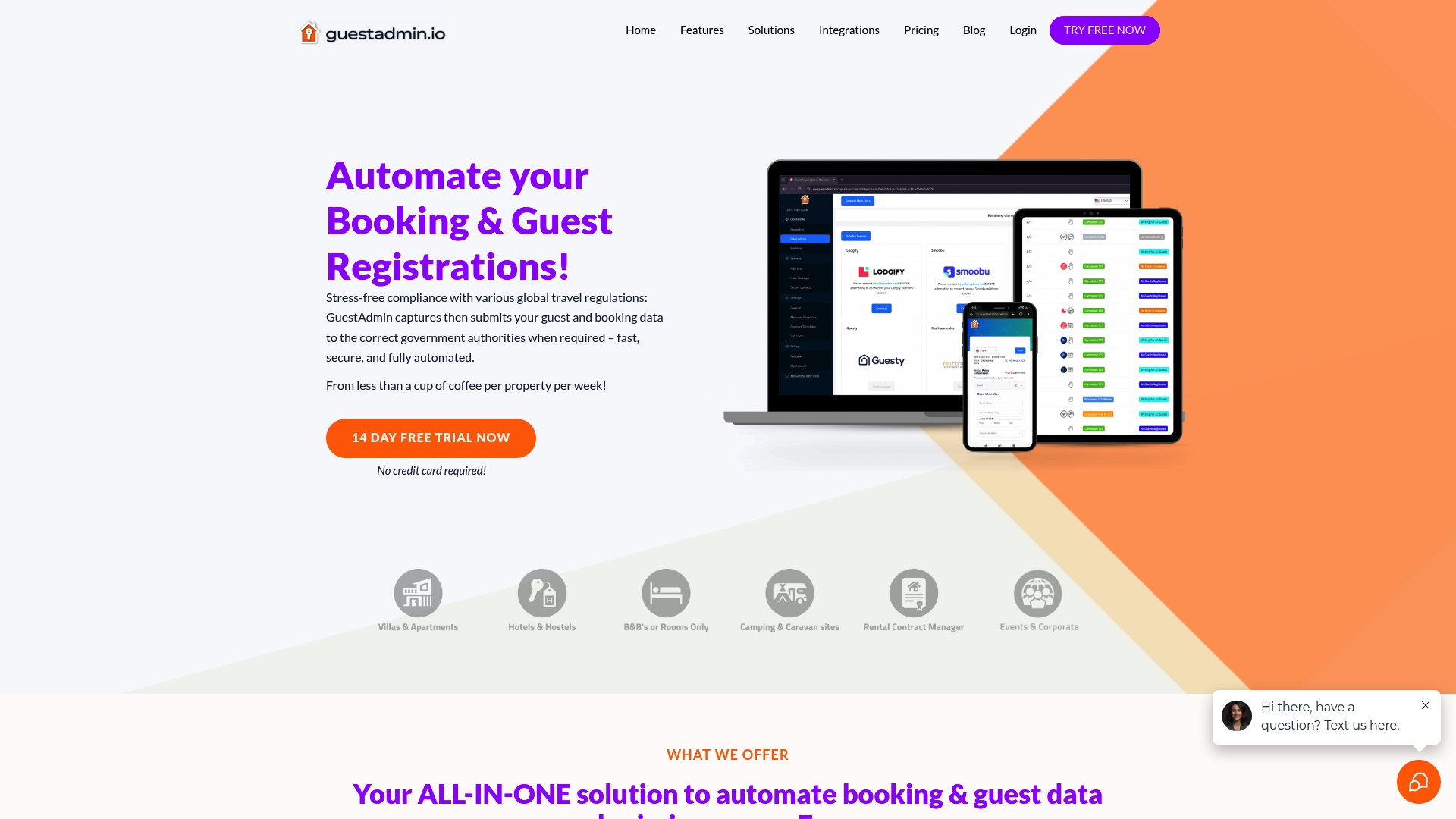
GuestAdmin.io is built specifically for property owners and managers operating short-term rentals across Europe. It automates guest registration and ID verification, generates EU-compliant monthly reports, and submits data to the relevant authorities within 24 hours. Whether you manage one property or fifty, the centralised dashboard gives you full visibility across your portfolio, with alerts for missing data and upcoming deadlines. No more juggling portals, spreadsheets, and paperwork. If you are preparing for the May 2026 SDEP requirements or already dealing with multi-country multi-property compliance workflow complexity, start with short-term rental compliance explained to see exactly where GuestAdmin.io fits into your operations.
Frequently asked questions
What is the primary role of a PMS in hospitality?
A PMS serves as the central system managing reservations, guest check-in/out, billing, housekeeping, and reporting to support daily hotel and rental operations. As day-to-day workflows grow more complex, centralisation becomes essential rather than optional.
How does PMS help in complying with EU short-term rental regulations?
PMS can automate data collection and reporting required by Regulation (EU) 2024/1028, submitting standardised monthly reports through the EU Single Digital Entry Point from May 2026 onwards.
Why is separating check-in and guest registration important?
Legal compliance focuses on the timestamp and completeness of guest registration data, not the moment of physical arrival. Keeping both processes separate reduces error rates and simplifies regulatory audits considerably.
What challenges do multi-property managers face with PMS data?
Differences in national data schemas for guest ID, nationality, and address fields mean that a single generic export rarely satisfies all country portals. Per-jurisdiction mapping and testing are essential for accurate regulatory reporting.
How can automation improve compliance workflows?
Automation reduces manual errors, keeps data consistent across platforms, and builds auditable logs that serve as retrievable proof during authority inspections, turning compliance from a reactive task into a reliable daily process.
One Comment
Hospitality industry digitalization explained for managers
[…] managers gain real-time visibility across bookings, housekeeping, and billing from any device. Cloud PMS adoption boosts operational efficiency by up to 30%, making it the single most impactful first step for most […]