

TL;DR:
- Data security in hospitality involves protecting guest and operational data throughout its entire lifecycle from unauthorised access, loss, or misuse. It requires implementing layered technical controls, risk assessments, staff training, and regulatory compliance, particularly with GDPR and PCI DSS standards. A risk-based approach and continuous vigilance are essential to address common vulnerabilities like staff turnover, legacy systems, and vendor integrations, fostering trust and operational resilience.
Understanding what is data security in hospitality is no longer optional for property owners and managers. Every guest registration captures passport numbers, payment details, and personal contact information. Every booking system, Wi-Fi network, and IoT device holds data that hotels face as cyber targets. A single breach can mean regulatory fines, reputational damage, and lost guest trust. This guide explains the core concepts, legal obligations, and practical controls you need to protect guest information and keep your operation compliant.
Table of Contents
- Key takeaways
- What is data security in hospitality
- Regulatory obligations you must understand
- Practical security measures for guest data
- Common pitfalls and real-world vulnerabilities
- A risk-based approach to data security
- My perspective on hospitality data security
- Protect your properties with the right tools
- FAQ
Key takeaways
| Point | Details |
|---|---|
| Data security spans all systems | Hotels must protect guest data across PMS, payment, Wi-Fi, and IoT systems, not just databases. |
| GDPR and PCI DSS apply together | Legal and payment card frameworks require documented controls, encryption, and incident response plans. |
| Human error is a top risk | Staff training and strict access controls are as critical as technical safeguards. |
| Risk-based approach is required | Prioritise controls proportionate to the likelihood and impact of each specific threat. |
| Automation reduces compliance burden | Purpose-built software helps centralise, secure, and automate guest data management across properties. |
What is data security in hospitality
Data security in hospitality refers to the policies, technical controls, and organisational practices that protect guest and operational data from unauthorised access, loss, or misuse. It covers the full lifecycle of that data: from the moment a guest provides their passport at check-in to the point that record is securely archived or deleted.
The types of personal data held by a typical hotel or short-term rental property are far more sensitive than most industries handle day-to-day. They include:
- Passport and identity document details collected for registration and immigration compliance
- Payment card data processed through point-of-sale and online booking systems
- Booking records containing names, dates, special requests, and contact information
- Behavioural data from loyalty programmes, Wi-Fi usage, and in-room devices
- Staff and vendor records held in HR and procurement systems
The systems involved span property management systems (PMS), online travel agency (OTA) integrations, payment processors, guest-facing Wi-Fi networks, and increasingly, IoT devices such as smart locks and connected thermostats. Each of these represents a potential entry point for attackers.
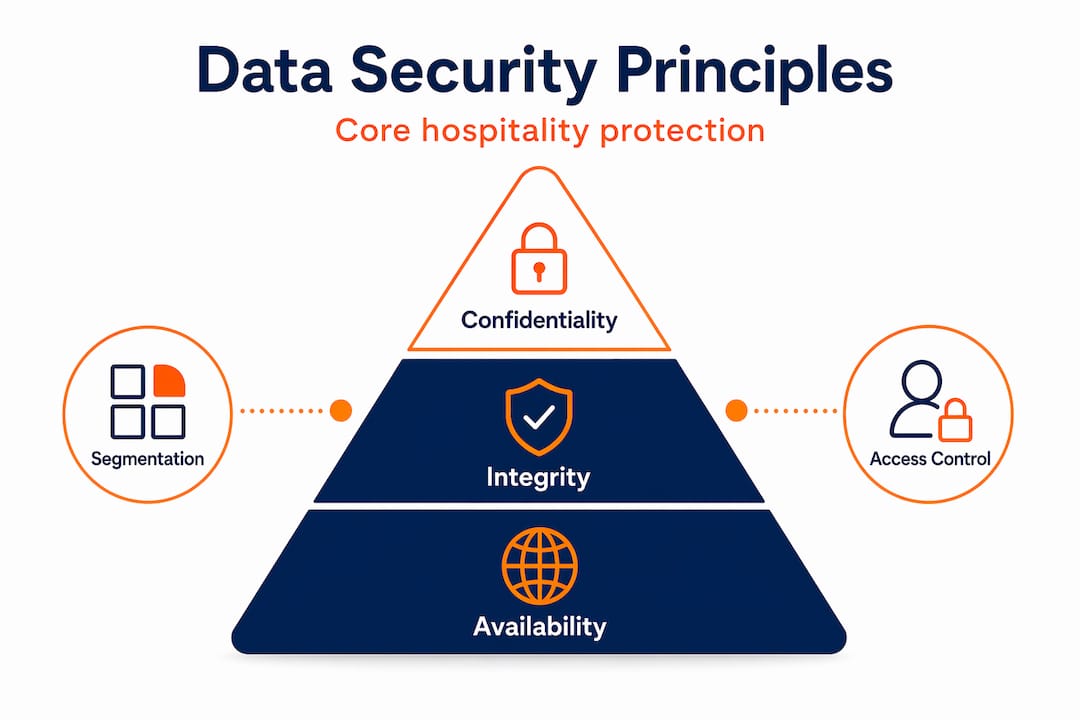
Data security is typically defined around three principles: confidentiality (only authorised parties access data), integrity (data remains accurate and unaltered), and availability (data is accessible when needed). In hospitality, all three matter. A ransomware attack that locks your PMS at peak check-in is an availability failure as much as a confidentiality one.
Network segmentation is one example of a control that addresses all three principles by isolating guest Wi-Fi and IoT devices from operational networks, limiting how far an attacker can move if they gain access through a connected device.
Regulatory obligations you must understand
The legal framework governing data protection in hotels is built on two primary pillars: the GDPR and the PCI DSS. Both carry significant compliance requirements and real consequences for non-compliance.
GDPR Article 32 requires that any organisation processing personal data applies technical and organisational measures proportionate to the risk. For hotels and property managers, this means documented risk assessments, pseudonymisation where appropriate, and the ability to demonstrate resilience. It is not a tick-box exercise. The regulation explicitly requires you to test, assess, and evaluate your security measures regularly.
PCI DSS Requirement 4 mandates strong cryptography for transmitting cardholder data, specifically requiring TLS 1.2 or higher with perfect forward secrecy. Simply encrypting data on a hard drive is not enough. Application-level encryption and tokenisation are necessary to protect payment data during use and in transmission, not only at rest.
Beyond encryption, compliance requires attention to:
- Data minimisation: Collect only what you genuinely need for the stated purpose
- Consent and transparency: Guests must understand what data you hold and why
- Incident response: You must have a documented plan to detect, contain, and notify within required timeframes
- Vendor oversight: Third-party security weaknesses can expose your guest data indirectly; contracts must include security provisions
The consequences of non-compliance are substantial. GDPR fines can reach €20 million or 4% of global annual turnover. PCI DSS non-compliance can result in payment processing privileges being revoked. Neither outcome is recoverable quickly.
Pro Tip: Keep a concise data processing register covering what personal data you hold, where it is stored, who has access, and how long you retain it. Regulators will ask for this during an investigation, and having it ready dramatically reduces your exposure.
Practical security measures for guest data
Protecting guest information requires layered controls across technology, processes, and people. No single measure is sufficient on its own. Below is a practical framework hospitality operators should implement, broadly aligned with NIST-adapted guidance for the sector.
-
Access controls: Implement role-based permissions so staff can only access data relevant to their function. A front desk agent does not need access to payment reconciliation records. Multi-factor authentication (MFA) should be mandatory for all systems that hold personal or financial data.
-
Encryption in transit and at rest: Apply TLS 1.2 or higher for all data transmitted across networks. Use full-disk encryption on servers and devices. For payment data, tokenisation replaces card numbers with non-sensitive equivalents, reducing what is exposed if systems are compromised.
-
Network segmentation: Keep guest Wi-Fi, IoT devices, and operational systems on separate network segments. If a guest’s connected device is compromised, segmentation prevents the attacker from reaching your PMS or payment terminals.
-
Incident response planning: Document your response steps before an incident occurs. Know who is responsible, how you will contain a breach, and what your notification obligations are under GDPR.
-
Staff training: Phishing attacks specifically target front desk and operational staff. Regular training on recognising suspicious emails, handling data requests, and reporting incidents is one of the highest-return investments in security.
-
Regular testing: Penetration testing and vulnerability assessments validate that your controls work as intended. Schedule these at least annually, or after any significant change to your systems.
The table below summarises the security controls and their primary purpose:
| Control | Primary purpose | Relevant standard |
|---|---|---|
| Multi-factor authentication | Prevent unauthorised account access | GDPR Article 32 |
| TLS 1.2+ encryption | Protect data in transit | PCI DSS Requirement 4 |
| Tokenisation | Remove sensitive payment data from scope | PCI DSS |
| Network segmentation | Limit breach spread across systems | NIST, PCI DSS |
| Penetration testing | Validate control effectiveness | GDPR Article 32 |
| Staff security training | Reduce human error and phishing risk | GDPR Article 32 |
Pro Tip: After any staff member leaves, run an immediate access review. Revoke credentials the same day. Orphaned accounts sitting dormant in your systems are a low-effort target for attackers and an easy compliance failure to avoid.
Common pitfalls and real-world vulnerabilities
Even well-intentioned security programmes have gaps in hospitality environments. Knowing where these gaps typically appear is the first step to closing them.
High staff turnover is a persistent issue. Former employees with active credentials represent an easily preventable but frequently overlooked risk. Without automated offboarding processes, these accounts accumulate quietly until someone exploits them.

Legacy systems are another common vulnerability. Older PMS platforms and on-premise payment terminals often lack support for modern encryption standards or cannot receive security patches. Operators running these systems face a genuine dilemma: replacement is expensive, but continuing to use unsupported software creates measurable risk.
Some of the most common pitfalls Guestadmin sees in the field include:
- Flat network architectures where guest Wi-Fi shares the same segment as operational systems
- Reliance on disk encryption alone without protecting data at the application layer, which fails PCI DSS requirements
- Absent or untested incident response plans that exist on paper but have never been rehearsed
- Vendor integrations added without security review, expanding the attack surface as technology adoption grows
- Security treated as an annual audit exercise rather than a continuous operational discipline
The expanding vendor and platform ecosystem is worth specific attention. Each new OTA integration, payment gateway, or IoT device adds a connection point. Security programmes that do not scale alongside technology adoption will fall behind.
A risk-based approach to data security
Not every property faces identical risks. A boutique apartment with ten units has a different threat profile to a hotel chain with a centralised PMS and hundreds of staff. A risk-based approach means allocating security investment where it matters most for your specific operation.
The table below illustrates how to assess and prioritise security decisions based on likelihood and impact:
| Risk scenario | Likelihood | Impact | Priority action |
|---|---|---|---|
| Phishing attack on front desk staff | High | High | Mandatory phishing training and MFA |
| Orphaned staff accounts exploited | Medium | High | Automated offboarding process |
| Guest Wi-Fi used to access PMS | Medium | Critical | Network segmentation |
| Vendor integration exposes guest data | Medium | High | Contractual security provisions, vendor review |
| Legacy system exploited via known CVE | Low | Critical | Upgrade or isolate legacy systems |
Vendor due diligence is a component many operators underestimate. Your GDPR obligations extend to how your data processors handle guest data. Data processing agreements must include specific security requirements, not just general assurances.
Practical data security also requires governance at the leadership level. Security decisions made only by technical staff, without buy-in from ownership and management, rarely receive the resource or priority they need. This is one area where culture makes a measurable difference to outcomes.
My perspective on hospitality data security
I’ve worked alongside enough property managers and hotel operators to recognise a recurring pattern. Data security gets treated as an IT task until something goes wrong. At that point, it becomes everyone’s problem.
What I’ve come to believe is that data security is fundamentally an operational trust issue, not a technical one. Guests hand over their passport details and payment credentials on the assumption that you will protect them. When that trust is broken, the reputational damage outlasts the legal penalty.
The tradeoff between convenience and security is real, and I do not think it is always resolved correctly. Requiring MFA for every system login does create friction for staff. Some properties genuinely cannot afford to replace legacy systems immediately. These are legitimate constraints. What I find less acceptable is when operators know the gap exists and choose to defer action indefinitely.
The most security-conscious operations I have seen share one characteristic: they treat staff as the first line of defence, not the weakest link. Regular, practical training, clear incident reporting channels, and a culture where asking “is this safe?” is encouraged, these make a more measurable difference than most technical controls.
The sophistication of attacks is increasing. Phishing emails targeting hospitality staff are now personalised and convincing. The response cannot be static. Continuous vigilance, not a single annual review, is what keeps guest data secure in practice.
— Alex
Protect your properties with the right tools
Keeping guest data secure across multiple properties is genuinely complex. The administrative demands of automating compliance checks while maintaining accurate audit trails and secure data storage require more than spreadsheets and manual processes.
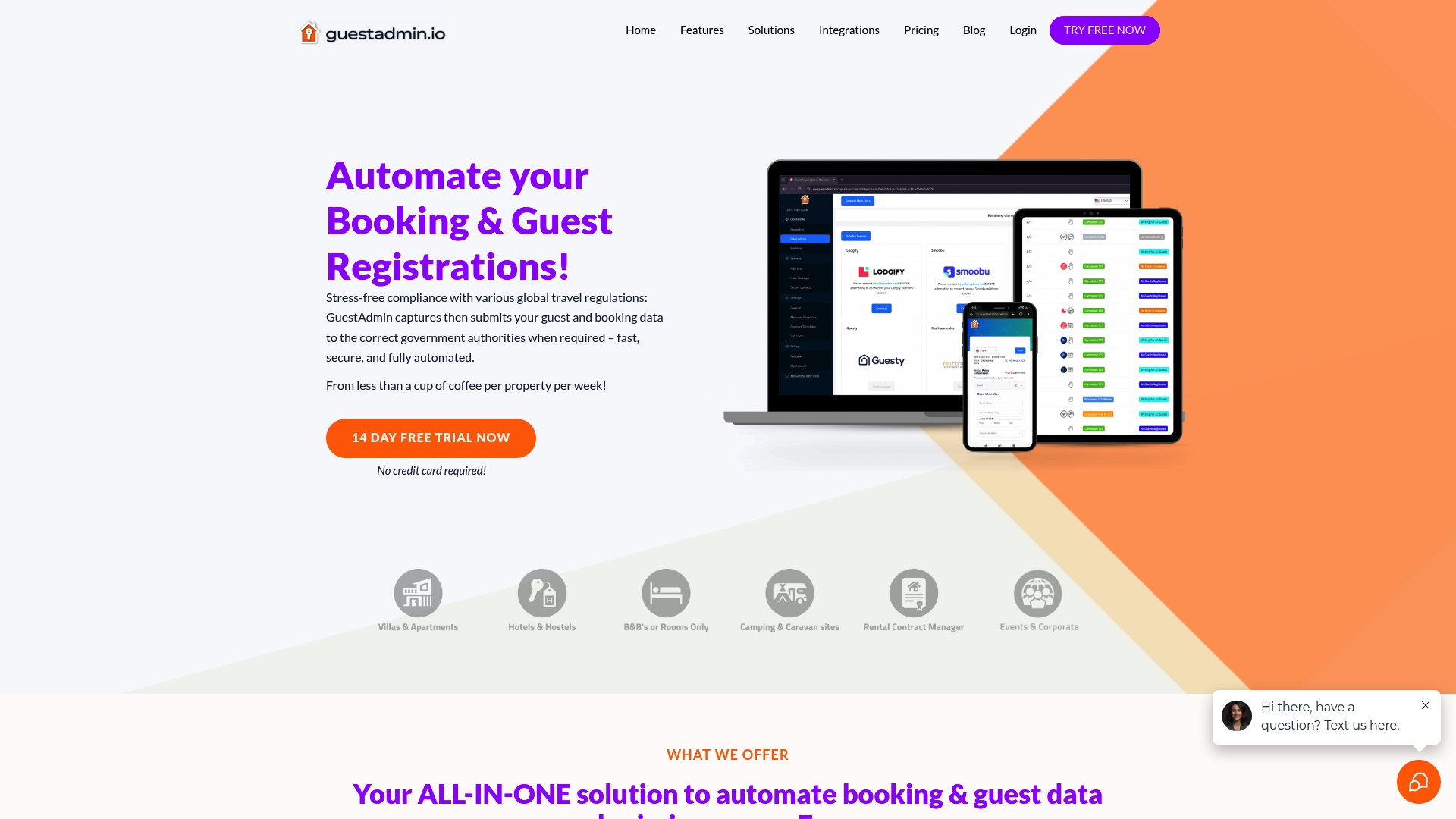
Guestadmin is built specifically for property owners and managers operating in the European short-term rental market. The platform captures, processes, and submits guest data to relevant authorities securely, with GDPR-compliant storage, role-based access controls, and automated data archiving built in. You get a real-time dashboard across all your properties, AI-powered processing, and integrations with the PMS and OTA platforms you already use.
If you manage multiple properties, explore the top property management software options to find the right fit for your compliance and security needs. You can also read the step-by-step compliance guide to understand how automation reduces your data security risk in practice.
FAQ
What types of guest data must hotels protect?
Hotels must protect identity documents (passports, national ID cards), payment card data, booking records, contact details, and any behavioural or preference data collected during a stay. All of this falls under GDPR personal data definitions.
What is PCI DSS and does it apply to my property?
PCI DSS (Payment Card Industry Data Security Standard) applies to any property that accepts, stores, or transmits payment card data. It requires strong encryption, network security, and access controls for all cardholder data environments.
How does GDPR affect hospitality data security?
GDPR Article 32 requires hotels and property managers to implement technical and organisational security measures proportionate to the risk they pose to guest data, including encryption, access controls, and documented incident response procedures.
What is the biggest security risk for hospitality operators?
Phishing attacks targeting front desk and operational staff are among the most common entry points, alongside orphaned user accounts from staff turnover and unsecured vendor integrations that expand the attack surface.
How can property managers simplify data security compliance?
Using purpose-built property management software with built-in GDPR compliance, automated data archiving, role-based access controls, and audit trails significantly reduces both administrative burden and the risk of human error.
5 Comments
Why guest data security matters for property managers
[…] property managers overseeing multiple short-term rentals across Europe, understanding data security in hospitality is not optional. It is the operational foundation on which compliant, profitable management is […]
Secure guest data access: a 2026 guide for hosts
[…] less time resolving data errors, responding to access requests, and managing audit queries. Good data security in hospitality is also good […]
Data security best practices 2026: protect your business
[…] property managers handling guest data in European markets, GDPR adds specific obligations around data minimisation and purpose limitation that must be built […]
Top hospitality data security practices for Europe 2026
[…] Data security in hospitality: what you need to know […]
How to archive guest data safely: a 2026 guide
[…] Encrypting guest data at rest and in transit, combined with role-based access control, is the recognised best practice for reducing breach risk in hospitality settings. Encryption at rest protects stored records if a server or device is compromised. Encryption in transit protects data moving between your property management system (PMS), booking platforms, and third-party tools. Use TLS 1.2 or higher for data in transit and AES-256 for stored records. […]