

TL;DR:
- EU regulation mandates digital guest data submission by May 2026, reducing manual errors and legal risks.
- Automated registration streamlines data collection, verification, and submission, saving up to 87% in admin workload.
- Proper automation enhances compliance, guest experience, and creates capacity for revenue growth.
Many property managers across Europe still treat guest registration as a box-ticking exercise. It is not. From May 2026, EU regulation 2024/1028 mandates digital submission of guest data to national authorities, making manual spreadsheets and paper forms not just inefficient but legally precarious. Miss a deadline or submit incomplete records, and you risk fines, delisting, or both. This article explains exactly what automated guest registration is, how it works in practice, what it means for your portfolio, and how to stay confidently compliant without drowning in admin.
Table of Contents
- What is automated guest registration and why does it matter?
- How does automated guest registration work?
- Major benefits: from risk reduction to revenue gains
- Navigating real-world challenges and compliance nuances
- Our take: what most property managers get wrong about automation
- How GuestAdmin helps you automate compliance with confidence
- Frequently asked questions
Key Takeaways
| Point | Details |
|---|---|
| Automated registration defined | It digitally collects and submits guest data for compliance, saving time and reducing errors. |
| Legal landscape is changing | New EU rules in 2026 will require digital guest registration and swift data submission. |
| Business impact is huge | Automation slashes admin workload, minimises compliance risks, and lifts guest satisfaction. |
| Operational nuance matters | Navigating country-specific rules, GDPR, and multi-property management is vital for success. |
| Choose the right solution | Opt for tools with broad integrations and adaptive workflows to futureproof your properties. |
What is automated guest registration and why does it matter?
Automated guest registration is a digital process that collects, validates, and submits guest data to the relevant government authorities without manual intervention. Instead of logging into multiple portals, copying passport details by hand, and hoping nothing gets lost, the system handles it all. As the European guest registration guide explains, this process automates guest data collection and submission end-to-end, reducing both human error and operational delay.
Why does this matter now more than ever? The EU 2024/1028 regulation759356_EN.pdf) requires short-term rental platforms and hosts to submit guest data digitally, in real time, to local authorities. Non-compliance is no longer a grey area. The rules are clear, the deadlines are tight, and the penalties are significant.
Manual data handling creates several serious risks:
- Lost or incomplete records due to human error during data entry
- GDPR violations when guest data is stored insecurely or retained beyond legal limits
- Missed submission windows, particularly when managing multiple properties across different countries
- Operational delays that slow down check-in and frustrate guests
- Disjointed oversight when managing several properties without a centralised system
Automation resolves all of these at once. The benefits are not just operational. They are strategic.
Key fact: Properties using automated registration report up to 87% reduction in administrative workload, freeing managers to focus on guest experience and revenue growth.
When compliance becomes effortless, you gain confidence. You spend less time chasing data and more time improving your offering. For multi-property operators, this shift from reactive to proactive management is genuinely transformative.
How does automated guest registration work?
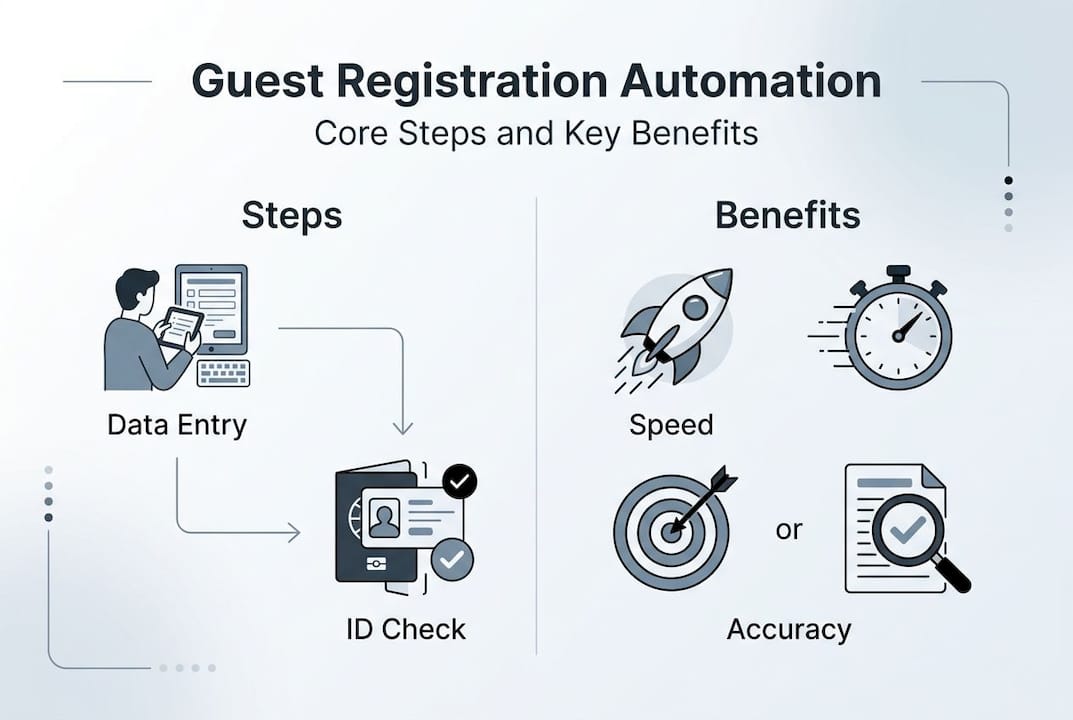
Understanding the workflow helps you evaluate any solution properly. Here is a typical step-by-step process for an automated system:
- Booking confirmed: A reservation is created via Airbnb, Booking.com, or your property management system (PMS).
- Guest messaging triggered: The system automatically sends a secure check-in link requesting identity documents and personal details.
- ID capture and verification: Guests upload their passport or ID. Optical character recognition (OCR) technology extracts the relevant data instantly.
- Rule-based validation: The system checks the data against country-specific requirements, flagging any missing fields before submission.
- Secure API submission: Validated data is sent directly to the relevant authority portal via an encrypted API connection, within the required deadline.
- Confirmation and archiving: A submission receipt is logged and the guest record is securely archived for the legally required retention period.
As outlined in GuestAdmin’s feature set, the mechanics involve PMS and OTA integrations, ID verification, AI-powered validation, and API submissions to official portals. This is not a simple form-fill tool. It is a full compliance engine.
Common platform integrations include Booking.com, Airbnb, Guesty, Hostaway, and Lodgify, meaning your existing booking stack connects seamlessly. You can also automate guest management across all channels from a single dashboard.
Submission deadlines vary significantly by country. Here is a summary for the most common markets:
| Country | Submission deadline | Authority portal |
|---|---|---|
| Italy | Within 6 hours of check-in | Alloggiati Web |
| Spain | Within 24 to 48 hours | Guardia Civil / Mossos |
| Portugal | Within 3 days of check-in | SEF / AIMA |
| France | Within 24 hours | Local municipality |
For multi-property operators, managing these differing deadlines manually is a recipe for missed submissions. Automation removes that risk entirely by applying country-specific rules automatically.
Pro Tip: Before your busiest season, run a full test of your automation routines against each country’s submission portal. Catching configuration issues in advance is far less costly than a missed deadline during peak occupancy.
Major benefits: from risk reduction to revenue gains
Now that the workflow is clear, it is worth asking: what does automation actually deliver in measurable terms?
Digital automation reduces manual processing time by 40 to 60%, cuts errors by 50%, and lowers overall admin workload by up to 87%. Those are not marginal improvements. For a manager handling 20 or more properties, that is the difference between a full-time compliance role and a streamlined, mostly hands-off process.

Guest satisfaction also improves measurably. Faster, smoother digital check-ins mean guests arrive without friction. They receive clear instructions, complete the process on their own device, and feel reassured that their data is handled professionally. This directly influences review scores.
Here is a side-by-side comparison of manual versus automated registration:
| Factor | Manual process | Automated process |
|---|---|---|
| Admin time per booking | 20 to 40 minutes | Under 2 minutes |
| Error rate | High (human entry) | Very low (AI validation) |
| Compliance gaps | Frequent | Rare |
| Guest check-in experience | Slow, paper-heavy | Fast, digital, frictionless |
| Multi-property scalability | Difficult | Built-in |
There is also hidden value that many managers overlook. When your automation saves time, you create space to upsell. Think late check-out options, local experience packages, or premium add-ons. Compliance automation is not just a cost-saving measure. It is a platform for revenue growth.
The EU compliance strategy guide reinforces this point: properties that invest in compliant, professional operations attract higher-quality guests and retain them more effectively. Reputation and compliance are more connected than most managers realise.
Navigating real-world challenges and compliance nuances
Automation does not mean set-and-forget. Real-world implementation involves a range of edge cases that your chosen platform must handle gracefully.
As GuestAdmin’s platform features highlight, these edge cases include multi-property management, GDPR data handling, and automatic updates for cancellations and booking modifications. Each of these requires specific logic built into the system.
Key challenges to plan for:
- Multi-property, multi-certificate workflows: Each property may require a separate registration certificate. Your system must manage these independently without cross-contamination of records.
- Cancellations and amendments: When a booking changes, the authority submission may need updating or withdrawing. Manual systems rarely handle this reliably.
- GDPR consent and encryption: Guest data must be collected with explicit consent, stored securely, and deleted or archived after the legally required period (typically 3 to 5 years depending on jurisdiction).
- Country-specific quirks: Italy requires submission within 6 hours. Portugal allows 3 days. Spain sits in between at 24 to 48 hours. A one-size-fits-all approach will fail.
For operators managing properties across multiple jurisdictions, the key is a platform with adaptive, rule-based submission logic. This means the system knows which rules apply to which property and applies them automatically, without you needing to configure each booking manually.
The country-specific deadlines and GDPR requirements are evolving as EU 2024/1028 takes full effect. Staying ahead means choosing a platform that updates its rule sets as regulations change, rather than relying on you to track legislative updates yourself.
Pro Tip: Set calendar reminders for each country’s regulatory review dates and confirm your platform provider pushes rule updates automatically. This is a question worth asking during any software demo.
Our take: what most property managers get wrong about automation
Most property managers approach automation as a compliance task. Tick the box, avoid the fine, move on. That framing misses the point entirely.
Automation is not just a legal safeguard. It is a signal. When a guest receives a professional, seamless digital check-in, they form an immediate impression of how you run your business. When platforms verify registration and find mistakes, the consequences go beyond fines. Delisting from Airbnb or Booking.com can wipe out months of revenue overnight.
The real opportunity is in combining automation with human judgement. AI handles the data. Your team handles the relationship. The time saved on admin is not just a cost reduction. It is capacity you can reinvest into better guest communication, faster issue resolution, and smarter upselling.
We have seen operators cut their compliance overhead by more than half and use that freed capacity to improve their average review score within a single season. That is the real return on investment. Compliance automation done well does not just protect you. It actively grows your business.
How GuestAdmin helps you automate compliance with confidence
If you manage short-term rentals across Europe, staying compliant should not consume your working week.
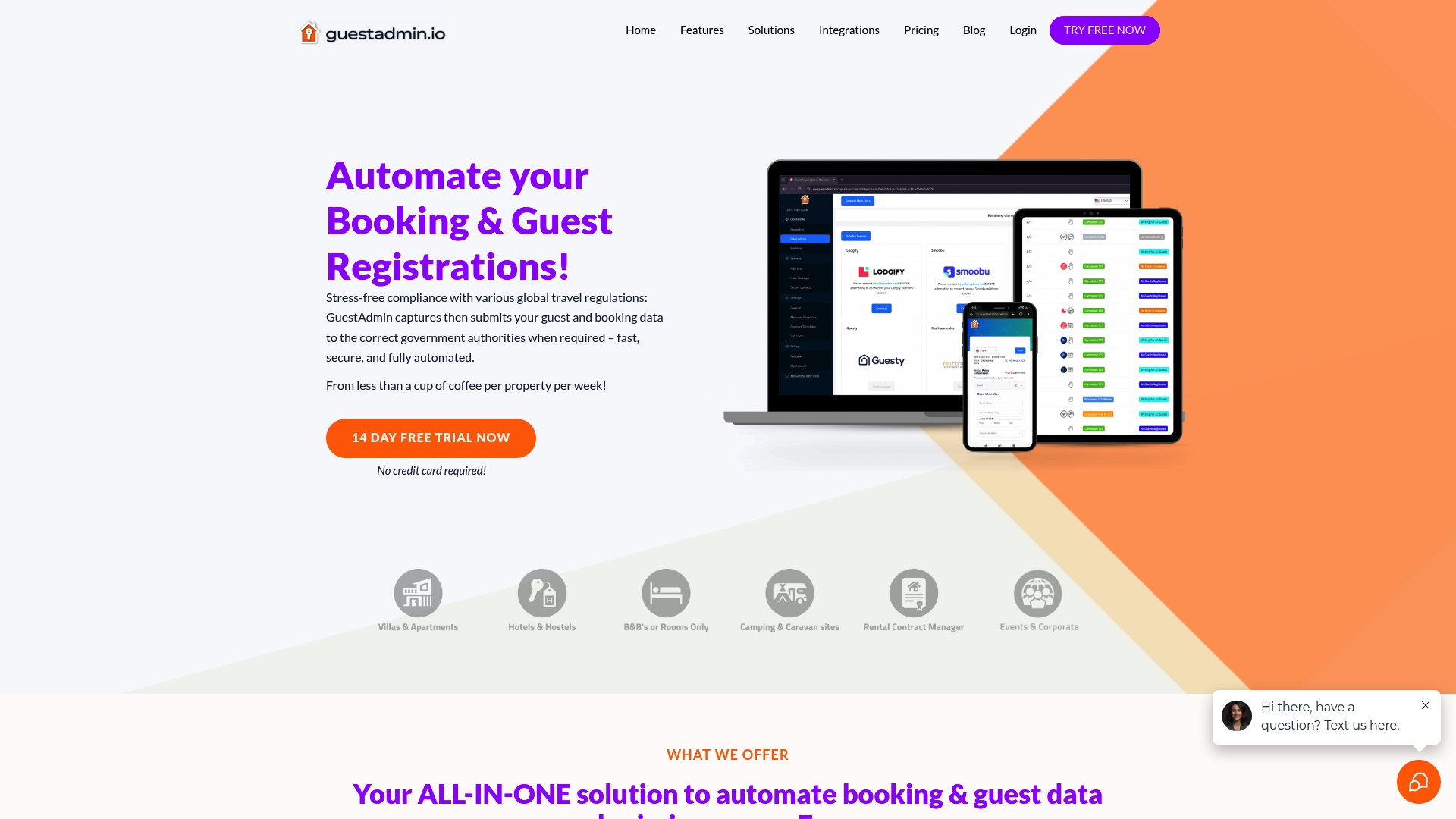
GuestAdmin is built specifically for property owners and managers who need reliable, country-aware automated guest registration without the complexity. The platform integrates with your existing PMS and OTA tools, applies the correct submission rules for each jurisdiction, and securely archives guest data in line with GDPR requirements. Discover the full range of rental automation benefits or explore our multi-property compliance solutions to see how GuestAdmin fits your portfolio. Book a demo and see how effortless compliance can genuinely be.
Frequently asked questions
Is automated guest registration required by law in Europe?
From May 2026, EU 2024/1028 mandates digital property registration for short-term rentals, with strict submission deadlines and platform-level verification requirements across member states.
How quickly must guest data be submitted to authorities?
Deadlines vary by country: Italy requires submission within 6 hours, Spain within 24 to 48 hours, and Portugal allows up to 3 days from check-in.
What are the penalties for non-compliance or late reporting?
Manual errors or late reports can result in fines ranging from €1,000 to over €50,000, and booking platforms may delist non-compliant properties without prior warning.
Does automation help with GDPR compliance?
Yes. Leading platforms encrypt guest data, ensure explicit consent is captured at check-in, and automate secure data retention for the required 3 to 5 years depending on the jurisdiction.
Which platforms support automated guest registration?
Popular solutions include GuestAdmin, Chekin, and Lodgify, all of which offer integrations with major PMS systems such as Guesty and Hostaway for seamless, end-to-end compliance management.
7 Comments
Government reporting for rentals: compliance made simple
[…] a managed, repeatable process. Explore our guide to compliance made simple or learn more about our automated registration solutions to see how straightforward compliant guest management can […]
Streamline property admin: unlock efficiency for rental compliance
[…] a passport number or an incorrect arrival date can invalidate a submission. Platforms built around guest registration automation apply validation rules at the point of data capture, catching errors before they become compliance […]
Understanding booking data regulations for secure rentals
[…] platform automates guest registration from the point of booking through to secure archiving, ensuring every required data field is […]
Automate guest registration for effortless compliance
[…] guest registration compliance in this context means recognising that the data requirements are already demanding, and they are […]
Choose the right guest registration method for your rentals
[…] your exact jurisdiction matters before selecting a tool. Explore digital guest books and automated registration explained for a deeper look at how these tools work in […]
Automate guest data for hassle-free compliance
[…] understand why this matters so much right now, consider what guest registration automation actually involves in practice. A guest books through an OTA platform. Their passport details, […]
Rental Regulations for European Short-Term Lets - Automated guest check-in for short term rental, hotels & campsites
[…] Guest registration is one of the most time-sensitive duties. Authorities may require details such as the guest’s full name, date of birth, nationality, document information, arrival and departure dates, and the address of the accommodation. Some systems require reporting before arrival, others after check-in, and some apply different time limits to non-resident guests. […]