

TL;DR:
- EU Regulation 2024/1028 mandates property managers to ensure data privacy compliance across all member states.
- Automated tools can streamline GDPR adherence but do not absolve managers from legal responsibility.
- Proper controls, staff engagement, and evidence-ready records are essential for regulator inspections.
Property managers across Europe are discovering that data privacy is no longer a back-office IT concern. EU Regulation (EU) 2024/1028 places direct legal responsibilities on short-term rental operators, making it clear that the person managing bookings and guest records is also responsible for how that data is collected, stored, and reported. Many owners assume their software handles everything. It does not. This guide walks you through exactly what the new EU framework requires, what your day-to-day privacy obligations look like, and how to build processes that hold up under scrutiny.
Table of Contents
- How EU regulation reshapes data privacy in hospitality
- Core data privacy obligations for owners and managers
- AI and automation: new frontiers and hidden risks
- Benchmarking compliance: what actually matters to regulators
- Why “automated compliance” still needs a manager’s attention
- Streamline compliance with the right hospitality tools
- Frequently asked questions
Key Takeaways
| Point | Details |
|---|---|
| Harmonised EU compliance | Property managers must meet unified European data privacy and reporting rules, not just local laws. |
| Operational discipline needed | Compliance involves hands-on controls like encryption and audits, not merely IT solutions. |
| AI brings new obligations | AI and automation create privacy governance duties, including consent, impact assessments, and cross-border compliance. |
| Regulators value evidence | Authorities expect demonstrable security, access control, retention, and audit logs over vendor performance claims. |
| Manager involvement remains key | Automation helps, but managers must actively monitor, train staff, and oversee incident response for true compliance. |
How EU regulation reshapes data privacy in hospitality
Now that you know what’s at stake, let’s clarify how Europe’s rules have changed the playing field for short-term rental operators.
The harmonised data sharing protocols introduced by Regulation (EU) 2024/1028 replace the patchwork of local national rules that previously governed how rental data was collected and reported. This is a significant shift. Before this regulation, a property manager operating in Spain faced different rules than one in Portugal or Italy. Now, a single unified framework applies across all EU member states, meaning the same standards for data collection, registration accuracy, and reporting apply whether you are managing one apartment in Lisbon or twenty villas in Tuscany.
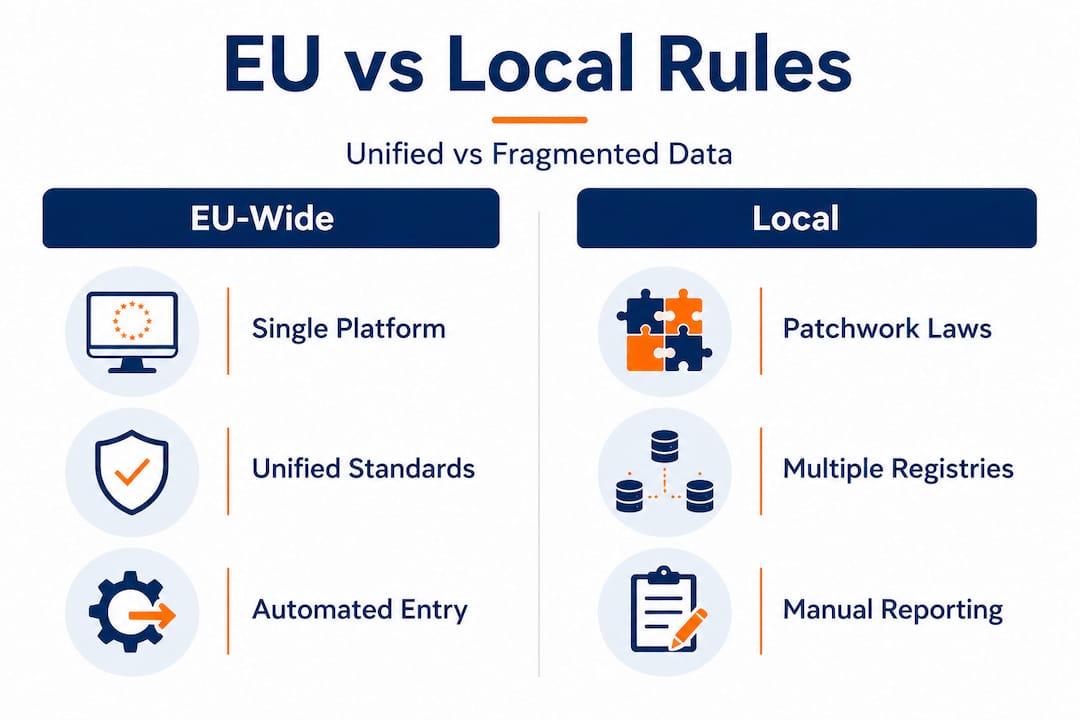
One of the most important practical changes is the introduction of a Single Digital Entry Point, a centralised EU platform through which all required rental data must flow. This increases the scrutiny applied to every submission. Errors that might once have slipped through inconsistent local systems are now more easily identified. Accurate data is no longer just good practice; it is a legal requirement with direct consequences.
Understanding data security in short-term rentals is now essential for every operator, not just large hotel chains. Here is how the old local regime compares to the new EU-wide approach:
| Area | Previous local regime | New EU-wide regime |
|---|---|---|
| Registration rules | Varied by municipality or country | Unified standards across all member states |
| Data reporting | Submitted to local authorities | Flows through a Single Digital Entry Point |
| Audit requirements | Inconsistent, often paper-based | Standardised digital logs required |
| GDPR alignment | Interpreted locally | Mandatory harmonised GDPR compliance |
| Penalties for non-compliance | Variable and often unclear | Consistent enforcement framework |
Property managers must now maintain accurate and up-to-date records covering:
- Registration details: Your property registration number and operator identity.
- Activity data: Booking volumes, occupancy periods, and guest nationality data.
- Reporting logs: Timestamped evidence that submissions were made on time and with accurate information.
- Correction history: Records of any amendments made to previously submitted data.
You can find a detailed breakdown of registration rules for 2026 to understand exactly what your registration record must include. For a broader overview of navigating 2026 regulations, it is worth reviewing the full scope of changes before your next audit cycle.
Core data privacy obligations for owners and managers
With new EU requirements understood, here is what concrete data privacy practices look like for your day-to-day operations.
The hospitality sector has historically treated data privacy as a technology department issue. That approach is no longer workable. Privacy and security controls are now operational disciplines, covering encryption, retention, access management, and evidence gathering for audits. Every person in your team who touches guest data is part of your compliance posture.
Encryption is the baseline. Guest data must be encrypted both at rest (stored on your server or cloud provider) and in transit (moving between systems). If you are using a property management system (PMS) that does not confirm end-to-end encryption, that is a risk you are currently carrying.

Access controls are equally critical. Each staff member should have unique login credentials, and access to sensitive guest data should be restricted to those who genuinely need it. A cleaning team coordinator does not need to see a guest’s passport number. A reservations manager does not need access to financial transaction logs beyond their role. Limiting access limits your exposure if a breach occurs.
Here is a practical summary of the core controls you should have in place:
- Encrypted storage for all guest identity documents and booking records
- Unique staff credentials with role-based access permissions
- Automated data retention schedules that delete records after the required legal period
- Secure, encrypted backups stored separately from primary systems
- A written incident response plan that assigns clear responsibilities
- Regular staff training on phishing, data handling, and reporting obligations
- Documented evidence for each of the above, ready for an audit at any time
The following table outlines the key control areas and what “good” looks like in practice:
| Control area | Minimum standard | Evidence expected |
|---|---|---|
| Encryption | AES-256 at rest, TLS in transit | System configuration records |
| Access management | Role-based, unique credentials | Access logs, user activity reports |
| Data minimisation | Collect only legally required data | Data mapping documentation |
| Retention and deletion | Automated schedules aligned to legal limits | Deletion logs with timestamps |
| Incident response | Written plan, tested annually | Plan document, test records |
| Staff training | Annual minimum, recorded | Training completion certificates |
Pro Tip: Map every piece of guest data you collect to the specific legal basis for collecting it. This “data mapping” exercise is the single most useful document you can produce for a regulator, because it shows deliberate, lawful intent rather than accidental data accumulation.
GDPR automation for rentals can significantly reduce the manual effort involved in maintaining these controls. Platforms built specifically for the EU short-term rental market can automate deletion schedules, enforce access controls, and generate the evidence logs you need for property management data security audits.
AI and automation: new frontiers and hidden risks
Beyond manual processes, automation and AI are reshaping the scope and complexity of compliance for property managers across Europe.
AI tools are appearing in every corner of hospitality management. Personalised pricing engines, automated guest messaging, smart lock integrations, and facial recognition check-in systems are all increasingly common. Each one introduces new privacy obligations that many operators have not yet accounted for.
AI in hospitality now demands extra privacy governance, covering profiling disclosures, consent for biometrics, and privacy impact assessments. In plain terms, this means:
- Consent and transparency for personalisation: If your booking platform uses AI to personalise offers based on a guest’s previous stays or browsing behaviour, you must clearly disclose this and obtain valid consent.
- Biometric data is a special category: Any facial recognition or fingerprint-based check-in system is processing special category data under GDPR. This requires explicit consent, a clear legal basis, and a Data Protection Impact Assessment (DPIA) before deployment.
- Privacy Impact Assessments: Whenever you introduce a new AI tool that processes guest data at scale or in a novel way, a formal DPIA is required. This is not optional; it is a legal obligation under Article 35 of GDPR.
- Cross-border data transfers: Many AI platforms and cloud services store or process data outside the EU. You must verify that any such transfer is covered by an adequacy decision or appropriate safeguards such as Standard Contractual Clauses.
- Automated decision-making disclosures: If your system automatically declines a booking or flags a guest based on algorithmic scoring, guests have the right to know this and to request human review.
“The question is not whether to use AI in guest management, but whether you can clearly explain to a guest, and a regulator, exactly what data is used, how decisions are made, and what rights the guest has. If you cannot answer those questions, your AI deployment is a compliance liability.”
For SaaS compliance essentials, it is important to choose platforms that publish their own GDPR compliance documentation, data processing agreements, and sub-processor lists. Do not assume a vendor is compliant simply because they operate in Europe. Ask for evidence.
The good news is that well-designed automation genuinely reduces risk. Automated submission systems eliminate the human errors that cause missed deadlines or inaccurate reporting. The key is ensuring that rental data security and transparency are built into any automated workflow, not bolted on afterwards.
Benchmarking compliance: what actually matters to regulators
Automated metrics are appealing, but here is what actually counts when regulators come calling.
Vendors frequently promote impressive-sounding statistics: “99% submission accuracy,” “zero missed deadlines,” “100% GDPR compliance.” These figures are often self-reported and measure operational outputs rather than the legal controls that regulators actually inspect. Understanding this distinction protects you from a false sense of security.
Regulators focus on demonstrable controls, including lawful basis for processing, data minimisation, retention practices, and full auditability. A regulator investigating your property will not ask for your vendor’s marketing brochure. They will ask to see evidence.
Here is a comparison of vendor-reported metrics versus what inspectors actually examine:
| What vendors report | What regulators inspect |
|---|---|
| Submission accuracy rate | Evidence of lawful basis for each data category |
| Deadline compliance percentage | Retention schedules and deletion logs |
| Error reduction figures | Access control records and staff training logs |
| System uptime statistics | Incident response plan and breach notification history |
| Integration coverage | Data processing agreements with all third parties |
The practical takeaway is this: your compliance readiness must be measured by what you can demonstrate on paper, not by what a dashboard tells you. At any moment, you should be able to produce the following without scrambling:
- A current register of all personal data you hold on guests, including its legal basis
- Documented retention and deletion schedules, with evidence of enforcement
- Access logs showing who accessed guest data and when
- Signed data processing agreements with every third-party vendor who handles guest data
- A completed DPIA for any AI or automated profiling system in use
- A written incident response plan, tested within the last twelve months
- Training records for all staff with access to guest data
Pro Tip: Run a quarterly internal audit using this checklist. The goal is not perfection; it is readiness. Regulators respond far more favourably to operators who can demonstrate active, documented effort than to those who simply claim their software “handles it.”
For a fuller picture of your obligations, review secure booking data regulations alongside the 2026 rental compliance guide to ensure your internal processes align with current legal requirements.
Why “automated compliance” still needs a manager’s attention
With best practices and compliance benchmarks in mind, here is a real-world look at why hands-on engagement still matters, regardless of how sophisticated your software is.
There is a tempting belief in the short-term rental market that once you deploy the right platform, compliance takes care of itself. This belief is understandable. Good software genuinely removes enormous amounts of manual work and reduces the risk of errors that come from juggling spreadsheets and paper forms. However, platforms reduce your risk; they do not absorb your liability.
The owner or manager of record remains legally responsible under GDPR and Regulation (EU) 2024/1028. If a data breach occurs or a regulator finds a gap in your controls, the accountability falls on you, not your software vendor. This is not a criticism of technology; it is simply the legal reality.
Reviewing the EU compliance terminology guide is a practical starting point for ensuring you understand what you are accountable for, in plain language. Terms like “data controller,” “data processor,” and “lawful basis” are not just legal jargon; they define who carries responsibility when things go wrong.
Where managers must stay personally engaged:
Access controls and staff changes: When a staff member leaves, their access must be revoked immediately. Software does not do this automatically unless someone tells it to. A former employee with active credentials is a breach waiting to happen.
Vendor due diligence: Every time you add a new integration, a new OTA connection, or a new guest-facing tool, you take on a new data processing relationship. Each one requires a signed data processing agreement. This is a management decision, not an IT task.
Incident response: When a breach occurs, the clock starts immediately. Under GDPR, you have 72 hours to notify your supervisory authority if the breach is likely to affect the rights of individuals. No software system can make the judgement call about whether notification is required. A manager must.
Physical security: Audits often extend beyond digital systems. Printed registration forms left in a communal area, a tablet with guest details visible at a reception desk, a key lockbox code written on a sticky note – these are all compliance failures that no SaaS platform can prevent. You cannot automate judgement; only process. Be ready to explain why your solution works, and be genuinely confident in that explanation.
Streamline compliance with the right hospitality tools
To close, here is where specialised solutions can give you back time and genuine peace of mind.
Managing data privacy obligations across multiple properties, jurisdictions, and guest touchpoints is genuinely complex. The detail involved in maintaining audit-ready records, enforcing retention schedules, and submitting accurate data to government portals is significant. Doing this manually is not just time-consuming; it creates the conditions for errors that carry real financial and legal consequences.
GuestAdmin.io is built specifically for European short-term rental operators who need to meet these obligations without building a compliance department. The platform automates data capture, applies GDPR-aligned retention rules, and submits guest data to the relevant authorities within 24 hours of check-in. Every submission is logged, timestamped, and retrievable for audit purposes. You can learn more about how to avoid fines with compliance solutions and explore the full range of automated guest management features that remove the manual burden from your team. For a structured overview of your obligations, the guide on essential compliance for STR lets is an excellent starting point.
Frequently asked questions
What personal data must short-term rental owners protect?
Owners must protect guest identity documents, contact information, and booking details as required under GDPR and EU rules. EU rules require protection of personal data shared for registration, guest identity, and activity data reporting.
How does automation help with GDPR compliance in hospitality?
Automation reduces human error, enforces data minimisation and retention limits, and produces audit evidence for compliance reviews. Automation in hospitality can streamline privacy controls, lower error rates, and generate the compliance records regulators expect to see.
Are AI tools in guest management risky for data privacy?
AI tools introduce specific risks such as guest profiling and biometric data processing, requiring explicit disclosures and valid consent to meet legal standards. AI in hospitality raises governance requirements for personalisation, profiling, and biometric data handling that go beyond standard GDPR obligations.
What is the difference between local and EU-wide STR data rules?
EU regulation now harmonises core data sharing, registration, and reporting requirements across all member states, removing the inconsistencies that previously existed between countries. The EU’s unified regime replaces local short-term rental data rules with standardised requirements enforced through a central digital platform.
5 Comments
Guest information archiving steps: a practical guide
[…] policy and your ability to respond to subject access requests efficiently. Pair it with documented data privacy best practices specific to hospitality so nothing falls through the […]
API integrations in hospitality: a practical guide
[…] Master data privacy in hospitality for smooth EU compliance […]
Guest data processing guide for European property owners
[…] specific national provisions that sit alongside GDPR. If you operate across multiple jurisdictions, EU data compliance requirements will vary property by […]
Benefits of automated compliance for rental managers
[…] audit readiness and evidence quality at every stage of the guest lifecycle. You can read more about EU data privacy compliance and how automation supports it in […]
Guest Data Submission to Authorities Made Simple - Guest Registration Services
[…] Owner access needs care too. An owner may need visibility of records for their property without access to guest information from every property in the portfolio. Role-based access keeps operational responsibility clear and limits unnecessary access to personal data. […]