

TL;DR:
- Guests’ personal data must be handled within GDPR constraints even for compliance purposes.
- The upcoming EU STR Regulation is integrated with GDPR, emphasizing transparency and purpose limitation.
- Minimalist data collection and secure automated systems help hosts stay compliant and maintain guest trust.
Many hosts across Europe assume that collecting guest information for compliance purposes gives them broad freedom to store, share, and use that data as they see fit. This assumption is wrong, and it is a costly one. The General Data Protection Regulation (GDPR) places firm boundaries on how guest data is handled, even when that data is collected for entirely lawful purposes such as government reporting. With the EU STR Regulation (2024/1028) coming into full effect in May 2026, property owners and managers face a more structured regulatory environment than ever before. Understanding where the rules align, and where they differ, is essential to avoiding serious fines and maintaining guest trust.
Table of Contents
- What is GDPR and why does it matter for short-term rentals?
- How the EU STR Regulation and GDPR intersect in 2026
- What guest data is collected, and how should it be handled?
- Balancing transparency, compliance, and privacy: Real-world challenges
- Why strict data minimisation is the real risk-reducer: Our view
- Streamline your compliance with the right solutions
- Frequently asked questions
Key Takeaways
| Point | Details |
|---|---|
| GDPR still governs all guest data | Even with new STR regulations, property managers must follow GDPR rules when handling guest information. |
| Share only required data | Only collect and report guest details that are specifically required by law, keeping within GDPR’s minimisation principle. |
| Balance compliance and privacy | Transparency is important but must not override privacy safeguards; align practices with both regulatory and data protection requirements. |
| Automate for fewer errors | Using digital tools to manage compliance reduces GDPR errors and paperwork burdens. |
What is GDPR and why does it matter for short-term rentals?
The General Data Protection Regulation is a European Union law that governs how organisations collect, store, process, and share personal data. It applies to any individual or business that handles information about EU residents, which means every short-term rental operator in Europe falls within its scope. As the EU Parliament confirms, GDPR protects personal data across all sectors, including short-term rentals.
For property owners and managers, the types of guest data that fall under GDPR protections are wide-ranging:
- Full name and identity document details (passport, national ID)
- Contact information (email address, phone number)
- Payment and billing details
- Stay dates, property address, and room or unit allocation
- Nationality and date of birth (often required for police or local authority reporting)
- Number of guests per booking, including details of accompanying individuals
Each of these categories is classified as personal data under GDPR and must be handled according to its principles. These include lawfulness, fairness, transparency, purpose limitation, data minimisation, accuracy, storage limitation, integrity, and confidentiality.
“The GDPR is not a barrier to compliance reporting. It is a framework that defines exactly how compliance reporting must be conducted, and the distinction matters enormously for hosts managing guest data.”
The financial consequences of non-compliance are significant. Regulators can issue fines of up to €20 million or 4% of annual global turnover, whichever is higher. For smaller property managers, even mid-range penalties can be damaging. Our GDPR compliance guide outlines the exact steps operators need to take, and understanding data security in rentals is a strong starting point for anyone reviewing their current practices.
Practical examples of common data mistakes include storing guest passport scans indefinitely on local computer drives, sharing full booking details with third parties who have no legal need for them, or failing to inform guests how their data will be used during the check-in process.
How the EU STR Regulation and GDPR intersect in 2026
The EU STR Regulation (2024/1028) introduces a structured framework for short-term rental registrations and data reporting across EU member states. As confirmed by the EU Parliament, the regulation mandates that hosts obtain registration numbers, and that platforms share activity data via Secure Data Exchange Points (SDEPs), all within a GDPR-compliant framework.
The relationship between the STR Regulation and GDPR is not one of conflict. Rather, the STR Regulation operates within the legal guardrails already established by GDPR. The key distinction is purpose. The STR Regulation focuses on market transparency and urban planning data, not tax enforcement. This has direct implications for which guest data can be shared, with whom, and for what reason.
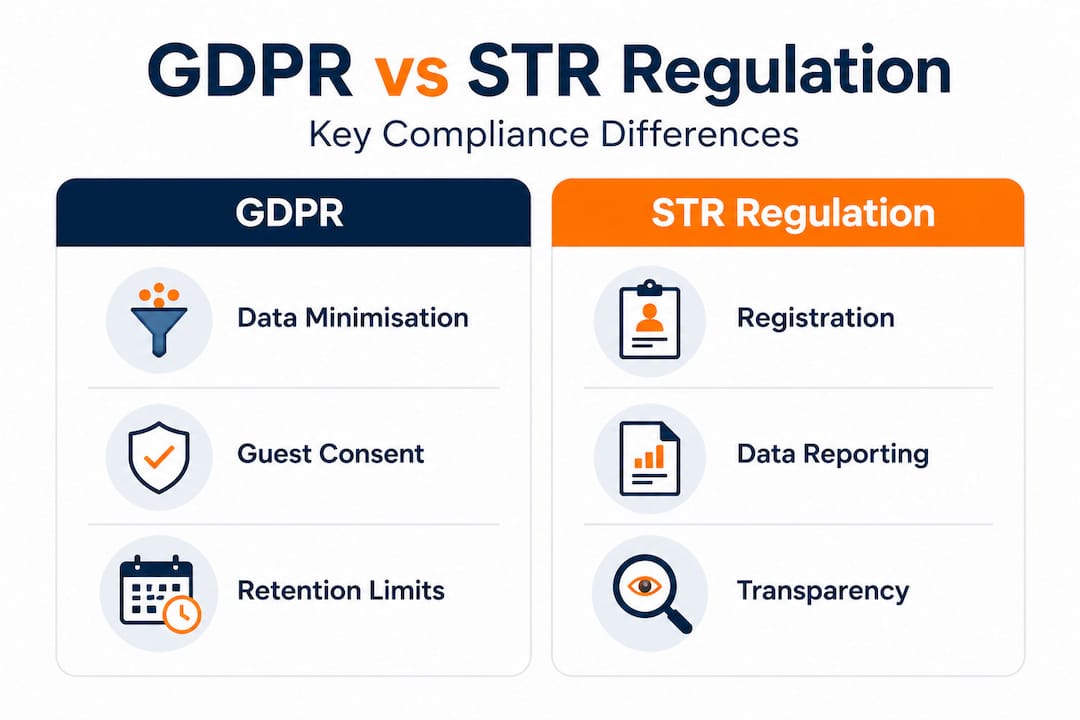
Here is a comparison of how key elements of each framework interact:
| Feature | EU STR Regulation 2024/1028 | GDPR |
|---|---|---|
| Primary goal | Market transparency and registration | Data protection and privacy |
| Data sharing mechanism | SDEPs (Secure Data Exchange Points) | Requires lawful basis and purpose limitation |
| Who data is shared with | Competent national authorities | Only authorised parties with legal basis |
| Guest data included | Anonymised activity statistics, registration numbers | Full personal data only when legally required |
| Retention rules | Determined by national rules | Limited to necessary period only |
| Tax data sharing | Not within scope | Separate legal basis required |
Pro Tip: Always verify that your legal basis for data sharing under the STR Regulation is documented clearly. “Legitimate interest” and “legal obligation” are two different bases under GDPR, and using the wrong one can expose you to regulatory challenge.
Platforms operating under the STR Regulation are required to implement SDEPs that comply with GDPR by design. This means the technology itself must enforce data minimisation, purpose limitation, and security standards. As a property manager, you should request confirmation from any platform you use that their data exchange mechanisms meet these standards. Navigating rental regulations in Europe in 2026 requires you to understand not just the law, but how the technology implementing it works. For a closer look at how booking data regulations apply to your daily operations, reviewing your current data flows is a worthwhile exercise.
A notable statistical point: the EU STR Regulation is expected to affect over 1.5 million short-term rental listings across the EU, many of them managed by individual hosts or small property managers who may not have dedicated compliance resources. This makes self-education and the right tools especially important.
What guest data is collected, and how should it be handled?
Understanding the types of guest data that short-term rental operators routinely collect is the first step to handling it correctly. GDPR’s purpose limitation principle, which requires that data collected for one specific reason cannot be repurposed for unrelated uses, is the most commonly misunderstood rule in this sector. As the EU Parliament highlights, GDPR limits data sharing to specific reporting purposes, requiring careful minimisation.

Here is a breakdown of common guest data categories and their appropriate uses:
| Data type | Lawful purpose | Can it be shared? |
|---|---|---|
| Full name | Booking and identity verification | Only with authorities when legally required |
| Passport or ID number | Government reporting (e.g., police registration) | Yes, for mandatory reporting only |
| Email address | Booking communication | No, not for regulatory reporting |
| Payment details | Transaction processing | No, not to be shared with authorities |
| Stay dates and property address | Registration and reporting | Yes, where required by national law |
| Nationality and date of birth | Some national reporting requirements | Yes, only where legally mandated |
A clear, step-by-step approach to compliant data handling is essential for every operator:
- Identify your legal basis before collecting any guest data. Is it a legal obligation, a contract, or legitimate interest?
- Collect only what is necessary for the stated purpose. Do not gather additional fields “just in case.”
- Inform guests clearly at the point of data collection, typically during booking or digital check-in, about how their data will be used.
- Store data securely using encrypted systems and restrict access to authorised team members only.
- Set a retention schedule and stick to it. Most national reporting requirements specify how long records must be kept. Delete data once that period ends.
- Document everything, including what data you collect, why, how it is stored, and when it is deleted.
Pro Tip: Avoid the temptation to retain guest records beyond the legally required period on the assumption that it might be useful later. This directly violates GDPR’s storage limitation principle and creates unnecessary risk.
Common mistakes in guest data processing include requesting copies of passports via messaging apps (which offer no encryption), sharing full guest lists with cleaning staff or contractors (who have no legal need for this information), and failing to delete old booking records after the retention period expires. Our government reporting guide explains exactly which data national authorities require, helping you avoid over-collection. Operators who use automation to reduce GDPR errors consistently report fewer incidents and more consistent processes across their portfolios.
Balancing transparency, compliance, and privacy: Real-world challenges
Most hosts want to do the right thing. The difficulty is that the right thing is not always obvious, particularly when reporting obligations pull in one direction and guest privacy pulls in another. As the EU Parliament confirms, hosts must balance reporting obligations with GDPR minimisation requirements.
Consider a common host dilemma. A local authority in Spain requires submission of guest identity details within 24 hours of arrival. A host managing ten properties across the country needs to collect, verify, and submit this data efficiently. The temptation is to over-collect, gathering additional information like email addresses, phone numbers, and payment details in the same sweep. Under GDPR, only the data mandated by Spanish law for police reporting can be submitted. Everything else remains protected and cannot be included in the submission.
Here are practical steps operators can follow to maintain this balance effectively:
- Map your data flows. Know exactly what data enters your system, where it goes, and who can access it.
- Apply minimisation at collection. Only ask guests for what the law requires at each stage of their stay.
- Use purpose-specific forms. A check-in form should collect different data than a booking confirmation. Do not conflate the two.
- Train your team. Anyone handling guest data must understand what is permissible. Mistakes often happen at the property level, not in the back office.
- Audit regularly. Review your data handling processes quarterly to check for drift from GDPR standards.
“The GDPR is not a barrier to compliance. It is a signal to guests that you take their privacy seriously. Operators who treat it as such build stronger reputations than those who treat it as a bureaucratic obstacle.”
Documentation is your best protection. If a regulator investigates your data practices, clear records of your legal basis for collection, your retention schedule, and your deletion confirmations demonstrate good faith. A GDPR compliance checklist designed specifically for short-term rental operators provides a structured way to audit your current practices, and our compliance guide makes the process far more manageable.
Why strict data minimisation is the real risk-reducer: Our view
There is a persistent instinct among operators to collect as much guest information as possible. The logic seems sound. More data means fewer gaps in your records, better reporting capability, and greater operational insight. But in practice, this instinct is the single most common route to GDPR difficulty.
We have worked with property managers across Europe who initially stored extensive guest profiles, including preferences, previous stay notes, and supplementary contact details, well beyond what any regulation required. When audited or challenged, the burden of justifying every data point was substantial. The managers who fared best were those who had kept their data lean and purposeful from the start.
The “less is more” mindset is not a compromise. It is a strategy. When you collect only what the law requires, every data point in your system has a clear legal basis. Your deletion schedules are simpler. Your storage architecture is cleaner. Your staff have fewer data fields to manage, which directly reduces human error. Our experience with automation reveals that when data collection is kept lean and structured, AI-powered processing encounters fewer inconsistencies and submission errors. The efficiency gains are real and measurable.
There is also a guest trust dimension that is easy to overlook. Guests who receive clear, concise privacy notices at check-in, covering only what is genuinely necessary, are far more likely to trust the property and return. Overly long privacy notices filled with vague justifications for extensive data collection raise suspicion and erode confidence. Minimisation is not just legally smart. It is commercially sensible.
This perspective directly challenges the instinct to over-prepare. For hosts thinking ahead about legal compliance for rentals in 2026 and beyond, the most effective posture is not to collect more and manage risk. It is to collect less and eliminate risk at the source. Regulators across the EU are increasing enforcement capacity, and the operators best positioned to pass scrutiny will be those who can demonstrate clear, minimal, purposeful data practices from day one.
Streamline your compliance with the right solutions
Managing GDPR obligations alongside STR reporting requirements is demanding, particularly as your portfolio grows. Manually tracking data collection, verifying minimisation, and coordinating submissions across multiple properties and jurisdictions is time-consuming and error-prone. The risk of a missed submission or a data handling mistake increases with every additional property you manage.

GuestAdmin.io is built specifically to address these challenges. The platform automates guest data capture, processes information through AI-powered tools, and submits regulatory reports to national authorities within 24 hours, all within a GDPR-compliant framework. You get a clear, real-time dashboard showing the status of every property and every submission, without the need to juggle spreadsheets or log into multiple portals. Whether you are exploring property management software options for the first time or looking for stronger multi-property management solutions, GuestAdmin.io provides the structure, security, and automation that turns compliance from a burden into a background process.
Frequently asked questions
Can I share guest data with local authorities under the EU STR Regulation?
Yes, but only the information specifically required for regulatory reporting under GDPR principles and the EU STR Regulation. As confirmed by the EU Parliament, the regulation focuses on transparency, not tax sharing, which means data submission must stay within those defined boundaries.
What types of guest data am I allowed to collect as a short-term rental host?
You may collect only the guest information necessary for booking, registration, and legal reporting, following the GDPR data minimisation principle. The EU Parliament confirms that GDPR requires minimisation of guest data collected for short-term rental purposes.
Am I required to store guest data after their stay is complete?
You should only retain guest data for as long as required to fulfil your reporting or legal obligations, then securely delete it. The EU Parliament notes that hosts must minimise retention and remove data once it is no longer legally necessary.
How do platforms make sure guest data sharing stays GDPR-compliant?
Platforms use Secure Data Exchange Points (SDEPs) designed to ensure all data transfers meet GDPR requirements and applicable national reporting laws. As the EU Parliament confirms, platforms share via SDEPs to maintain full GDPR compliance throughout the process.
One Comment
Examples of guest data regulations: 2026 guide for Europe
[…] GDPR compliance guide for short-term rentals covers the specific obligations that apply to hosts, including consent language for booking forms […]