

Modern property dashboards reduce compliance errors by up to 40% for European short-term rental operators, transforming how managers navigate complex regulatory environments. This guide explains how dashboards centralise data, automate submissions, and streamline multi-property operations whilst ensuring legal compliance across diverse jurisdictions. You’ll discover practical selection criteria, implementation strategies, and operational benefits that make dashboards essential for competitive rental management in 2026.
Table of Contents
- Understanding Dashboards In Short-Term Rental Property Management
- How Dashboards Ensure Regulatory Compliance For Short-Term Rentals
- Operational And Multi-Property Management Benefits Of Dashboards
- Common Misconceptions About Property Management Dashboards
- Comparing Dashboard Features For European Short-Term Rental Compliance
- Practical Implementation: Choosing And Using Dashboards Effectively
- Conclusion: Unlocking Value Through Dashboards In European Short-Term Rental Management
- Explore Dashboard Solutions To Streamline Your Rental Compliance
Key takeaways
| Point | Details |
|---|---|
| Centralised compliance automation | Dashboards consolidate guest data and automate regulatory submissions across Europe’s varied legal frameworks, reducing manual work significantly. |
| Substantial time and risk reduction | Multi-property operators save an average of 15 hours monthly whilst minimising penalties through timely, accurate compliance reporting. |
| Integration and security focus | Effective dashboards seamlessly connect with PMS and OTA platforms whilst maintaining GDPR compliance and robust data protection standards. |
| Scalability for growing portfolios | Advanced dashboards improve operational efficiency by up to 30% for properties exceeding 20 units through centralised oversight and automation. |
Understanding dashboards in short-term rental property management
Dashboards represent a fundamental shift from static spreadsheets and manual record-keeping to dynamic, real-time data centralisation platforms. For European short-term rental operators, these specialised tools aggregate booking information, guest details, and compliance requirements into unified interfaces accessible from any device. Unlike traditional reporting systems that capture historical data after events occur, modern dashboards process information continuously and trigger automated actions based on predefined rules.
Europe’s regulatory landscape drives dashboard adoption more than any other factor. Dashboards provide real-time centralisation of booking and guest compliance data essential for the European market, where regulations vary dramatically between jurisdictions. Property managers in Barcelona face different submission requirements than those operating in Berlin or Brussels, creating administrative complexity that manual systems cannot efficiently handle.
Core dashboard functions for short-term rentals include:
- Automated capture of guest registration data from multiple booking sources
- Real-time compliance status monitoring across properties and jurisdictions
- Scheduled data submissions to relevant government authorities
- Centralised document storage with secure, GDPR-compliant access controls
- Performance analytics for occupancy rates, revenue trends, and operational metrics
The technology underlying these platforms combines API integrations with property management systems, artificial intelligence for data validation, and secure cloud storage that meets European data protection standards. This infrastructure enables property managers to shift from reactive compliance management to proactive, automated workflows that reduce both labour costs and legal risks.
How dashboards ensure regulatory compliance for short-term rentals
Compliance automation represents the primary value proposition for property management dashboards in European markets. Automated data capture and submission within 24 hours reduces compliance delays by up to 40%, addressing the strict reporting deadlines imposed by many jurisdictions. Traditional manual processes create bottlenecks where guest information sits unprocessed, increasing the likelihood of missed deadlines and associated penalties.
Real-time validation systems within dashboards immediately flag incomplete or incorrect data entries. When guests provide registration information through integrated booking channels, the dashboard automatically checks for required fields such as passport numbers, dates of birth, and arrival times. Missing data triggers instant alerts to property managers, allowing corrections before official submission deadlines expire. This proactive approach contrasts sharply with manual systems where errors emerge only during retrospective audits.
Dashboards save operators on average 15 hours per month on compliance reporting compared to manual methods, time that managers redirect towards guest services and revenue optimisation. The financial impact extends beyond labour savings to include penalty avoidance, with fines for late or incorrect submissions ranging from hundreds to thousands of euros depending on jurisdiction and violation severity.

Multi-jurisdictional compliance presents unique challenges that dashboards address through configurable rule engines. A property manager operating across Spain, France, and Italy configures separate submission protocols for each country within a single platform. The dashboard automatically routes guest data to the appropriate authorities using jurisdiction-specific formats and transmission methods, whether that involves API submissions, secure file transfers, or web portal uploads.
Pro Tip: Configure automated compliance reports to generate weekly summaries of submission status across all properties, allowing you to identify patterns in data quality issues and address them systematically rather than reactively.
Operational and multi-property management benefits of dashboards
Centralised oversight transforms how property managers handle portfolios spanning multiple locations and markets. Rather than logging into separate systems for each property or jurisdiction, operators access unified dashboards displaying real-time status across their entire portfolio. This consolidation eliminates the cognitive load of context switching between platforms whilst reducing the likelihood of overlooked properties or missed tasks.
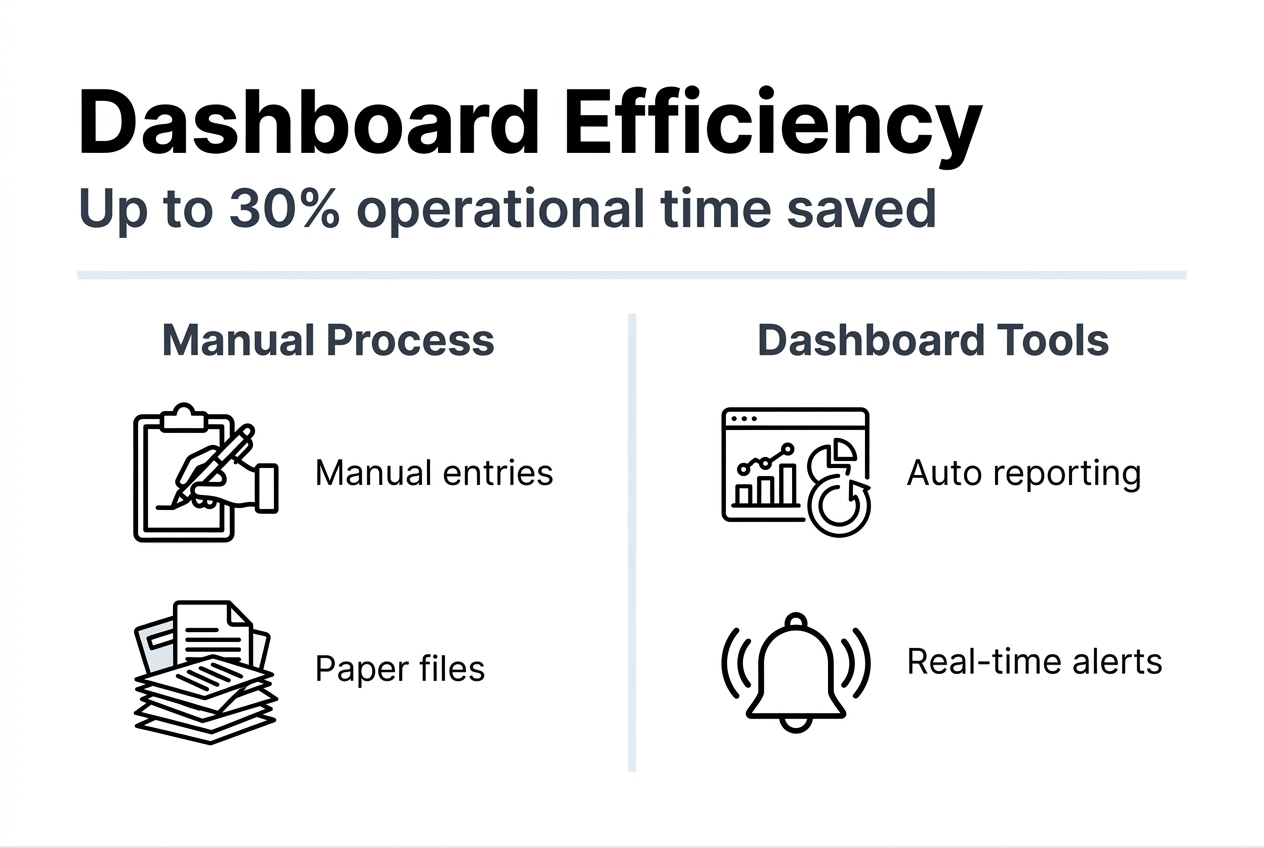
Multi-property dashboards increase operational efficiency by up to 30% for portfolios exceeding 20 units, primarily through workflow automation and reduced duplicate effort. Tasks such as guest data verification, booking confirmation processing, and compliance reporting scale linearly rather than exponentially as property counts increase. A manager overseeing 50 properties spends marginally more time on these activities than one managing 10 properties when using properly configured dashboard systems.
Integration capabilities amplify operational benefits by connecting dashboards with existing technology stacks. Modern platforms support bidirectional data flows with popular property management systems like Guesty, Hostaway, and Lodgify, alongside channel managers and online travel agencies including Booking.com and Airbnb. These integrations eliminate manual data entry whilst ensuring information consistency across systems, reducing errors that arise when guests update booking details through one channel but changes fail to propagate elsewhere.
| Portfolio Size | Manual Hours/Month | Dashboard Hours/Month | Time Savings | Efficiency Gain |
|---|---|---|---|---|
| 1-5 properties | 20 | 12 | 8 hours | 40% |
| 6-15 properties | 45 | 22 | 23 hours | 51% |
| 16-30 properties | 85 | 38 | 47 hours | 55% |
| 30+ properties | 140 | 65 | 75 hours | 54% |
The table demonstrates how time savings increase with portfolio size, though efficiency gains plateau around 50-55% as certain management activities remain inherently manual regardless of automation levels. Strategic managers leverage recovered time to focus on revenue management, guest experience enhancement, and market expansion rather than administrative compliance tasks.
Pro Tip: Prioritise dashboard platforms offering white-label reporting capabilities that allow you to share compliance status and performance metrics with property owners without revealing your operational systems or other clients’ data.
Common misconceptions about property management dashboards
Many property managers mistakenly believe dashboards suit only large-scale operators with dozens of properties. This perception stems from early enterprise-focused platforms requiring substantial implementation resources and minimum property counts. Modern cloud-based dashboards serve single-property owners through to management companies overseeing hundreds of units, with pricing and feature tiers scaled appropriately. Small operators actually gain proportionally more value from automation, as they typically lack dedicated compliance staff.
Another prevalent misunderstanding positions dashboards as static reporting tools that simply visualise data without driving actions. Contemporary platforms incorporate artificial intelligence that learns from historical patterns to predict compliance issues, suggest optimal pricing strategies, and automate routine decisions based on configurable rules. These systems evolve continuously, adapting to regulatory changes and operator preferences without requiring manual reconfiguration.
Some managers worry that dashboard complexity will increase rather than decrease their workload, particularly during initial implementation. Whilst onboarding requires upfront effort to configure integrations and establish workflows, properly designed platforms simplify operations dramatically once operational. The key lies in selecting solutions with intuitive interfaces and comprehensive onboarding support rather than feature-bloated systems designed for technical specialists.
The consequences of underutilising dashboard capabilities often manifest gradually. Operators who implement platforms but fail to activate automation features, configure integrations fully, or train staff properly forfeit potential efficiency gains. They continue manual processes in parallel with dashboard usage, effectively doubling workload rather than reducing it. Success requires commitment to transitioning fully from legacy systems and trusting automated workflows after proper validation.
Key misconceptions to avoid:
- Dashboards require technical expertise to operate effectively (modern platforms prioritise user-friendly interfaces)
- All dashboards offer equivalent compliance coverage (European-specific solutions provide superior regulatory alignment)
- Implementation disrupts operations significantly (phased rollouts minimise disruption whilst building confidence)
- Dashboard costs exceed value for smaller portfolios (subscription models scale with property counts and feature needs)
Comparing dashboard features for European short-term rental compliance
Evaluating dashboard solutions requires structured assessment of capabilities aligned with European short-term rental requirements. Four critical criteria distinguish effective platforms: compliance automation depth, integration breadth, data security robustness, and analytics sophistication. Each dimension impacts operational efficiency and risk management differently, necessitating prioritisation based on specific business contexts and growth trajectories.
Compliance automation encompasses more than simple data submission. Advanced platforms incorporate jurisdiction-specific validation rules, automated deadline tracking with escalating alerts, and exception handling protocols for edge cases such as extended stays or group bookings. Selecting dashboards with GDPR compliance and strong data security is critical for European operations, given the severe penalties associated with data protection violations and the reputational damage from security breaches.
Integration capabilities determine how seamlessly dashboards fit within existing technology ecosystems. Basic platforms offer manual CSV uploads and email-based data exchange, requiring ongoing manual intervention. Intermediate solutions provide API connections to major property management systems but lack flexibility for custom integrations. Enterprise-grade platforms support webhooks, custom API development, and real-time bidirectional synchronisation across unlimited connected systems.
| Feature Category | Basic Dashboard | Advanced AI Dashboard | Enterprise Solution |
|---|---|---|---|
| Compliance Automation | Manual submission with reminders | Automated 24-hour submission | Predictive compliance with AI validation |
| PMS/OTA Integrations | 2-5 major platforms | 10-15 platforms plus API access | Unlimited plus custom integrations |
| Data Security | Standard encryption | GDPR-compliant with audit trails | ISO 27001 certified with advanced controls |
| Analytics & Reporting | Basic occupancy metrics | Revenue forecasting and trends | Custom dashboards with predictive insights |
| Multi-property Support | Up to 10 properties | Up to 50 properties | Unlimited properties with hierarchy |
| Mobile Access | Responsive web only | Native mobile apps | Full-featured mobile with offline capability |
| User Management | Single user account | Team accounts with permissions | Role-based access control enterprise-wide |
The comparison reveals significant capability gaps between solution tiers. Property managers must balance current needs against anticipated growth, as migrating between platforms disrupts operations and risks compliance continuity. Starting with a scalable solution that supports growth trajectories proves more cost-effective than upgrading repeatedly as requirements evolve.
Data residency requirements particularly impact European operators, as certain jurisdictions mandate that guest data remains within specific geographic boundaries. Platforms offering EU-based server infrastructure and data privacy with GDPR automation eliminate compliance risks associated with cross-border data transfers whilst ensuring optimal performance through proximity to users.
Practical implementation: choosing and using dashboards effectively
Selecting the right dashboard begins with comprehensive requirements documentation covering current operations and three-year growth projections. Map existing compliance workflows, integration needs, team size, and property portfolio characteristics before evaluating vendors. This preparation enables focused conversations with solution providers and accurate assessment of feature alignment with actual business needs rather than marketing promises.
Implementation follows a structured onboarding sequence:
- Configure core settings including jurisdictions, property details, and user accounts with appropriate permission levels
- Establish integrations with existing PMS, channel managers, and OTA platforms through API connections or guided setup wizards
- Import historical booking and guest data to populate the dashboard with baseline information for analytics and compliance tracking
- Define automation rules for compliance submissions, alert thresholds, and workflow triggers aligned with your operational protocols
- Conduct parallel operations for 2-4 weeks, running both legacy systems and new dashboard to validate accuracy before full transition
- Train all team members on dashboard navigation, routine tasks, and exception handling procedures through hands-on sessions
- Establish ongoing monitoring protocols with weekly compliance reviews and monthly performance assessments
Best practices for maximising dashboard value include regular workflow audits to identify automation opportunities, proactive rule refinement based on evolving regulations, and systematic data quality checks to maintain accuracy. Operators who treat dashboards as static tools rather than dynamic systems requiring continuous optimisation forfeit significant potential benefits.
Staff training deserves particular attention, as even sophisticated platforms deliver poor results when users lack proficiency. Develop role-specific training materials focusing on daily tasks each team member performs, supplemented by comprehensive reference documentation for edge cases. Schedule quarterly refresher sessions to reinforce best practices and introduce new features as platforms evolve.
Pro Tip: Document your compliance workflows before implementation, then map each step to dashboard features to ensure nothing falls through the cracks during transition and to identify opportunities for further automation.
Multi-property management explained provides additional implementation guidance for operators scaling portfolios, including organisational structures and delegation strategies that leverage dashboard capabilities effectively.
Conclusion: unlocking value through dashboards in European short-term rental management
Dashboards fundamentally transform short-term rental operations by converting compliance from a reactive burden into an automated background process. The combination of real-time data centralisation, intelligent automation, and seamless integrations enables property managers to redirect energy from administrative tasks towards strategic growth initiatives and guest experience enhancement.
The European regulatory environment makes dashboard adoption not merely beneficial but increasingly essential for competitive operations. As governments implement stricter reporting requirements and enforcement mechanisms, manual compliance systems expose operators to escalating risks and operational costs. Early adopters gain sustainable advantages through established workflows and accumulated operational insights that compound over time.
Looking forward, dashboard evolution will incorporate increasingly sophisticated artificial intelligence for predictive analytics, dynamic pricing optimisation, and proactive risk management. Platforms will expand beyond compliance into comprehensive business intelligence tools that guide strategic decisions across all operational dimensions. Property managers who embrace these technologies position themselves to thrive amidst ongoing regulatory complexity and intensifying market competition.
Explore dashboard solutions to streamline your rental compliance
Managing European short-term rental compliance doesn’t have to consume your valuable time and resources. GuestAdmin.io offers purpose-built dashboard solutions that automate guest data capture, regulatory submissions, and multi-property oversight within a single, intuitive platform.
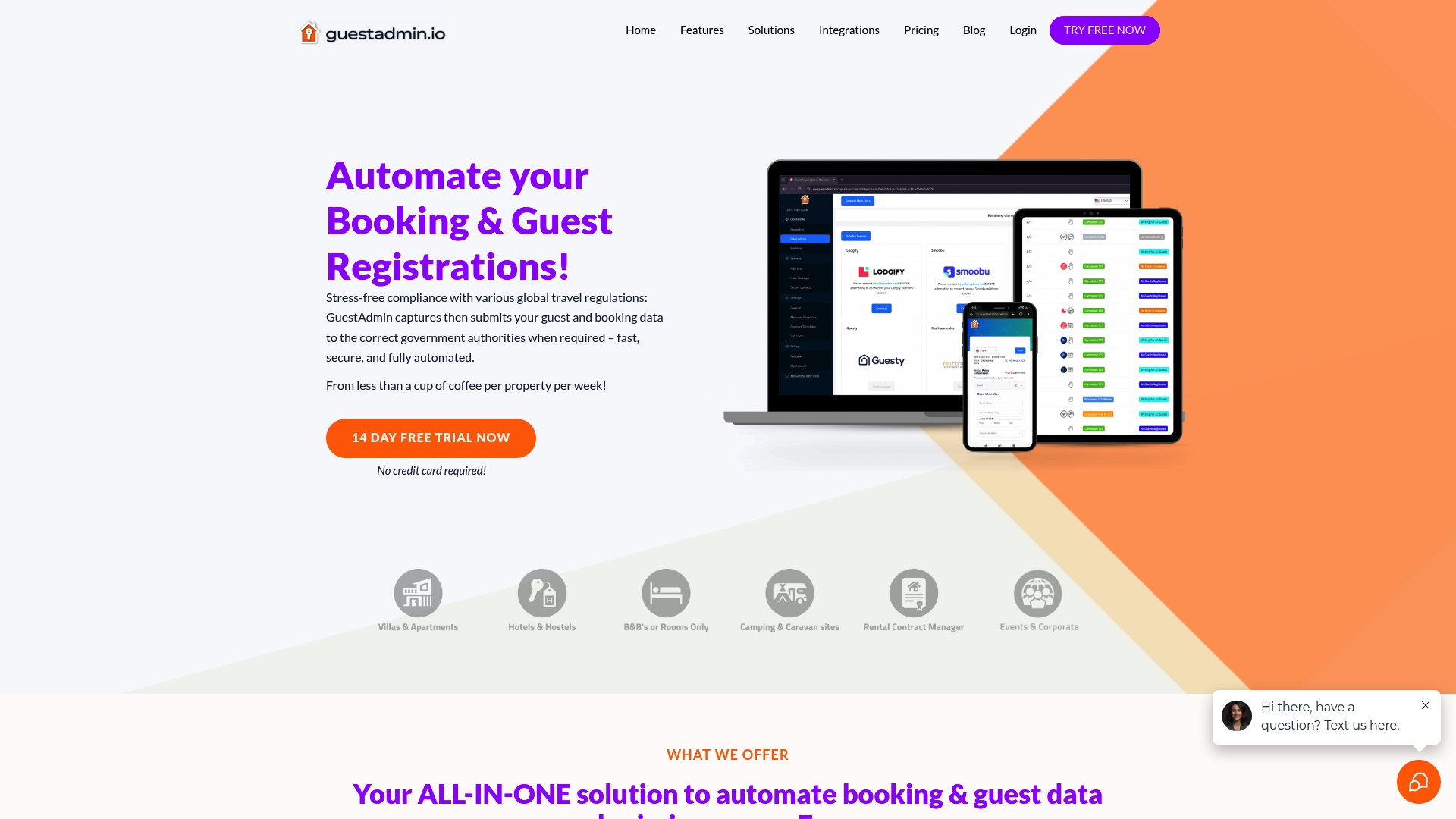
Our AI-powered system ensures 24-hour submission timelines whilst maintaining GDPR compliance and robust data security. Whether you’re streamlining compliance with multi-property management or seeking multi-property management tips for operational excellence, our platform scales with your portfolio. Discover how to automate booking compliance in 2026 and reclaim hours for strategic growth rather than administrative tasks.
Frequently asked questions
What regulatory challenges do dashboards help overcome in European short-term rentals?
Dashboards automate complex data collection processes, manage jurisdiction-specific submission deadlines, and adapt to varying regulatory requirements across European countries. They provide real-time compliance status monitoring that reduces risks of penalties from late or incorrect submissions. European rental legal compliance becomes manageable even for operators spanning multiple countries.
How do dashboards integrate with existing property management systems?
Modern dashboards connect seamlessly with major PMS and OTA platforms through API integrations that enable automatic, bidirectional data synchronisation. This eliminates manual data entry whilst ensuring information consistency across all connected systems. Property management tips detail integration best practices for various platform combinations.
Can dashboards help scale operations for large multi-property portfolios?
Absolutely. Dashboards improve efficiency by up to 30% for portfolios with more than 20 properties through centralised oversight and workflow automation. They enable managers to oversee dozens of properties with only marginally more effort than managing a handful. Multi-property management explained explores scaling strategies that leverage dashboard capabilities effectively.
What data security features should European rental operators prioritise?
Prioritise platforms offering GDPR-compliant data handling, EU-based server infrastructure, encrypted data transmission and storage, comprehensive audit trails, and role-based access controls. ISO 27001 certification provides additional assurance of robust security practices. These features protect both your business and guests from data breaches whilst ensuring regulatory compliance.
How long does dashboard implementation typically take for short-term rental operations?
Implementation timelines vary based on portfolio size and integration complexity, but most operators achieve full operational status within 2-4 weeks. This includes initial configuration, integration setup, historical data import, team training, and parallel operation validation. Phased rollouts for larger portfolios may extend to 6-8 weeks to ensure thorough testing and staff proficiency.
One Comment
Booking dashboard benefits for European rental managers
[…] can unlock efficiency with dashboards when you move away from fragmented tools, or explore further why use dashboards in rentals if you […]