

Managing multiple short-term rental properties across Europe presents unique challenges in 2026, with each jurisdiction imposing distinct travel regulations, licensing requirements, and data submission protocols. Property managers juggle complex compliance obligations whilst maintaining operational efficiency across diverse portfolios. Without standardised processes and appropriate tools, the administrative burden quickly becomes overwhelming, risking legal penalties and operational disruptions. This guide walks you through preparing, executing, and verifying a comprehensive multi-property management process designed to ensure compliance and streamline your operations throughout 2026.
Table of Contents
- Understanding The Regulatory Landscape Across Europe
- Preparing Your Tools And Processes For Efficient Management
- Executing A Streamlined Multi-Property Management Workflow
- Verifying Compliance And Optimising For Continual Success
- Enhance Your Multi-Property Management With Guestadmin
- Frequently Asked Questions
Key takeaways
| Point | Details |
|---|---|
| Regulatory complexity demands streamlined processes | European short-term rental regulations vary significantly by country and region, requiring efficient, standardised workflows to maintain compliance across multiple properties. |
| Proper preparation with tools is essential | Investing in property management systems, compliance automation, and guest data platforms before scaling operations prevents costly errors and legal issues. |
| Automated workflows reduce errors and save time | Centralised dashboards and automated data submissions eliminate manual processing risks whilst providing real-time visibility across your entire portfolio. |
| Regular verification catches problems early | Systematic audits and cross-checks of guest data and compliance submissions identify issues before they escalate into penalties or booking losses. |
| Continuous improvement optimises performance | Performance metrics and feedback loops help refine processes over time, ensuring your management approach evolves with changing regulations. |
Understanding the regulatory landscape across Europe
European short-term rental markets operate under a patchwork of national, regional, and municipal regulations that create significant compliance challenges for multi-property managers. The housing crisis study759356_EN.pdf) highlights how EU countries have developed diverse licensing requirements, occupancy limits, and reporting obligations in response to housing pressures. Cities like Barcelona, Paris, and Amsterdam enforce strict registration systems, whilst other jurisdictions maintain lighter regulatory frameworks.
Travel regulations compound these challenges by requiring property managers to collect, process, and submit guest data to local authorities within tight timeframes. Some regions demand real-time reporting within 24 hours of check-in, whilst others allow weekly or monthly batch submissions. Data requirements vary dramatically, from basic identification details to comprehensive passport scans and travel documentation. Understanding these regional differences forms the foundation for effective legal compliance for rentals in Europe.
Compliance failure carries serious consequences beyond financial penalties. Properties operating without proper licences face closure orders, whilst managers who fail to submit guest data risk prosecution under local laws. Online travel agencies increasingly verify licensing status before listing properties, meaning non-compliant rentals lose visibility and bookings. Insurance policies may become void if properties operate illegally, exposing managers to catastrophic liability.
The regulatory landscape continues evolving in 2026 as governments refine their approaches to short-term rentals. New data protection requirements under GDPR add another layer of complexity, requiring secure handling of sensitive guest information. Property managers must stay informed about legislative changes across all jurisdictions where they operate, making ongoing regulatory monitoring an essential component of successful multi-property management.
Key regulatory challenges include:
- Varying licence application processes and renewal cycles across jurisdictions
- Inconsistent guest data requirements and submission protocols
- Different occupancy limits and operational restrictions by municipality
- Evolving tax obligations including tourist taxes and VAT requirements
- Platform-specific compliance verification and documentation standards
Preparing your tools and processes for efficient management
Successful multi-property management begins with assembling the right technological infrastructure and establishing standardised workflows. Property management systems form the backbone of operations, centralising booking data, guest communications, and financial tracking across your portfolio. When evaluating property management software types, prioritise platforms offering native integrations with major online travel agencies and channel managers to eliminate manual data entry.
Compliance automation tools specifically designed for European short-term rentals represent critical investments for managers operating across multiple jurisdictions. These platforms capture guest information automatically from booking systems, validate data completeness, and submit required information to local authorities according to jurisdiction-specific protocols. The housing crisis study759356_EN.pdf) emphasises how digital platforms have become essential for managing compliance obligations efficiently.

Guest data platforms provide secure repositories for storing sensitive personal information whilst maintaining GDPR compliance. These systems encrypt data at rest and in transit, implement role-based access controls, and maintain detailed audit logs of all data access and modifications. Integration capabilities via APIs and webhooks enable seamless data flow between booking systems, compliance platforms, and local authority portals.
A comprehensive preparatory checklist ensures each property meets baseline requirements before accepting bookings:
- Verify current licence status and renewal dates for each property
- Document specific compliance requirements for each jurisdiction
- Configure automated guest data collection workflows
- Establish secure data storage and retention policies
- Test integration connections between all software platforms
- Train staff on standardised procedures and escalation protocols
Standardisation of workflows across your portfolio dramatically improves accuracy whilst reducing training requirements. Develop templated processes for common tasks such as guest check-in procedures, cleaning schedules, and maintenance requests. Document these workflows in accessible formats, ensuring team members can reference procedures when handling unfamiliar situations. Regular workflow reviews identify bottlenecks and opportunities for optimisation.
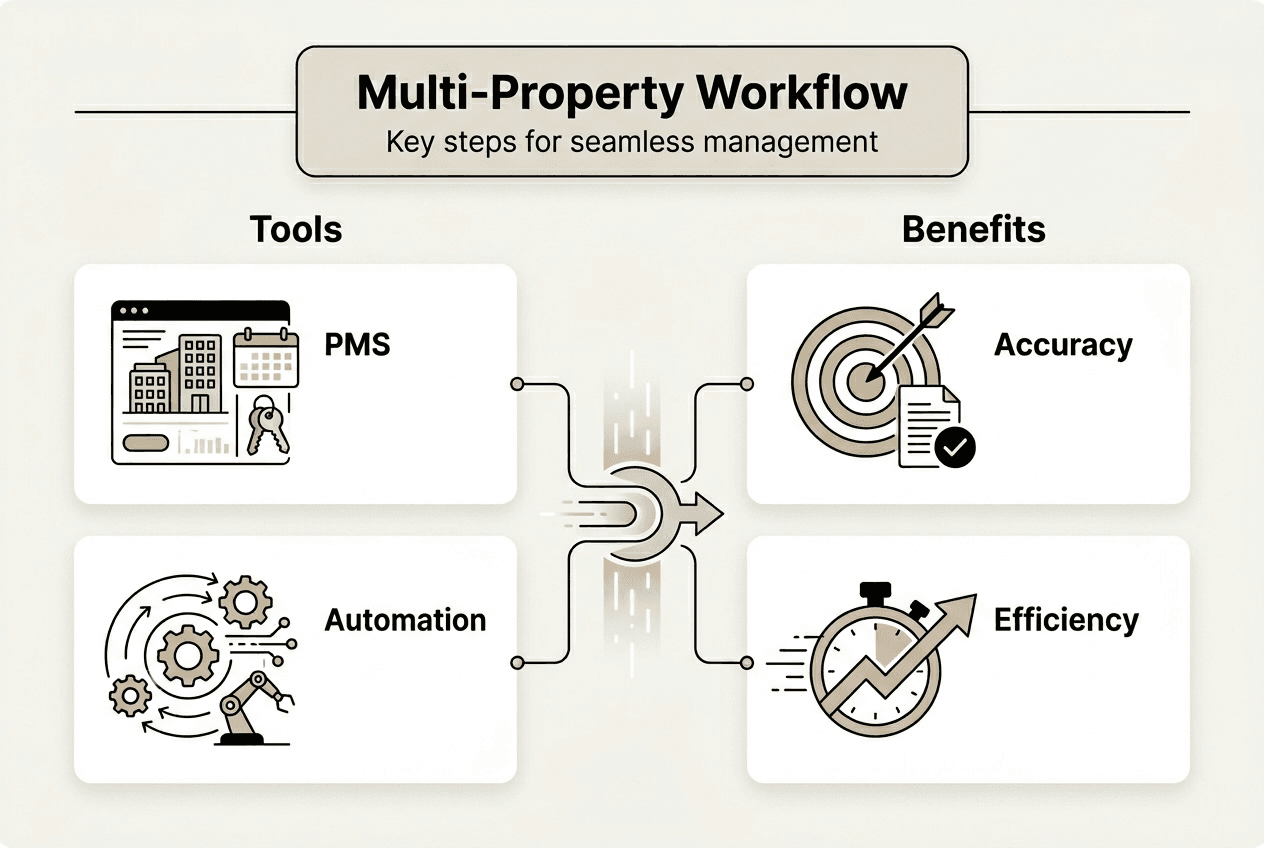
| Tool Category | Primary Function | Key Benefits |
|---|---|---|
| Property Management System | Centralised booking and operations | Unified dashboard, channel management, financial reporting |
| Compliance Automation | Guest data submission | Automated reporting, jurisdiction-specific protocols, error reduction |
| Guest Data Platform | Secure information storage | GDPR compliance, audit trails, controlled access |
| Channel Manager | Distribution management | Synchronised availability, rate parity, reduced overbookings |
Pro Tip: Create property-specific compliance calendars highlighting key dates such as licence renewals, tax filing deadlines, and regulatory reporting requirements to prevent last-minute scrambles.
Effective multi-property management explained requires balancing automation with human oversight, ensuring technology enhances rather than replaces critical decision-making.
Executing a streamlined multi-property management workflow
Implementing a systematic workflow transforms complex multi-property operations into manageable, repeatable processes. Begin with booking management, where centralised systems aggregate reservations from all distribution channels into a single dashboard. This visibility prevents double bookings whilst enabling dynamic pricing adjustments based on portfolio-wide occupancy patterns. Automated confirmation messages maintain consistent guest communications regardless of which team member handles the booking.
Guest registration represents a critical compliance touchpoint requiring careful execution. Modern systems capture necessary identification details during the booking process, validating data completeness before check-in. Automated workflows prompt guests to upload required documentation such as passport scans or national ID cards, reducing last-minute complications. The housing crisis study759356_EN.pdf) notes how implementing robust registration systems helps address regulatory concerns about short-term rental oversight.
Compliance submissions follow standardised protocols tailored to each jurisdiction’s requirements. Automated platforms extract relevant guest data, format information according to local specifications, and transmit submissions to appropriate authorities within mandated timeframes. Real-time status tracking confirms successful delivery whilst flagging any rejected submissions for immediate attention. This automation eliminates the error-prone manual processes that plagued earlier multi-property management approaches.
Local authority communication requires maintaining accurate contact databases and documentation of all regulatory interactions. Log all correspondence regarding licences, inspections, or compliance queries, creating an auditable record of your regulatory engagement. Proactive communication about operational changes or property updates builds positive relationships with officials, often smoothing future interactions.
Detailed execution steps include:
- Aggregate bookings from all channels into centralised management system
- Trigger automated guest registration workflows upon booking confirmation
- Validate guest data completeness and accuracy before check-in
- Submit required information to local authorities within jurisdiction timeframes
- Monitor submission status and resolve any rejections immediately
- Maintain comprehensive logs of all compliance activities and communications
- Generate performance reports tracking key metrics across properties
| Workflow Aspect | Manual Approach | Automated Approach |
|---|---|---|
| Guest data collection | Email requests, phone calls, physical forms | Integrated booking system capture, automated prompts |
| Data validation | Manual review, frequent errors | Automated checks, real-time error flagging |
| Authority submissions | Individual logins, varied formats | Centralised platform, standardised protocols |
| Time per property | 2-3 hours weekly | 15-20 minutes weekly |
| Error rate | 15-20% of submissions | Under 2% of submissions |
Centralised dashboards provide essential visibility across your entire portfolio, displaying real-time occupancy rates, upcoming compliance deadlines, and operational alerts requiring attention. Customisable views enable managers to focus on specific properties, regions, or metrics relevant to immediate priorities. Mobile access ensures you maintain oversight even when away from your desk.
Pro Tip: Schedule weekly portfolio reviews examining key performance indicators such as occupancy rates, compliance submission success rates, and guest satisfaction scores to identify trends before they become problems.
Mastering multi-property management workflow compliance whilst implementing multi-property management best practices creates sustainable operational excellence across your portfolio.
Verifying compliance and optimising for continual success
Systematic verification processes provide essential quality assurance, catching errors before they escalate into regulatory penalties or operational disruptions. Implement regular compliance audits examining guest data completeness, submission timing, and licence status across all properties. Monthly reviews identify patterns of missing information or delayed submissions, enabling targeted process improvements. Quarterly comprehensive audits assess overall compliance health and regulatory alignment.
Cross-checking mechanisms validate data accuracy by comparing information across multiple sources. Verify guest counts reported to authorities match booking system records, ensuring no discrepancies that might trigger regulatory scrutiny. Reconcile tax collections with booking revenues, confirming proper calculation and remittance of tourist taxes and other levies. These cross-checks reveal inconsistencies requiring investigation and correction.
Common compliance pitfalls include inconsistent guest data collection across properties, delayed authority submissions due to manual processing bottlenecks, and outdated licence information resulting from missed renewal deadlines. The housing crisis study759356_EN.pdf) emphasises how EU legislation continues evolving, requiring ongoing vigilance to maintain compliance as regulations change.
Avoid these frequent mistakes:
- Assuming compliance requirements are uniform across all jurisdictions
- Neglecting to update processes when regulations change
- Relying on manual data entry without validation checks
- Failing to maintain backup documentation of submissions
- Ignoring warning signs such as increasing error rates or delayed submissions
Performance metrics guide continuous improvement by quantifying operational effectiveness. Track submission success rates, average processing times, and error frequencies across your portfolio. Compare metrics between properties to identify high performers and struggling locations. Guest satisfaction scores provide valuable feedback on operational quality, whilst financial metrics such as revenue per available night measure commercial performance.
Feedback loops transform raw data into actionable insights. Regular team meetings review performance metrics, discussing challenges and sharing successful strategies. Guest feedback surveys reveal operational pain points from the customer perspective, highlighting areas requiring attention. Property-level performance reviews identify specific issues affecting individual locations, enabling targeted interventions.
Continuous improvement strategies include:
- Establish baseline performance metrics across all key operational areas
- Set specific, measurable improvement targets for underperforming properties
- Implement process changes on a trial basis, measuring impact before full rollout
- Document successful innovations and share across your organisation
- Schedule regular training sessions addressing common errors or new requirements
- Maintain awareness of regulatory developments in all operating jurisdictions
- Invest in technology upgrades that demonstrably improve efficiency or accuracy
Successful multi-property managers view compliance not as a burdensome obligation but as a competitive advantage. Properties maintaining impeccable regulatory records avoid disruptions affecting less diligent competitors. Efficient processes free resources for revenue-generating activities such as marketing and guest experience enhancements. The multi-property management tips essential for managers provide additional strategies for operational excellence.
Enhance your multi-property management with GuestAdmin
Navigating the complexities of European short-term rental compliance demands specialised tools designed specifically for multi-property operations. GuestAdmin offers a comprehensive platform automating guest registration and data submissions across diverse EU jurisdictions, eliminating manual processing whilst ensuring timely compliance. Our AI-powered data validation catches errors before submission, whilst real-time dashboards provide complete visibility across your entire portfolio.
Our platform integrates seamlessly with major property management systems and online travel agencies, creating unified workflows that reduce administrative burden. GDPR-compliant data handling protects sensitive guest information whilst maintaining the accessibility you need for efficient operations. Discover how multi-property management explained through our comprehensive guides can transform your approach, or explore multi-property management tips for managers to refine your strategies. Understanding property owner responsibilities for EU rentals ensures you meet all obligations whilst maximising operational efficiency in 2026.
Frequently asked questions
What is the multi-property management process?
The multi-property management process encompasses the coordinated steps required to ensure regulatory compliance and efficient operations across a portfolio of short-term rental properties. It includes booking management, guest registration, compliance submissions, local authority communications, and ongoing verification activities. Effective processes balance automation with human oversight, creating sustainable workflows that scale across multiple properties and jurisdictions.
How does technology simplify multi-property management?
Technology platforms centralise data from multiple properties into unified dashboards, eliminating the need to manage each location separately. Automated workflows handle repetitive tasks such as guest data collection and authority submissions, reducing manual effort whilst improving accuracy. Integration capabilities connect booking systems, compliance platforms, and financial tools, creating seamless information flow across your technology stack.
What are the biggest compliance challenges for multi-property managers?
Varying regulations across jurisdictions create complexity, as each location may have different licensing requirements, data submission protocols, and operational restrictions. Keeping track of multiple renewal deadlines, reporting schedules, and regulatory changes demands systematic organisation. Ensuring consistent data quality across all properties whilst maintaining GDPR compliance adds another layer of difficulty requiring specialised tools and processes.
How often should I audit my properties for compliance?
Conduct monthly spot checks examining recent guest data submissions and licence status for a rotating selection of properties. Perform comprehensive quarterly audits reviewing all properties, verifying documentation completeness, and assessing overall compliance health. Annual deep audits should examine historical records, identify systemic issues, and evaluate whether current processes remain fit for purpose as your portfolio and regulations evolve.
Where can I find additional guidance on managing bookings?
Comprehensive resources on booking management strategies help optimise occupancy whilst maintaining operational efficiency. Learn how to manage multi-property bookings easily through proven techniques that balance revenue maximisation with sustainable workloads. These guides cover channel management, dynamic pricing, and guest communication strategies specifically designed for multi-property portfolios operating across European markets.
22 Comments
doxycycline 100 mg
doxycycline 100 mg
doxycycline 100 mg
finasteride prostate
finasteride prostate
finasteride prostate
mobic meloxicam
mobic meloxicam
mobic meloxicam
remeron 15 mg tablet
remeron 15 mg tablet
remeron 15 mg tablet
fluconazole 100 mg tablet for yeast infection
fluconazole 100 mg tablet for yeast infection
fluconazole 100 mg tablet for yeast infection
tetracyklin
tetracyklin
tetracyklin
generic antibiotics online pharmacy
generic antibiotics online pharmacy
generic antibiotics online pharmacy
furosemide 20 mg
furosemide 20 mg
furosemide 20 mg
online cialis cheap
online cialis cheap
online cialis cheap
vardenafil south africa
vardenafil south africa
vardenafil south africa
vidalista 10mg reviews
vidalista 10mg reviews
vidalista 10mg reviews
how to take topamax for alcoholism
how to take topamax for alcoholism
how to take topamax for alcoholism
minoxidil 5mg capsulas
minoxidil 5mg capsulas
minoxidil 5mg capsulas
acyclovir brand names philippines
acyclovir brand names philippines
acyclovir brand names philippines
saxenda dosering ophogen
saxenda dosering ophogen
saxenda dosering ophogen
ketoconazole dermatology guide
ketoconazole dermatology guide
ketoconazole dermatology guide
terbinafine for ringworm
terbinafine for ringworm
terbinafine for ringworm
terbinafine antifungal mechanism
terbinafine antifungal mechanism
terbinafine antifungal mechanism
acular ketorolac reference page
acular ketorolac reference page
acular ketorolac reference page
ivermectin mechanism clinical data
ivermectin mechanism clinical data
ivermectin mechanism clinical data
minoxidil long‑term timeline
minoxidil long‑term timeline
minoxidil long‑term timeline
otitis media amoxicillin guide
otitis media amoxicillin guide
otitis media amoxicillin guide