

Overbooking a property during peak season can cost you hundreds in refunds, platform penalties, and damaged reviews. Outdated guest data puts you at risk of compliance fines under strict new European regulations. These aren’t rare mishaps, they’re daily risks for short-term rental managers relying on manual updates or slow polling systems. Real-time booking monitoring eliminates these problems by synchronising booking data instantly across all platforms, ensuring accuracy and compliance. With new EU laws requiring timely reporting of bookings and guest information, understanding real-time booking monitoring has become essential for managing short-term rentals across Europe in 2026.
Table of Contents
- Understanding Real-Time Booking Monitoring And Its Role In Short-Term Rental Compliance
- European Regulations Shaping Real-Time Booking Monitoring In 2026
- How Real-Time Booking Monitoring Benefits Property Managers And Owners In Practice
- Streamline Your Short-Term Rental Compliance With Guestadmin Solutions
Key takeaways
| Point | Details |
|---|---|
| Real-time booking monitoring prevents overbooking | Instant synchronisation ensures accurate guest data across all platforms, eliminating costly double bookings. |
| EU Regulation 2024/1028 mandates data sharing | Standardised registration and reporting systems become mandatory for all EU member states from May 2026. |
| Automation drives compliance efficiency | API integration and event-driven systems enable faster, more reliable updates than traditional polling methods. |
| Webhook systems outperform polling | Event-driven architectures update bookings within seconds, compared to 5-15 minute delays with polling. |
| Compliance demands intensify in 2026 | Property managers across Europe face stricter reporting requirements and enforcement mechanisms. |
Understanding real-time booking monitoring and its role in short-term rental compliance
Real-time booking monitoring involves immediate synchronisation of booking data across all channels to prevent overbooking and ensure compliance. When a guest books your property on Airbnb, that reservation updates instantly in your property management system, Booking.com, and local compliance databases. This instant synchronisation contrasts sharply with traditional polling systems, which check for updates at fixed intervals, creating gaps where double bookings and data errors can occur.
The technology behind real-time monitoring relies on two primary approaches: event-driven webhooks and polling-based systems. Webhooks push updates immediately when changes occur, whilst polling systems periodically check for new information. Event-driven webhook architectures update bookings within seconds, outperforming polling systems with delays of 5-15 minutes. For property managers juggling multiple platforms, those minutes matter enormously.
Synchronisation speed directly impacts your bottom line and compliance standing. A five-minute delay might seem trivial until two guests book the same dates on different platforms simultaneously. You’re left managing refunds, negative reviews, and potential platform penalties. Beyond overbooking, slow updates create compliance risks when local authorities require accurate guest data within 24 hours of arrival.
API integration for property managers enables these real-time updates by creating seamless data flows between booking platforms, property management systems, and compliance databases. Modern APIs support bidirectional communication, meaning changes flow both ways instantly. When you block dates for maintenance in your PMS, those dates immediately become unavailable across all booking channels.
Key advantages of real-time booking monitoring include:
- Elimination of double bookings through instant calendar synchronisation
- Automated guest data capture at the moment of booking
- Immediate compliance reporting to local authorities
- Reduced manual data entry and associated human errors
- Centralised visibility across all properties and platforms
Pro Tip: Prioritise providers offering two-way real-time synchronisation for multi-channel management. One-way systems create data silos that defeat the purpose of real-time monitoring.
The compliance dimension cannot be overstated. European authorities increasingly require property managers to submit accurate booking and guest data within tight timeframes. Manual processes simply cannot keep pace with these requirements across multiple properties and jurisdictions. Real-time booking dashboard compliance tools provide the infrastructure needed to meet these obligations consistently and reliably.
European regulations shaping real-time booking monitoring in 2026
European Union lawmakers recognised that fragmented short-term rental regulations were creating enforcement challenges and market distortions. Regulation (EU) 2024/1028 mandates interoperable registration and data-sharing systems for Member States and booking platforms from May 2026. This landmark regulation, known as the EU Short-Term Rental Regulation (EUSTRR), fundamentally changes how property managers operate across Europe.

The regulation establishes several core requirements. Each EU member state must create a single digital entry point where hosts register their properties and receive unique registration numbers. These numbers must be displayed in all listings across booking platforms. Platforms like Airbnb and Booking.com must share monthly activity data with national authorities, including number of guests, nights booked, and rental income. EUSTRR harmonises short-term rental registration and platform data sharing across all 27 EU countries.
National single digital entry points serve as centralised hubs for compliance. Instead of navigating different systems in Paris, Berlin, and Barcelona, you register properties through standardised national portals. These portals issue unique registration numbers that follow a common EU format, making cross-border enforcement practical for the first time. The standardisation dramatically simplifies compliance for property managers operating in multiple countries.
Cities gain stronger enforcement powers via mandatory data sharing from rental platforms. Local authorities can now verify that properties are properly registered, identify illegal operators, and ensure tax compliance. The regulation balances local autonomy with EU-level harmonisation, allowing cities to set additional rules whilst operating within a common framework.
| Regulation aspect | Property manager obligation | Compliance deadline |
|---|---|---|
| Property registration | Obtain unique registration number via national portal | May 2026 |
| Listing display | Show registration number on all platform listings | May 2026 |
| Activity reporting | Ensure platforms share monthly data with authorities | Ongoing from May 2026 |
| Guest data collection | Maintain accurate records of guests and booking details | 24 hours of arrival |
| Platform cooperation | Use platforms compliant with data-sharing requirements | May 2026 onwards |
Main compliance obligations for property managers under EUSTRR include:
- Registering all short-term rental properties through national digital entry points
- Displaying unique registration numbers prominently in all online listings
- Maintaining detailed records of bookings, guests, and rental income
- Ensuring guest data accuracy for timely submission to local authorities
- Cooperating with platform data-sharing requirements
- Updating registration information when property details change
The harmonisation effect cannot be understated. Previously, a property manager with rentals in five EU countries navigated five completely different regulatory systems. EUSTRR creates common standards whilst preserving local flexibility for cities to address specific housing concerns.
The regulation’s impact extends beyond registration. Rental legal compliance in Europe now requires sophisticated data management capabilities that manual processes cannot deliver. Real-time booking monitoring becomes essential infrastructure for meeting these obligations consistently across all properties. Understanding property owner responsibilities in EU rentals helps you prepare for the compliance landscape ahead.
How real-time booking monitoring benefits property managers and owners in practice
Theory matters less than results. Real-time booking monitoring delivers measurable improvements in daily operations, compliance accuracy, and risk reduction. Properties using real-time synchronisation see a 90% reduction in overbooking compared to polling systems. That’s not a marginal improvement, it’s a fundamental transformation of operational reliability.
| Manual booking monitoring | Real-time automated monitoring |
|---|---|
| Updates require manual data entry across platforms | Instant synchronisation across all channels |
| 5-15 minute delays create overbooking windows | Updates occur within seconds of booking |
| Human errors in data transcription common | Automated data capture eliminates transcription errors |
| Compliance reporting requires manual compilation | Automated submission to authorities |
| Limited visibility across multiple properties | Centralised dashboard for all properties |
| Time-intensive process for multi-property portfolios | Scales effortlessly regardless of portfolio size |
Operational gains extend beyond preventing double bookings. Real-time booking monitoring ensures guest data is always up to date, critical for compliance and error reduction. When a guest updates their booking details, those changes propagate instantly to your compliance records. You’re not chasing outdated information or manually updating multiple systems. The moment a booking is confirmed, guest registration begins automatically.
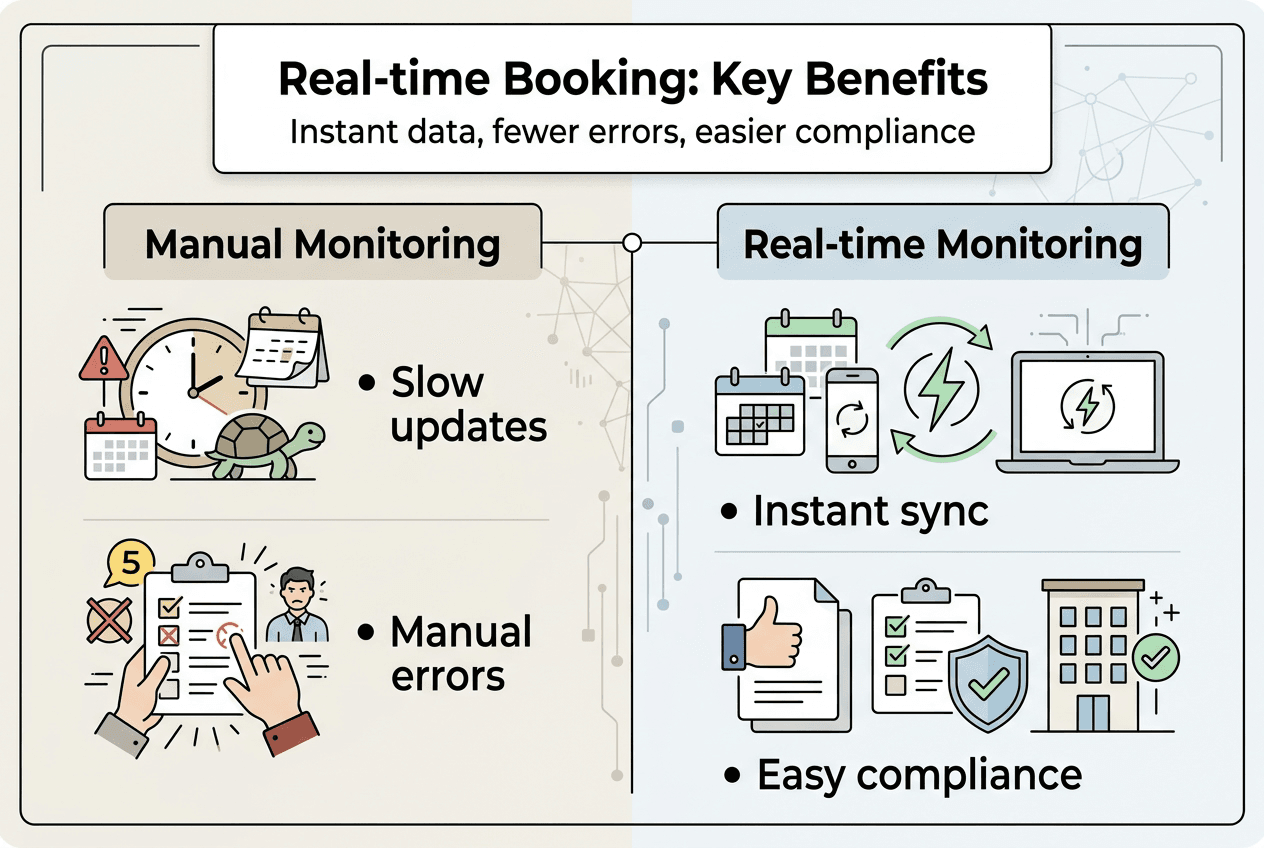
Automation reduces manual errors and speeds data submission securely. Consider the typical workflow without automation: receive booking notification, manually enter guest details into your PMS, transcribe information to local compliance portals, verify accuracy, submit within deadline. Each step introduces error risk and consumes valuable time. Real-time monitoring collapses this workflow into a single automated process.
The scale of European short-term rentals underscores why automation matters. Airbnb, Expedia and Booking hosted 398 million guest nights in the EU in Q3 2025, underscoring volume and compliance stakes. Managing even a modest portfolio of 10 properties across multiple platforms means processing hundreds of bookings monthly. Manual monitoring becomes unsustainable at that volume.
Top 5 ways real-time monitoring reduces risks and saves time:
- Eliminates overbooking penalties by synchronising availability instantly across all platforms, protecting your revenue and platform standing.
- Ensures compliance deadlines are met automatically through instant data submission to local authorities, avoiding fines and legal complications.
- Reduces administrative workload by 70-80% through automated data capture and reporting, freeing time for guest experience improvements.
- Provides instant visibility into portfolio performance via centralised dashboards, enabling data-driven decisions about pricing and availability.
- Minimises guest complaints related to booking errors or miscommunication, protecting your reputation and review scores.
Pro Tip: Integrate with trusted PMS and booking platforms for seamless data flow. Choose solutions offering native integrations rather than third-party middleware, which introduces additional failure points and delays.
Automating booking compliance transforms compliance from a constant worry into a background process. You focus on hospitality whilst systems handle regulatory requirements. Property automation examples demonstrate how early adopters have cut compliance work by 75% whilst improving accuracy. Real-time booking dashboards provide the command centre for managing these automated processes effectively.
Streamline your short-term rental compliance with GuestAdmin solutions
Navigating European compliance requirements whilst managing multiple properties demands sophisticated automation. GuestAdmin offers automated real-time booking monitoring specifically designed to simplify compliance for short-term rental managers across Europe. Our platform captures booking data instantly from major OTAs and PMS systems, processes guest information securely, and submits required data to local authorities within regulatory timeframes.
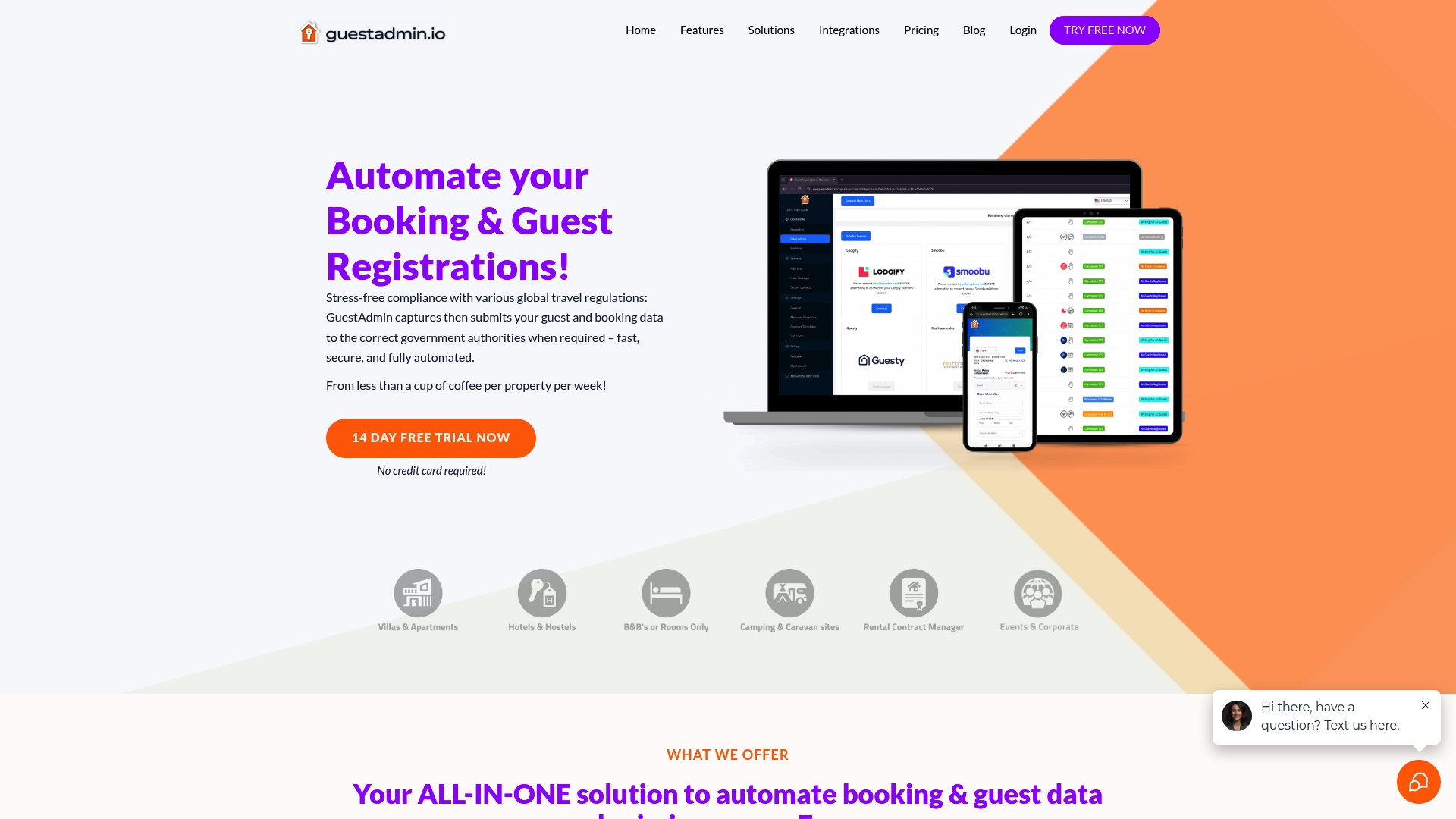
Support for multi-property owners ensures consistent data reporting and licence management across your entire portfolio. Whether you manage 5 properties or 500, GuestAdmin scales effortlessly whilst maintaining the accuracy authorities demand. Integration with multiple booking platforms reduces manual work and compliance risk, creating a single source of truth for all your rental data.
Automate booking compliance tools handle the complexity of varying local requirements whilst you focus on guest experience. Our multi-property management compliance features provide centralised control with property-specific customisation. Real-time booking dashboards give you instant visibility into compliance status, upcoming submissions, and potential issues requiring attention.
What is real-time booking monitoring? Frequently asked questions
What is real-time booking monitoring and how does it differ from traditional methods?
Real-time booking monitoring synchronises booking data instantly across all platforms using event-driven webhooks, updating within seconds of any change. Traditional polling methods check for updates at fixed intervals, creating 5-15 minute delays where overbooking and data errors can occur.
Why is real-time booking monitoring critical for compliance with EU regulations in 2026?
EU Regulation 2024/1028 requires accurate, timely reporting of booking and guest data to national authorities from May 2026. Real-time monitoring ensures you meet 24-hour submission deadlines consistently whilst maintaining data accuracy across all properties, preventing fines and legal complications.
Which technologies enable real-time booking monitoring for short-term rentals?
API integrations and webhook architectures form the foundation of real-time monitoring. These technologies create bidirectional data flows between booking platforms, property management systems, and compliance databases, enabling instant synchronisation without manual intervention.
How does real-time booking monitoring improve operational efficiency for property managers?
Real-time monitoring eliminates 70-80% of manual data entry by automating booking capture and compliance reporting. It prevents double bookings, reduces guest complaints, and provides centralised visibility across your entire portfolio through unified dashboards.
What should European rental owners look for in a booking monitoring system?
Prioritise systems offering two-way real-time synchronisation, native integrations with major platforms, automated compliance reporting for multiple jurisdictions, and GDPR-compliant data handling. Legal compliance guides for Europe help evaluate whether systems meet regulatory requirements. Understanding guest registration requirements in your operating jurisdictions ensures your chosen system addresses specific local needs.
Recommended
- Real-time booking dashboards cut compliance work by 50% in 2026
- Real-Time Booking Dashboards: Enhancing Rental Compliance
- Automate booking compliance for short-term rentals 2026
- Property Management Trends 2026: 60% Time Saved with Automation
- Master defining ad placement for higher ROI in 2026 – Palmador Blog
- How AI Automation Is Reshaping Enterprise Operations in 2026 — SimplyAI
25 Comments
ciprofloxacin hcl 500 mg
ciprofloxacin hcl 500 mg
ciprofloxacin hcl 500 mg
fluconazole 100 mg tablet
fluconazole 100 mg tablet
fluconazole 100 mg tablet
Streamline booking workflows for rental compliance 2026
[…] Real-time booking monitoring: why it matters in 2026 […]
cap vibramycin 100mg
cap vibramycin 100mg
cap vibramycin 100mg
doxycycline hyclate 100 mg tab
doxycycline hyclate 100 mg tab
doxycycline hyclate 100 mg tab
lasix furosemide 40 mg
lasix furosemide 40 mg
lasix furosemide 40 mg
sertraline 25mg for sleep
sertraline 25mg for sleep
sertraline 25mg for sleep
augmentin antibiotic
augmentin antibiotic
augmentin antibiotic
tadalafil commercial name
tadalafil commercial name
tadalafil commercial name
viagra best songs
viagra best songs
viagra best songs
dutasteride receding hairline
dutasteride receding hairline
dutasteride receding hairline
semaglutida para que serve
semaglutida para que serve
semaglutida para que serve
Real-time booking dashboard advantages for managers
[…] how real-time booking monitoring ties directly into compliance obligations is increasingly important for managers operating across […]
does doxycycline give you heartburn
does doxycycline give you heartburn
does doxycycline give you heartburn
cialis headaches reddit
cialis headaches reddit
cialis headaches reddit
acyclovir cream price in india
acyclovir cream price in india
acyclovir cream price in india
ivermectin mechanism FAQ
ivermectin mechanism FAQ
ivermectin mechanism FAQ
avanafil pharmacological side effects
avanafil pharmacological side effects
avanafil pharmacological side effects
vardenafil cautionary risks
vardenafil cautionary risks
vardenafil cautionary risks
orlistat use limitations
orlistat use limitations
orlistat use limitations
medical review transparency
medical review transparency
medical review transparency
online safety fraud prevention
online safety fraud prevention
online safety fraud prevention
orlistat adverse effects
orlistat adverse effects
orlistat adverse effects
augmentin medical description
augmentin medical description
augmentin medical description
Alcohol Impact on PK Curve
Alcohol Impact on PK Curve
Alcohol Impact on PK Curve