

Many property owners assume that simply collecting guest details satisfies their legal obligations, but the reality of government reporting for short-term rentals is far more complex and strictly enforced. With EU Regulation 2024/1028 now harmonising data collection requirements across member states from May 2026, understanding precisely what data to collect, when to submit it, and how to maintain compliance has become essential. This guide clarifies your reporting obligations, explains the deadlines and data elements required, and shows you how to manage compliance efficiently whilst avoiding severe penalties.
Table of Contents
- Key takeaways
- Understanding government reporting obligations for short-term rentals
- Key data elements and deadlines for reporting guests
- How to comply: digital systems, automation, and penalties for non-compliance
- Special considerations: GDPR data security, multi-jurisdiction management, and annual reporting
- Manage your rental compliance with ease
- Frequently asked questions about government reporting for rentals
Key Takeaways
| Point | Details |
|---|---|
| Harmonised reporting May 2026 | From May 2026 EU Regulation 2024/1028 harmonises data collection across member states, creating standardised reporting requirements for short term rentals. |
| Deadline variability by country | Deadlines vary by jurisdiction and can be as strict as a few hours after guest arrival. |
| Core data elements | The essential data elements cover identity information and booking details including full legal name exactly as shown on official documents, date of birth, nationality, ID numbers, contact details, check in and check out dates, number of guests, total nights and the property registration identifier. |
| GDPR storage mandatory | Data must be stored securely in line with GDPR and retained for the periods specified by each authority. |
| Digital tools essential | Employing digital tools and automation supports timely submission, data accuracy and easier ongoing compliance. |
Understanding government reporting obligations for short-term rentals
Government reporting for short-term rentals means property owners must systematically collect guest information and submit it to designated authorities within strict timeframes. EU Regulation 2024/1028 mandates harmonised data collection and sharing for short-term rentals starting May 2026, creating uniform standards across member states whilst allowing some local variations. This legislation fundamentally changes how property owners operate, moving from voluntary or inconsistent local schemes to mandatory, standardised reporting.
The scope of these obligations extends to virtually all short-term rental properties offered through platforms or direct bookings. Hosts must register their property where local registration schemes exist and report detailed guest data for every booking. The regulation aims to improve tax collection, enhance security, and provide authorities with accurate tourism statistics. Understanding property owner responsibilities for EU rentals helps you navigate these complex requirements effectively.
Core reporting requirements include:
- Guest identity verification and documentation for all adults staying at your property
- Booking details including check-in and check-out dates, number of guests, and total nights
- Property registration numbers and unique identifiers for each listing you operate
- Real-time or near-real-time submission to country-specific government portals
- Secure data storage compliant with GDPR regulations for specified retention periods
Compliance deadlines vary by jurisdiction but are universally tight. Italy requires submission within 6 hours of guest arrival, whilst Spain’s requirements vary by autonomous region, with some demanding reporting within 24 hours. France, Portugal, and other EU nations each maintain their own submission portals and technical specifications, though the underlying data elements remain largely consistent under the new regulation. Missing these deadlines exposes you to immediate enforcement action and financial penalties.
Different countries implement certain rules with local variations despite EU harmonisation. Some require additional fields such as vehicle registration details or purpose of stay, whilst others focus solely on core identity and booking data. Hotels often operate under separate reporting schemes with different requirements than short-term rentals, so understanding your property classification matters significantly.
Key data elements and deadlines for reporting guests
The essential guest data you must collect falls into two categories: identity information and booking details. Identity data includes full legal name exactly as shown on official documents, date of birth, nationality, passport or national ID number, and contact information including email and phone number. Booking data encompasses check-in and check-out dates, number of guests by age category, total nights booked, and your property’s unique registration identifier.
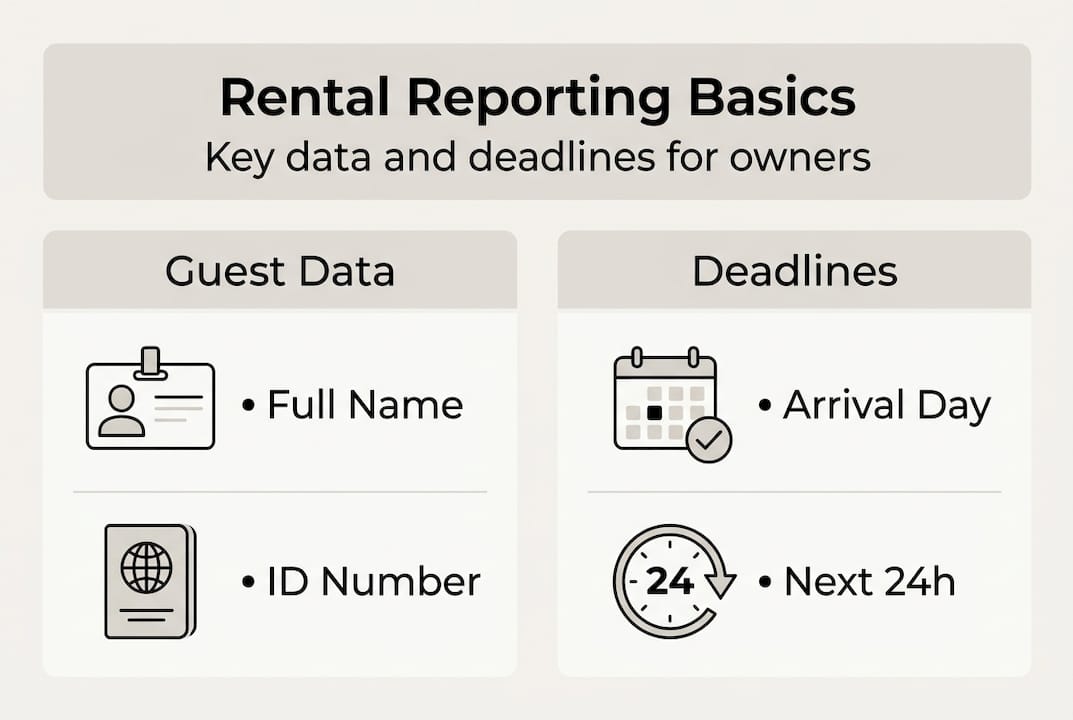
Hosts must collect data such as full name, date of birth, nationality, ID number, contact information, and booking dates, often within 24 hours of guest check-in, with specific timeframes varying by country. The precision required is absolute: misspelt names, incorrect ID numbers, or missing fields will trigger rejection from government portals, forcing resubmission and potentially causing deadline violations.
Submission deadlines create the greatest compliance challenge for property owners:
| Country | Submission deadline | Additional requirements |
|---|---|---|
| Italy | 6 hours after check-in | Vehicle registration if applicable |
| Spain | 24 hours (varies by region) | Purpose of stay in some regions |
| France | Before guest arrival | Accommodation tax declaration |
| Portugal | 24 hours after check-in | Tourist tax reporting |
| Germany | Immediate upon check-in | Local registration varies by city |
These tight deadlines mean manual data entry becomes practically impossible for properties with regular turnover. A Friday evening check-in requires weekend processing, and multiple same-day arrivals compound the workload exponentially. Delays risk substantial fines and enforcement actions, with authorities increasingly using automated systems to detect late or missing submissions.
Some jurisdictions require additional fields beyond the core data set. Vehicle registration details matter in tourist areas with parking restrictions. Purpose of stay helps authorities distinguish between leisure and business travel for statistical purposes. Hotels operating under different licensing schemes often have separate reporting portals and requirements than short-term rental properties, though both must comply with national data protection standards.
Pro Tip: Automate data capture by integrating your booking system with official government portals through API connections or middleware platforms. This eliminates manual transcription errors, ensures submissions meet exact deadline requirements, and maintains audit trails proving compliance if authorities question your records.
How to comply: digital systems, automation, and penalties for non-compliance
Digital submission portals vary significantly across countries, each requiring exact data formats, specific authentication methods, and unique technical specifications. Italy’s Alloggiati Web portal, Spain’s regional tourist registration systems, France’s COMEDEC platform, and Portugal’s RNET each operate differently despite harmonisation efforts. Successfully submitting booking data for compliance requires understanding these technical requirements and maintaining reliable submission workflows.
Integrating online travel agencies and property management systems ensures seamless compliance by automatically capturing guest data at booking and transmitting it to relevant authorities on schedule. Automation tools integrating with property management systems allow hosts to submit guest data digitally to country-specific portals on time, reducing manual workload whilst improving accuracy. These systems typically offer:
- Real-time data synchronisation from booking platforms to government portals
- Automated validation checking data completeness and format before submission
- Retry mechanisms handling temporary portal outages or connectivity issues
- Comprehensive audit logs documenting every submission with timestamps and confirmation receipts
Failure to report accurately or punctually leads to severe financial and operational consequences. Non-compliance penalties range from €1,000 to €50,000 fines, licence revocation, and platform delisting, with authorities increasingly coordinating enforcement across jurisdictions. Barcelona recently imposed a €64 million fine on a major platform for systematic reporting failures, whilst Paris routinely issues fines up to €50,000 per violation for hosts who repeatedly miss deadlines or submit incomplete data.
Beyond financial penalties, non-compliance can result in:
- Immediate suspension of your rental licence, preventing legal operation until resolved
- Mandatory delisting from major booking platforms that verify compliance status
- Criminal liability in extreme cases involving deliberate fraud or data falsification
- Retrospective audits examining years of historical bookings with compounded penalties
Pro Tip: Maintain comprehensive audit trails and proof of submission for every guest report. Save confirmation receipts, submission timestamps, and copies of data transmitted. These records become essential evidence if authorities dispute your compliance or if technical issues cause submission failures outside your control.
“Automation doesn’t just save time, it fundamentally reduces legal risk by eliminating the human errors that trigger most compliance violations. Property managers using integrated systems report 94% fewer submission failures compared to manual processes.”
Leveraging automated booking compliance solutions transforms reporting from a constant administrative burden into a background process requiring minimal oversight. This shift allows you to focus on guest experience and property operations rather than wrestling with government portals and deadline anxiety.

Special considerations: GDPR data security, multi-jurisdiction management, and annual reporting
Securely storing and protecting personal guest data under GDPR requirements adds another compliance layer beyond simple reporting. GDPR mandates secure storage of guest data for 2 to 6 years followed by deletion, with multi-listing properties required to track via unique IDs for each property. This means implementing encryption for data at rest and in transit, restricting access to authorised personnel only, and maintaining detailed logs of who accessed what data and when.
Managing properties across multiple regions compounds complexity significantly. Each jurisdiction maintains separate registration systems, unique property identifiers, and distinct reporting portals. A property manager operating listings in Barcelona, Paris, and Rome must navigate three entirely different technical systems, each with its own authentication credentials, data format specifications, and submission schedules. Tracking multiple listings requires assigning unique identifiers to each property and maintaining separate compliance records per jurisdiction.
Annual anonymised reporting requirements exist in some countries alongside real-time guest data submissions. Spain requires an annual anonymised report to the Land Registry detailing guests and rental purposes, separate from regional tourist registrations. This summary report aggregates your yearly rental activity without identifying individual guests, providing authorities with statistical data for urban planning and tourism management purposes.
Deadlines and additional fields vary for edge cases that don’t fit standard tourist scenarios. Business travellers may require different classification than leisure guests. Long-term stays exceeding 30 days might fall under different reporting rules in some jurisdictions. Vehicle information becomes mandatory in areas with parking restrictions or environmental zones. Understanding these nuances prevents unexpected compliance gaps.
Hotels and hostels often operate under separate licensing and reporting schemes despite offering similar accommodation services. Traditional hospitality businesses typically report through established police registration systems predating short-term rental regulations, though they must still verify their specific local requirements haven’t changed under new EU rules.
Maintaining GDPR compliance whilst meeting government reporting obligations requires following these key steps:
- Implement end-to-end encryption for all guest data stored in your systems or transmitted to government portals
- Establish clear data retention policies specifying exactly how long you’ll store information before secure deletion
- Create access controls limiting who can view or modify guest data within your organisation
- Document your data processing activities in a GDPR-compliant register available for regulatory inspection
- Provide guests with transparent privacy notices explaining what data you collect, why, and how long you retain it
- Implement secure backup systems ensuring data isn’t lost whilst preventing unauthorised access
- Establish breach notification procedures to alert authorities and affected guests within 72 hours if security incidents occur
Understanding property management data security requirements for Europe helps you balance reporting obligations with privacy protection, ensuring you meet both sets of legal requirements simultaneously.
| Data element | Retention period | Deletion requirement |
|---|---|---|
| Guest identity data | 2-6 years (varies by country) | Mandatory secure deletion after retention period |
| Booking records | Minimum 6 years for tax purposes | Can retain longer if legitimate business need documented |
| Payment information | 7 years for accounting compliance | Must anonymise or delete after period expires |
| Marketing consent data | Until consent withdrawn | Immediate deletion upon guest request |
Manage your rental compliance with ease
Navigating the complex landscape of government reporting requirements across multiple European jurisdictions demands sophisticated tools designed specifically for property managers. Manual processes simply cannot keep pace with 6-hour submission deadlines, varying data format requirements, and the constant risk of costly penalties for missed reports.
Leveraging automated booking compliance solutions transforms your reporting workflow from a constant source of stress into a reliable background process. Integrated platforms connect directly with your existing property management systems and online travel agency accounts, automatically capturing guest data at the moment of booking and submitting it to the appropriate government portals within required timeframes. This automation eliminates transcription errors, ensures GDPR-compliant secure property management data handling, and maintains comprehensive audit trails proving your compliance if authorities ever question your records. Access a detailed compliance checklist for property management to verify you’re meeting every requirement across all your properties and jurisdictions.
Frequently asked questions about government reporting for rentals
What data do I need to report to government authorities?
You must report guest identity information including full name, date of birth, nationality, and ID document number, plus booking details such as check-in and check-out dates, number of guests, and your property’s registration identifier. Some jurisdictions require additional fields like vehicle registration or purpose of stay. Understanding property owner responsibilities for EU rentals ensures you capture all required data elements for your specific locations.
How quickly must I submit guest data after check-in?
Submission deadlines range from 6 hours in Italy to 24 hours in most other EU jurisdictions, with some countries like France requiring submission before guest arrival. These tight timeframes make automation essential, as manual processing cannot reliably meet such strict deadlines, especially for properties with frequent turnovers or multiple same-day check-ins.
What are the penalties for failing to comply with government reporting?
Penalties range from €1,000 to €50,000 per violation depending on jurisdiction and severity, with repeated failures leading to licence revocation and mandatory platform delisting. Barcelona recently imposed a €64 million fine on a major platform for systematic reporting failures, whilst Paris routinely issues maximum fines for hosts who repeatedly miss deadlines or submit incomplete data.
Can I automate the reporting process?
Yes, automation is not only possible but practically essential for reliable compliance. Integrated platforms connect your property management system directly to government portals, automatically submitting guest data within required timeframes whilst maintaining audit trails. Following a comprehensive booking data submission guide helps you implement automation effectively across all your properties.
How should I securely store guest data in compliance with GDPR?
Implement end-to-end encryption for data storage and transmission, restrict access to authorised personnel only, maintain detailed access logs, and establish clear retention policies specifying exactly when data will be securely deleted. GDPR requires storing guest information for 2 to 6 years depending on jurisdiction, followed by mandatory secure deletion to protect guest privacy whilst meeting government record-keeping requirements.
2 Comments
Navigate short-term rental regulations in Europe: 2026 guide
[…] guidance on government reporting requirements, a dedicated walkthrough explains exactly what data must go where and […]
Holiday Let Guest Book Requirements Explained - Guest Registration Services
[…] Europe, tourist accommodation providers are commonly required to register guests and transmit specified data to police, tourism, statistics or municipal systems. Some places require records shortly after […]