

European short-term rental managers are facing a sharp rise in enforcement activity, and the financial stakes have never been higher. Fines can reach €50,000+ for missed guest registration and reporting obligations across multiple EU jurisdictions. With sweeping digital registration rules taking effect from May 2026, the window to get your processes in order is narrowing fast. This article delivers a practical compliance checklist, explains the new digital registration requirements, and shows you how automation can dramatically reduce manual workload while keeping your properties fully protected.
Table of Contents
- Understanding the new EU digital compliance rules
- Property compliance checklist: Step-by-step essentials
- Automating guest data management for effortless compliance
- Edge cases, pitfalls, and verification: What can go wrong
- Take control of compliance with automation tools
- Frequently asked questions
Key Takeaways
| Point | Details |
|---|---|
| Know your EU obligations | EU-wide digital registration and platform reporting are mandatory from May 2026 for all rentals. |
| Adopt a step-by-step checklist | Following a practical compliance checklist prevents costly fines and streamlines operations. |
| Automate for accuracy and speed | Automation tools reduce manual errors and save time, protecting your listings and legal standing. |
| Validate and audit regularly | Ongoing audits and verification ensure sustained compliance and reduce risks. |
Understanding the new EU digital compliance rules
With new compliance standards enforced from 2026, property managers must first grasp the regulatory framework before building their checklist.
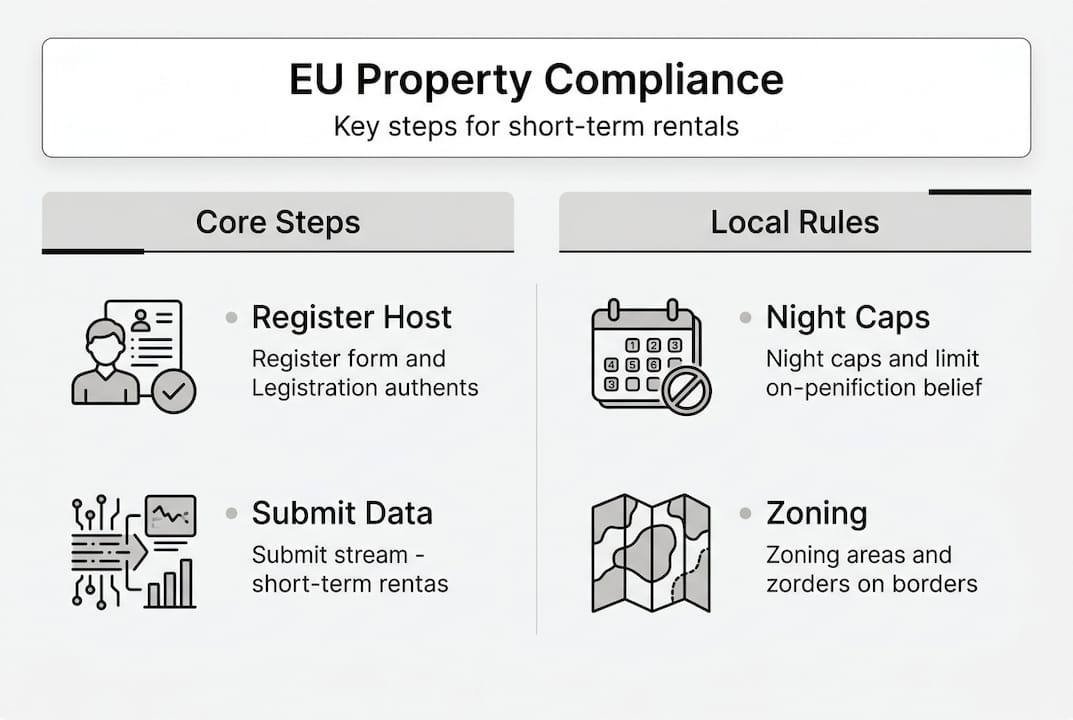
EU Regulation 2024/1028 mandates digital registration for all EU short-term rentals, requiring unique host registration numbers and monthly platform reporting from May 2026. This is a significant shift from the fragmented, country-by-country systems that many managers have navigated until now. The regulation introduces a standardised approach that affects every property listed on major online platforms.
A central feature of the new framework is the concept of single digital entry points (SDEPs). These are nationally operated portals where hosts register their properties and receive a unique registration number. That number must then be displayed on every online listing. Platforms are required to verify these numbers and report listing data monthly to national authorities.
For legal compliance requirements, platforms must now submit the listing address, registration number, nights rented, and guest numbers monthly for large platforms. This is a meaningful escalation from previous voluntary or inconsistent reporting practices.
It is important to note that licensing rules, night caps, and zoning restrictions remain regional. The EU regulation harmonises registration and reporting, but local authorities still set the rules on how many nights you can rent and whether a licence is required. Staying current with latest EU rental regulation insights is essential as local rules continue to evolve.
| Requirement | Pre-2026 approach | Post-May 2026 requirement |
|---|---|---|
| Host registration | Varies by country | Mandatory unique number via SDEP |
| Listing display | Inconsistent | Registration number required on all listings |
| Platform reporting | Voluntary or ad hoc | Monthly data submission for large platforms |
| Guest data reporting | Country-specific portals | Maintained locally, aligned with EU standards |
Property compliance checklist: Step-by-step essentials
Now that the rules are clear, the next move is to build your property compliance process step-by-step.
Core compliance items include obtaining and displaying your registration number, collecting guest ID and reporting it within 24 hours, maintaining GDPR-compliant data storage, conducting regular safety checks, and filing taxes correctly. These are the non-negotiable foundations for every property in your portfolio.
Here is a practical step-by-step checklist:
- Register your property via your country’s SDEP and obtain your unique registration number.
- Display the registration number on all online listings, including Airbnb, Booking.com, and your own website.
- Collect guest ID at check-in using a compliant digital or physical process.
- Submit guest data to the relevant authority within the required timeframe (24 hours for most EU countries; 6 hours for Italy).
- Store guest data securely in encrypted, GDPR-compliant systems for the required retention period.
- Conduct safety checks covering fire safety, carbon monoxide detectors, and emergency exit signage.
- File local taxes including tourist tax, VAT where applicable, and income declarations.
- Audit your compliance records quarterly to catch gaps before inspections occur.
Jurisdiction-specific requirements vary considerably. Spanish SES.Hospedajes and Italian Alloggiati Web are the primary guest submission portals in those countries, with fines ranging from €1,000 to €50,000+. Data retention requirements span 2 to 6 years depending on the country.
| Country | Submission portal | Deadline after check-in | Data retention |
|---|---|---|---|
| Spain | SES.Hospedajes | 24 hours | 3 years |
| Italy | Alloggiati Web | 6 hours | 5 years |
| France | Local mairie system | 24 hours | 2 years |
| Germany | Local Einwohnermeldeamt | 24 hours | 6 years |
For a full breakdown of guest registration requirements by country, including document types accepted and portal access instructions, it is worth reviewing the dedicated guidance for each jurisdiction you operate in.
Pro Tip: Set calendar reminders for quarterly compliance audits. Regulations change frequently, and a brief review every three months can prevent costly oversights before they become enforcement issues.
Short-term rental safety rules are also tightening across Europe. Smoke alarms, fire extinguishers, and clearly posted emergency contacts are now standard requirements in most jurisdictions, not optional extras.
Automating guest data management for effortless compliance
Completing compliance manually is overwhelming. Automation can radically simplify the process and give you genuine confidence that nothing is missed.

Automation tools cut errors by up to 60% and reduce admin time by up to 87%, with platforms such as GuestAdmin, Chekin, and Guesty integrating directly with your existing systems. These are not marginal improvements. For a manager handling ten or more properties, that time saving translates directly into fewer late-night data entries and far fewer compliance risks.
Here is what a well-configured automation setup handles for you:
- Guest ID collection via digital check-in forms sent automatically before arrival
- Document verification using AI-powered scanning to confirm ID validity
- Automatic submission to national portals including SES.Hospedajes (Spain), Alloggiati Web (Italy), SEF (Portugal), and equivalents in France, Germany, and Czechia
- GDPR-compliant data archiving with encrypted storage and automatic deletion after the required retention period
- Real-time dashboards showing submission status across your entire portfolio
- Integration with major PMS and OTA platforms via APIs and webhooks, so booking data flows directly into your compliance workflow
Pro Tip: Before May 2026, run a full integration test between your PMS and your compliance automation tool. Identify any data mapping gaps early, particularly for guest nationality fields and document types, which vary by country portal.
For compliant guest data storage, encryption at rest and in transit is the baseline. Any tool you choose should be able to demonstrate GDPR compliance documentation and provide audit logs on request.
The regulatory tech landscape for rentals is maturing quickly. Choosing a platform with active development and jurisdiction-specific updates means you are not scrambling every time a country changes its portal or deadline requirements.
Edge cases, pitfalls, and verification: What can go wrong
Even with a checklist and automation in place, it is vital to anticipate error sources and unique scenarios for full coverage.
The most common failure points for property managers include manual data entry errors, outdated records in PMS systems, and relying on multiple disconnected portals without a central overview. Multi-property managers need a consistent single source of truth across their PMS and OTA integrations. Without it, manual errors frequently lead to significant fines and platform delisting.
Some edge cases catch managers off guard:
- Professional vs non-professional host distinctions: Several countries apply different rules depending on whether you are classified as a professional operator. This affects tax obligations, licensing requirements, and reporting frequency.
- Integration errors: A PMS update or OTA API change can silently break your data submission pipeline. Without monitoring, you may not notice until a fine arrives.
- Overlapping deadlines: If a guest checks in late at night in Italy, the 6-hour submission window means data must be submitted before dawn. Manual processes simply cannot reliably meet this requirement.
- Listing display failures: If your registration number is missing from a listing after a platform update, you may be flagged for non-compliance even if your underlying registration is valid.
“Spain fined Airbnb €64M for unlicensed listings; platforms may delist thousands of non-compliant properties overnight.”
This is not a theoretical risk. Delisting removes your revenue stream immediately, often without prior warning. The reputational damage to your property’s review history can take months to recover.
For multi-property management, verification steps should include quarterly audits of all active registrations, testing of integration pipelines before and after any platform updates, and a review of each country’s portal for any rule changes. The guest registration guide provides a useful reference for checking current portal requirements by jurisdiction.
Take control of compliance with automation tools
The most efficient route to sustained compliance is harnessing proven automation solutions tailored to your property portfolio.
GuestAdmin is built specifically for European short-term rental managers who need reliable, automated compliance across multiple jurisdictions. From digital guest onboarding to automatic submission to national portals, the platform removes the manual burden and replaces it with a clear, auditable process.
Whether you manage two properties or two hundred, the automation in rentals compliance approach scales with your portfolio. You can explore the full legal compliance guide to understand exactly what is required in each country you operate in, then book a demo to see how GuestAdmin maps to your specific setup. The 2026 deadline is close. Getting your compliance infrastructure right now means you can focus on growing your portfolio rather than managing regulatory risk.
Frequently asked questions
What is the EU registration number, and how do I get it?
The EU registration number is a unique code assigned to each short-term rental listed online. You apply for it through your country’s single digital entry point, as required by EU Regulation 2024/1028, and the number must be displayed on all your listings.
How quickly must guest data be submitted after check-in?
Most European countries require guest ID data to be submitted within 24 hours of check-in. Italy is stricter, with a 6-hour submission deadline that makes manual compliance particularly challenging.
What happens if I miss a compliance deadline?
Missed deadlines can result in fines, platform delisting, and in some countries, criminal penalties. Spanish authorities fined Airbnb €64M for unlicensed listings, illustrating how seriously enforcement is being taken across Europe.
Can automated tools handle multi-property portfolio compliance?
Yes. Tools such as GuestAdmin, Chekin, and Guesty integrate with property management systems to manage compliance across multiple rentals. Automation handles data collection, verification, and submission, significantly reducing the risk of manual errors across a large portfolio.
How should guest IDs be stored to comply with GDPR?
Guest ID data must be encrypted and stored for 2 to 6 years, depending on the country. GDPR-compliant encrypted storage is the legal baseline, and any platform you use should provide audit logs and automatic deletion once the retention period expires.
One Comment
Why choose SaaS for rentals: Effortless compliance & automation
[…] the guesswork from regulatory obligations. Whether you manage two properties or two hundred, the compliance automation guide can help you understand exactly how GuestAdmin fits your operational […]