

TL;DR:
- Proper automation ensures compliance, reduces errors, and prevents delisting risks in European short-term rentals.
- Manual data handling is error-prone, time-consuming, and not scalable for growing property portfolios.
- Using integrated, secure tools with automated submission workflows safeguards revenue and regulatory standing.
One weak link in your guest booking data handling could mean regulatory fines, platform delisting, or both. Across Europe, authorities are tightening their grip on short-term rentals, and non-compliant properties face delisting from major platforms. The stakes are real. Whether you manage one property or fifty, how you capture, validate, and submit guest data directly affects your legal standing and your income. This guide walks you through the full booking data processing workflow, from understanding what’s required to automating every step securely and efficiently.
Table of Contents
- Understanding the booking data processing challenge
- Essential tools and prerequisites for secure processing
- Step-by-step: Automating your booking data processing workflow
- Staying compliant and troubleshooting workflow issues
- Why practical automation is the property manager’s best defence
- Automate compliance and booking workflows the smart way
- Frequently asked questions
Key Takeaways
| Point | Details |
|---|---|
| Compliance is crucial | Failure in booking data processing can lead to delisting and a drop in rental supply. |
| Automate for security | Automation minimises errors, secures guest data, and ensures regulatory reporting accuracy. |
| Prepare the right tools | Choosing proper software and integrating security is foundational for workflow success. |
| Verify and adapt | Regularly check and update your processes to stay compliant with evolving European regulations. |
Understanding the booking data processing challenge
Setting the scene for why a robust workflow matters, we’ll first break down what booking data processing involves and what’s really at stake.
Booking data processing refers to the end-to-end workflow of collecting guest information at the time of reservation, validating that data against regulatory requirements, storing it securely, and submitting it to the relevant government authority within a set timeframe. It sounds straightforward. In practice, it’s one of the most administratively demanding tasks a property manager faces, especially when you’re operating across multiple jurisdictions with different rules.
The booking data compliance process has grown significantly more complex since the EU introduced stricter short-term rental regulations. Platforms are now jointly liable for the properties they list, which means they must actively delist properties that fail to meet reporting obligations. Cities enforcing these rules have seen an 18–30% drop in short-term rental supply as a direct result.
“Platforms face strict joint liability and must delist non-compliant properties. Cities have already seen an 18–30% drop in short-term rental supply as enforcement takes hold.”
Understanding your legal obligations for rentals is the first step. Most European jurisdictions require the following guest data fields at a minimum:
- Full legal name
- Date of birth
- Nationality
- Passport or national ID number
- Travel dates (check-in and check-out)
- Number of guests
- Country of residence
- Contact details
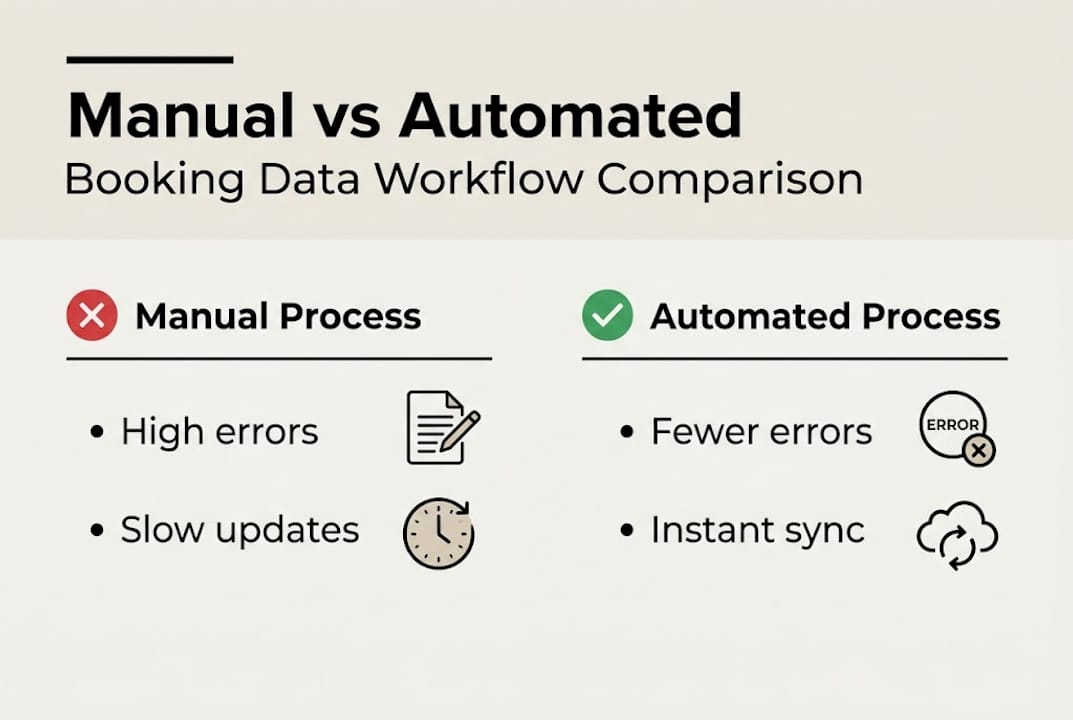
Manual processing of this data is error-prone and time-consuming. A missed field, a typo in a passport number, or a late submission can trigger a compliance failure. Here’s how manual and automated workflows compare:
| Factor | Manual workflow | Automated workflow |
|---|---|---|
| Data entry | Human input, high error risk | System-captured, validated automatically |
| Submission timing | Dependent on staff availability | Triggered within 24 hours of booking |
| Audit trail | Spreadsheets or paper records | Digital logs with timestamps |
| Regulatory updates | Manual monitoring required | Provider updates rules automatically |
| Scalability | Difficult beyond a few properties | Handles hundreds of properties |
| GDPR compliance | Inconsistent | Built-in encryption and access controls |
The contrast is stark. Manual workflows might work for a single property with low booking volumes, but they are not sustainable as your portfolio grows or as regulations become more demanding.
Essential tools and prerequisites for secure processing
Understanding the risks and requirements means the right setup comes next. Here’s how to choose and prepare essential tools for workflow automation.
Before you automate anything, you need the right foundation. Three minimum requirements apply to every property manager operating in the European short-term rental market: a secure digital platform capable of handling guest data, a valid regulatory registration or licence number for each property, and encrypted storage that meets GDPR standards.
Choosing the right property management software options is critical. Not all platforms are built with compliance in mind. Look for tools that integrate directly with government reporting portals, not just OTA (Online Travel Agency) channels. Automation is consistently praised by leading providers as the most reliable route to compliant data handling.

Here’s a comparison of tool categories available to property managers:
| Tool type | Compliance features | Provider examples |
|---|---|---|
| Full compliance platform | Government portal integration, AI validation, archiving | GuestAdmin.io |
| Guest check-in software | ID capture, digital signature, partial reporting | Chekin |
| Full PMS | Booking management, some reporting integrations | Guesty, Hostaway |
| Manual + spreadsheet | None built-in | N/A |
When evaluating any tool, prioritise these security features:
- End-to-end data encryption (in transit and at rest)
- Role-based access controls to limit who can view guest data
- Audit logs that record every action taken on a record
- Automatic data retention and deletion policies aligned with GDPR
- Two-factor authentication for platform access
Integration capability matters enormously. A platform that connects to your existing PMS, your OTA channels, and your local government portal saves you from duplicating data entry across systems. Explore the automation solutions overview to understand what’s available for your specific market.
Pro Tip: Choose tools that already integrate with multiple regulatory portals across different countries. Even if you only operate in one market today, regulations shift and portfolios grow. Future-proofing your stack now avoids a costly migration later.
Step-by-step: Automating your booking data processing workflow
With the right foundation in place, automating your workflow is now straightforward. Follow these actionable steps for efficient, compliant processing.
Automation sharply reduces the risks and errors associated with manual data entry. Here is a clear, numbered process to follow:
- Preparation: Configure your platform with property registration details, regulatory IDs, and submission deadlines for each jurisdiction you operate in.
- Capture: Use a digital guest registration form or PMS integration to collect all required guest data fields at the point of booking or check-in.
- Validation: Run automated checks to confirm all required fields are present and correctly formatted before any submission is attempted.
- Encryption: Ensure all captured data is encrypted immediately and stored in a GDPR-compliant environment with restricted access.
- Government submission: Trigger automated submission to the relevant authority within the required timeframe, typically 24 hours of guest arrival.
- Archiving: Store confirmed submissions with timestamps and reference numbers for audit purposes, retaining records for the legally required period.
Pro Tip: Set up automated validation rules that flag incomplete or inconsistent guest data before it reaches the submission stage. Catching errors early prevents failed transmissions and the follow-up work they create.
Review time-saving automation tips for specific configuration advice. You should also ensure your system sends real-time alerts for failed transmissions so that nothing slips through unnoticed. Explore streamlined rental workflows to see how other managers have structured their processes.
Avoid these common mistakes that undermine even well-designed workflows:
- Submitting incomplete guest records due to missing mandatory fields
- Missing submission deadlines because of manual handoffs between systems
- Failing to back up submitted records in a retrievable format
- Relying on a single integration point with no fallback if it fails
- Not testing the workflow with dummy data before going live
Staying compliant and troubleshooting workflow issues
Even the best-automated workflows must be monitored and adapted. Here’s how to keep your booking data process robust and compliant.
Automation does not mean set-and-forget. Regulatory requirements change, integrations break, and submission portals update their specifications. Verifying that your workflow is functioning correctly is an ongoing responsibility.
Start by checking your audit logs regularly. Every compliant platform should generate a timestamped record of each submission, including confirmation receipts from the relevant authority. If a submission fails, the log should tell you why and when. Platforms must delist non-compliant properties without warning, so catching failures early is essential.
“Regulatory enforcement is not a future risk. It is a present reality. Properties that cannot demonstrate compliant data submission face immediate consequences, including removal from major booking platforms.”
Refer to the compliance submission guide for jurisdiction-specific verification steps. When something goes wrong, follow this troubleshooting sequence:
- Check the integration status between your PMS and the reporting platform
- Review the audit log for the specific submission that failed
- Test the connection using dummy booking data to isolate the issue
- Confirm that your regulatory registration details are current and correctly entered
- Escalate to your software provider if the issue persists beyond basic checks
Supply loss from non-compliance can reach up to 30% in cities with active enforcement. That figure represents real revenue loss for property managers who assume their workflow is running correctly without verifying it.
Build a compliance review into your annual calendar. Each year, check for regulatory updates in every jurisdiction you operate in, update your submission templates if required fields have changed, and re-test your workflow end-to-end. Regulations in 2026 continue to evolve, and what was compliant last year may not meet this year’s standards.
Why practical automation is the property manager’s best defence
Once you’re confident in your process, it’s worth pausing to consider what’s really protecting your operations in an increasingly challenging regulatory landscape.
There’s a temptation to treat automation as a convenience. It’s faster, yes. It reduces admin, certainly. But the more important truth is that automation is a form of risk management. Manual processes simply cannot keep pace with the volume of data, the frequency of regulatory updates, and the speed at which enforcement actions now move.
We’ve seen cases where a manager operating a small portfolio lost a listing because a spreadsheet formula broke and a submission never went through. No alert. No fallback. Just a compliance failure that could have been prevented with a properly configured automated system. That kind of disruption is not just inconvenient. It directly affects revenue and reputation.
The managers who fare best in this environment are those who invest in automation and risk reduction as a core part of their operations, not an afterthought. Scalable solutions, clean audit records, and systems that move with regulation are not luxuries. They are the baseline for operating responsibly in the European short-term rental market.
Automate compliance and booking workflows the smart way
Ready to put these strategies into action? GuestAdmin.io is built specifically for property managers who need compliant, automated booking data workflows without the administrative burden.
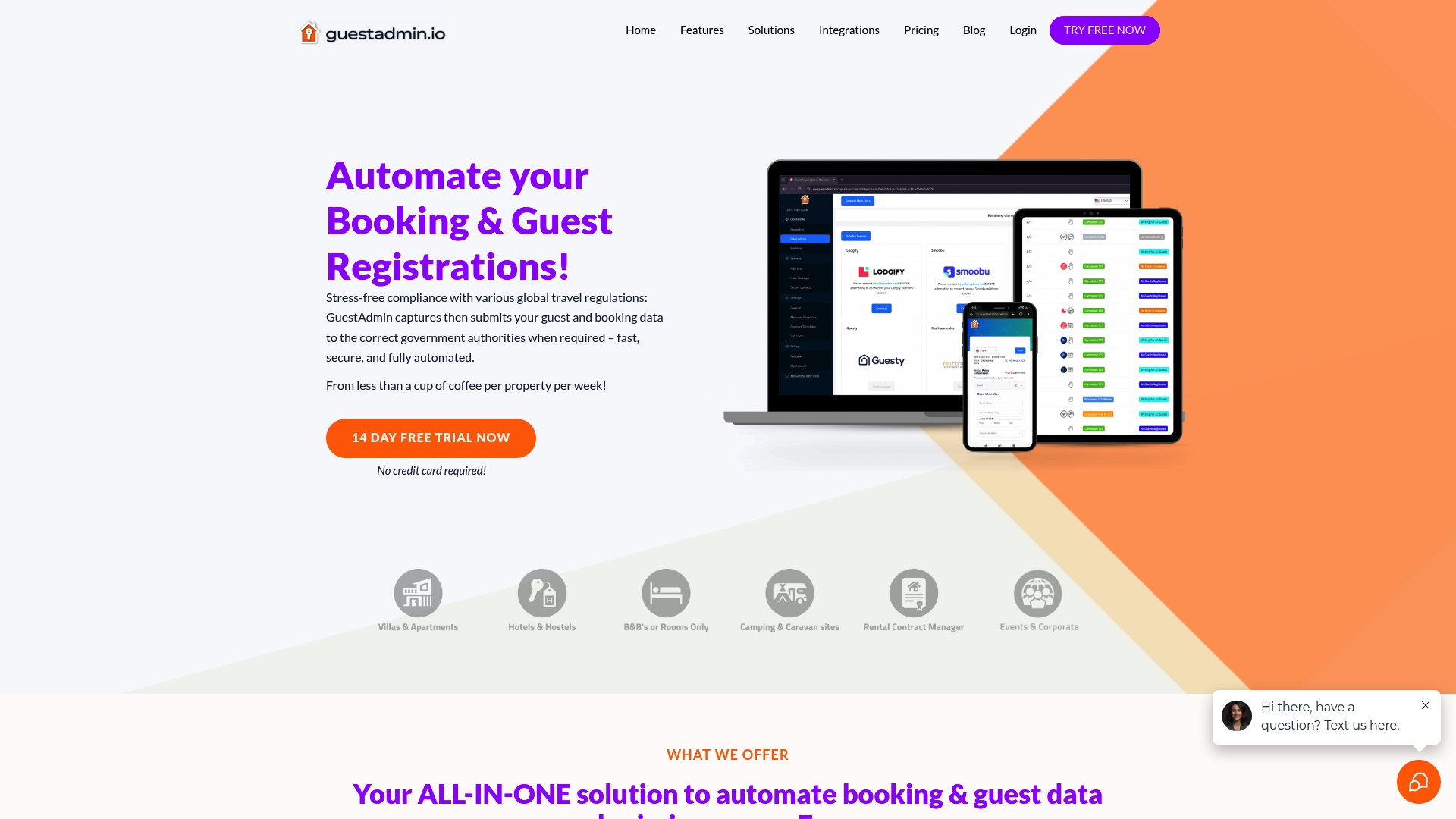
GuestAdmin.io captures, validates, and submits guest data to government authorities automatically, within 24 hours of arrival. It integrates with leading PMS platforms and OTA channels, supports multi-property management, and keeps your records GDPR-compliant and audit-ready. Whether you’re just getting started or managing a large portfolio, explore compliance explained for short-term rentals, learn how to streamline multi-property compliance, and discover the full potential of automation in rentals.
Frequently asked questions
What is a booking data processing workflow in property management?
It’s a structured process for capturing, validating, storing, and submitting guest data to meet legal and platform obligations in the European short-term rental market.
How does automation help with booking data compliance?
Automation reduces manual errors, prevents missed deadlines, and helps protect against regulatory fines or delisting by keeping submissions timely and accurate.
What are the main risks if booking data is mishandled?
Failure to process data correctly can result in property delisting and up to 30% supply loss in cities with active enforcement.
What tools are needed to automate booking data workflows?
Use secure property management software with built-in regulatory reporting, encryption, and integration features, as automation is recognised as the preferred route for secure data processing.
One Comment
Understanding booking data regulations for secure rentals
[…] via unsecured channels: Never send guest data by ordinary email; use secure portals or optimised booking data workflows […]