

A single workflow error can now trigger fines over €1,000 or instant listing removal under EU Regulation 2024/1028. For property managers across Europe, booking workflows are no longer routine administration. They are a legal and operational risk area that demands precision, speed, and the right systems. This guide walks you through exactly what has changed, what is at stake, and how to build workflows that keep you compliant and competitive in 2026.
Table of Contents
- Why booking workflows matter more in 2026
- Manual vs automated booking workflows: What’s at stake
- Country-specific risks: Navigating European compliance complexity
- Real-world impact: What property managers achieve with better workflows
- Getting started: Building robust workflows for 2026 compliance
- Bridge to easy compliance with smart workflow solutions
- Frequently asked questions
Key Takeaways
| Point | Details |
|---|---|
| Compliance is essential | Managing booking workflows is now critical for meeting strict European rental regulations in 2026. |
| Automation reduces risk | Automated workflows cut errors and admin time by over half, minimising fines and delisting threats. |
| Country rules vary | Compliance must account for local variations, with Spain and Italy especially strict under EU law. |
| Data management matters | Secure guest data handling is required, including 18-month retention and GDPR alignment. |
| Continuous audit needed | Routine checklist audits help maintain legal, financial, and operational control across properties. |
Why booking workflows matter more in 2026
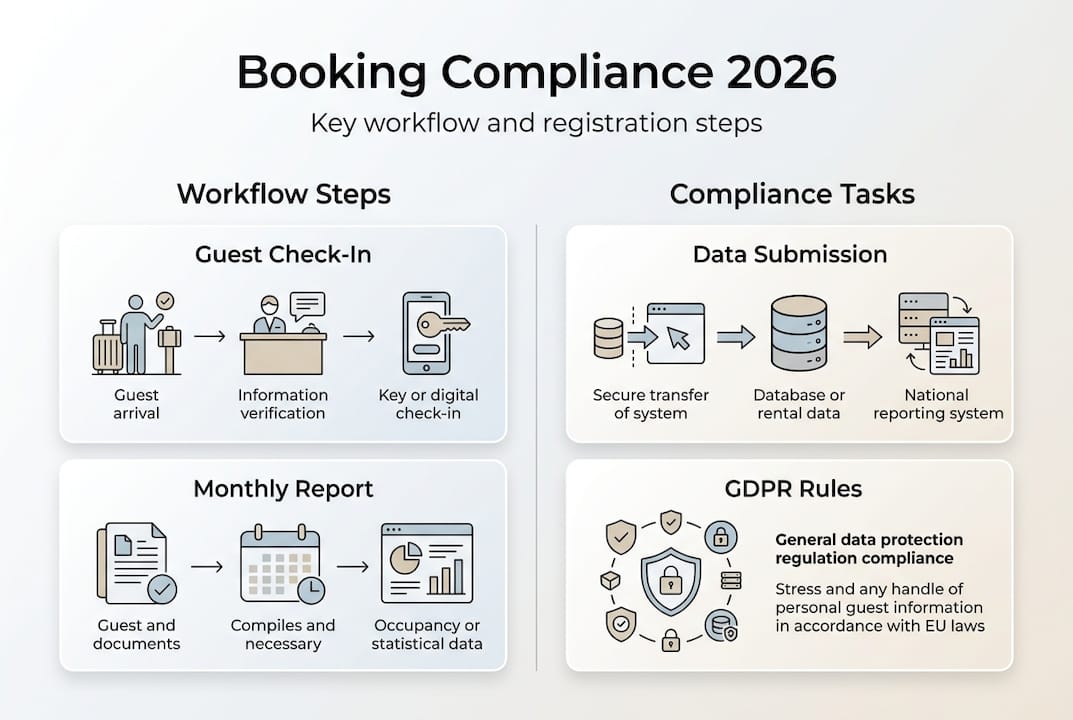
The regulatory landscape for short-term rentals in Europe shifted significantly with the introduction of EU Regulation 2024/1028. This regulation requires digital registration, unique property IDs, real-time data submission, and monthly SDEP (Single Digital Entry Point) reports. SDEP refers to the centralised EU system through which booking data must be submitted to national authorities. These are not optional extras. They are legal obligations.
Platforms such as Airbnb and Booking.com are now actively enforcing these rules. A listing without a valid registration ID can be removed within 24 hours. Manual errors can trigger fines starting at €1,000 per violation. For managers running multiple properties, the cumulative risk is substantial.
Understanding the compliance workflow basics is now a prerequisite for operating legally. Monthly reporting cycles, GDPR-compliant data retention for 18 months, and accurate guest registration are all non-negotiable. Booking workflow management is no longer a back-office task. It is a core business function.
| Compliance requirement | Deadline or frequency | Consequence of failure |
|---|---|---|
| Digital property registration | Before first listing | Immediate delisting |
| Unique registration ID display | Ongoing | Platform removal |
| SDEP monthly data report | Monthly | Fines from €1,000 |
| Guest data retention | 18 months minimum | GDPR penalty |
| Real-time data submission | Per booking | Audit failure |
The guest registration rules across Europe are increasingly standardised at the EU level, but local implementation varies. Staying on top of both layers is essential.
Manual vs automated booking workflows: What’s at stake
Manual booking management creates real, measurable risk. Spreadsheets, copy-pasted guest data, and separate OTA (Online Travel Agency) portals are prone to errors. Manual management causes double bookings, overbookings, and compliance failures that can result in fines or delisting.

Automation changes the equation entirely. Automation reduces admin work by up to 60%, errors by over 50%, and operational time by 80%. Those are not marginal gains. They represent a fundamental shift in how efficiently a property portfolio can be managed.
| Factor | Manual workflow | Automated workflow |
|---|---|---|
| Data entry errors | High | Minimal |
| OTA synchronisation | Manual, delayed | Real-time |
| Compliance submissions | Prone to omission | Automated, timely |
| Admin hours per month | 20+ hours | Under 5 hours |
| Scalability | Limited | High |
For managers with fewer than 20 properties, hybrid approaches are common. However, hospitality automation tools are increasingly accessible even for smaller portfolios, and the compliance risk of staying manual is growing. Automation centralises bookings, syncs OTAs, and captures guest data automatically, removing the human error factor from your most legally sensitive processes.
Pro Tip: Even if you manage only a handful of properties, automating your SDEP submissions and guest data capture alone can save hours each month and protect you from the most common compliance failures. Explore time-saving compliance automation to see where to start.
“Since switching to automated workflows, we have not missed a single submission deadline. The peace of mind alone is worth it, and we have reclaimed over 20 hours a month that used to go on admin.” — Property manager, Lisbon
Prioritising security in rental workflows is equally important. Guest data must be handled securely at every stage, from capture to submission to archiving.
Country-specific risks: Navigating European compliance complexity
EU Regulation 2024/1028 sets the framework, but each member state applies it differently. Spain and Italy require immediate audit response and are classified as Code Red jurisdictions, meaning enforcement is active and swift. France sits at Yellow status, with enforcement ramping up. Germany’s full implementation remains pending, but that does not mean managers there can afford to be complacent.
Data mismatches between OTA listings and SDEP submissions are one of the most common triggers for listing removal. If your Airbnb listing shows a different address format or registration number than what is submitted to the SDEP, you are at risk. Even minor discrepancies can flag an audit.
Common compliance pitfalls by location:
- Spain: Strict nightly caps in major cities; immediate audit response required; registration IDs must match across all platforms
- Italy: Regional variations in registration rules; Code Red enforcement; guest data must be submitted within 24 hours of arrival
- France: Yellow status but increasing enforcement; SDEP reporting now mandatory for most operators
- Germany: Pending full implementation; local city rules (e.g., Berlin) already apply strict short-term rental limits
- Portugal: Active enforcement; country-specific guest registration requirements include police reporting for non-EU guests
GDPR compliance applies across all of these markets, regardless of property size. Even a single-property host must handle guest data lawfully, store it securely, and be able to produce it on request. European data security standards are not optional for any operator.
Pro Tip: Check your local authority’s website at least quarterly. National implementations of EU Regulation 2024/1028 are still being updated, and nightly caps or registration requirements can change with little notice.
Real-world impact: What property managers achieve with better workflows
The numbers from managers who have overhauled their booking workflows are striking. One Spanish agency that scaled to over 400 properties using automation reported 38% revenue growth, 42% occupancy improvement, and 47 working weeks saved annually through workflow automation. That is nearly a full year of staff time recovered.
These results are not outliers. Across the industry, managers who invest in structured, automated workflows consistently report:
- Fewer compliance penalties: Automated submissions mean deadlines are never missed and data is always accurate.
- Higher occupancy rates: Real-time calendar sync across OTAs eliminates double bookings and last-minute gaps.
- Lower operational costs: Reducing manual admin by 60% or more frees staff to focus on guest experience and growth.
“We went from spending two days a week on compliance admin to less than two hours. The workflow changes paid for themselves within the first month.” — Operations manager, Barcelona
The 2026 automation trends show that AI-powered data processing and automated reporting are becoming standard, not premium features. Managers who adopt them now gain a competitive advantage that compounds over time. Equally, rental data privacy automation is reducing the risk of GDPR breaches, which carry their own significant financial penalties.
The organisational value extends beyond compliance. Better workflows mean better data, and better data means smarter decisions about pricing, availability, and property investment.
Getting started: Building robust workflows for 2026 compliance
Building a compliant booking workflow does not require a complete overhaul overnight. A structured approach makes the process manageable and effective.
- Audit your current workflow. Map every step from booking receipt to guest check-out. Identify where data is entered manually, where submissions happen, and where gaps exist.
- Map core compliance tasks. Automating core compliance steps including digital registration, guest data submission, calendar sync, and record keeping is best practice for 2026.
- Choose your automation tools. Select a platform that integrates with your existing OTAs and PMS (Property Management System). Ensure it supports SDEP reporting and GDPR-compliant data retention.
- Set up audit trails and data retention. Every guest record must be stored securely for at least 18 months. Your system should log every submission with timestamps.
- Sync your calendars. Real-time synchronisation across all booking platforms prevents double bookings and ensures your availability data is always accurate.
- Test before you go live. Run mock bookings through your new workflow to catch errors before they affect real guests or trigger compliance issues.
Pro Tip: Use a workflow compliance framework to document your process. A written workflow is easier to audit, easier to train staff on, and easier to update when regulations change.
The following checklist covers the essentials:
- Digital property registration completed and ID displayed on all listings
- Guest data capture automated at point of booking
- SDEP monthly reports scheduled and automated
- Data retention policy set to 18 months minimum
- Calendar sync active across all OTAs
- GDPR consent and data handling documented
Bridge to easy compliance with smart workflow solutions
Getting your booking workflows right in 2026 is achievable, and you do not have to build everything from scratch. GuestAdmin.io provides end-to-end workflow automation designed specifically for European short-term rental compliance.
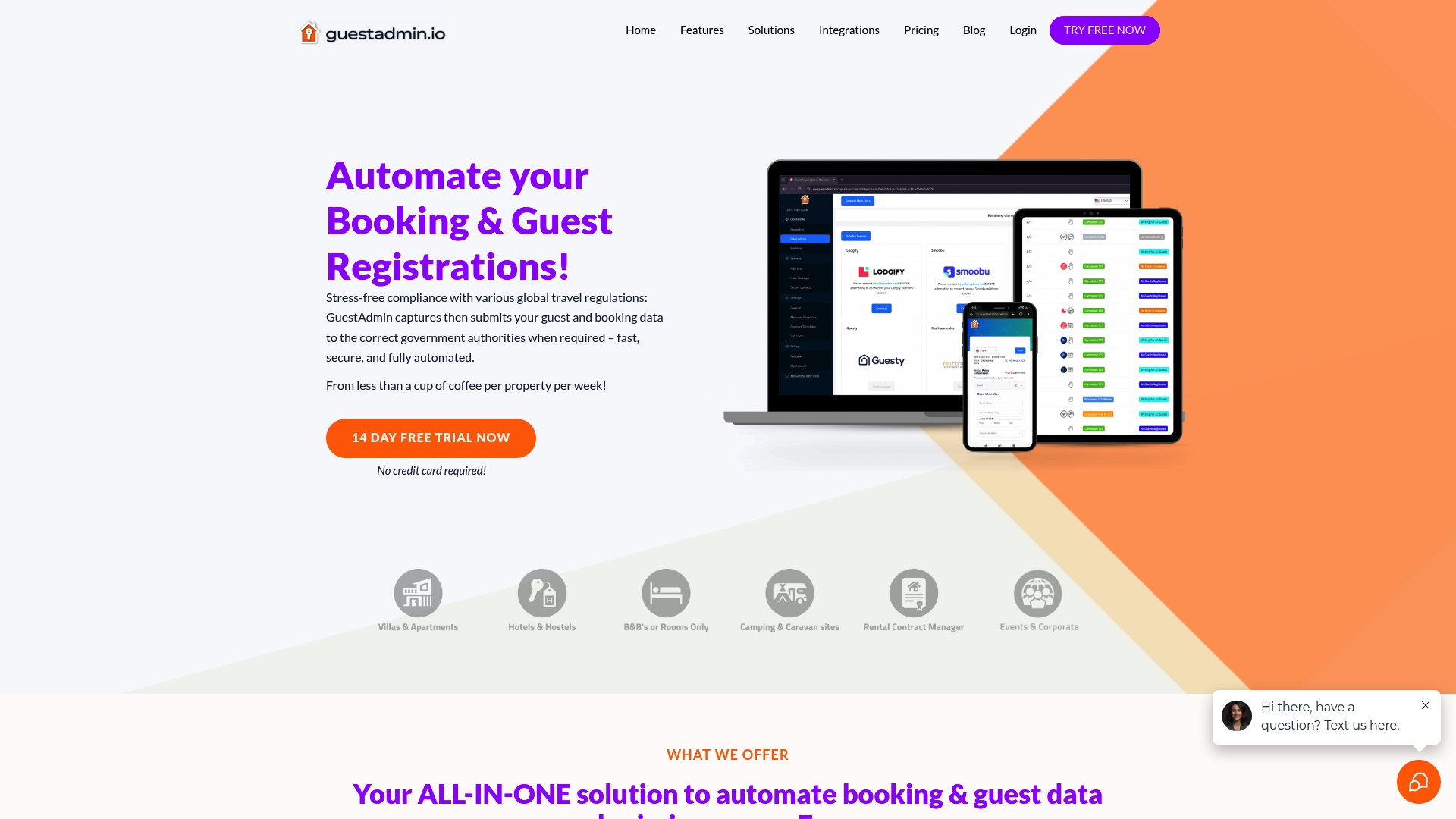
From automated booking compliance to SDEP reporting, guest data submission, and GDPR-compliant archiving, GuestAdmin handles the regulatory complexity so you can focus on running your properties. The platform integrates with your existing OTAs and PMS, and onboarding is straightforward. Use the compliance checklist for Europe to assess where your current workflow stands and identify the fastest route to full compliance. Quick-start guides, direct support, and a real-time dashboard make implementation fast and confident.
Frequently asked questions
What happens if I miss a booking data submission deadline in 2026?
Missing a submission can trigger immediate delisting and fines starting at €1,000 under EU Regulation 2024/1028. Platforms are required to act within 24 hours of a reported non-compliance.
Are booking automation tools suitable for small portfolios?
Yes. While manual processes persist for very small portfolios, automation is recommended even for under 20 properties given the compliance stakes in 2026.
How do automated workflows support GDPR compliance?
Automation systems securely manage guest data and enforce 18-month retention policies, ensuring you are audit-ready at all times without manual record keeping.
Do European regulations differ by country for short-term rentals?
Yes. Spain and Italy are Code Red jurisdictions with active enforcement, France is at Yellow status, and Germany’s full implementation is still pending.
How can I quickly check if my booking workflow is compliant?
Audit against the core requirements: guest data submission, calendar sync, SDEP reporting, and 18-month data retention. An automated compliance checklist is the fastest way to identify gaps.