

TL;DR:
- EU Regulation 2024/1028 mandates digital guest data submission for all short-term rentals from May 2026.
- Manual compliance approaches are increasingly risky, error-prone, and insufficient to meet legal requirements.
- Hospitality SaaS platforms automate data collection, reporting, and record-keeping, reducing fines and operational burdens.
From May 2026, every short-term rental property in the European Union will be subject to strict digital guest data submission requirements under EU Regulation 2024/1028. If you are still relying on spreadsheets, paper forms, or manual portals to manage your guest registration, that approach is no longer sufficient. The regulatory landscape has shifted fundamentally, and property owners and managers who do not adapt face significant financial and operational consequences. This guide explains what the new law demands, where manual compliance falls short, and why hospitality SaaS (Software as a Service) platforms have become essential tools for running a legally sound short-term rental operation in Europe.
Table of Contents
- The new reality: digital compliance under EU law
- Common compliance challenges faced by property managers
- How hospitality SaaS automates and safeguards compliance
- Real-world returns: efficiency, risk reduction, and peace of mind
- Our view: compliance success comes from smart automation, not shortcuts
- Take the next step: future-proof your compliance
- Frequently asked questions
Key Takeaways
| Point | Details |
|---|---|
| Compliance is digital | EU rules require all guest data to be submitted digitally from 2026, making old manual methods obsolete. |
| SaaS means fewer risks | Hospitality SaaS platforms automate compliance, reducing error, costs, and legal risk for property managers. |
| Penalties are severe | Failure to automate compliance can lead to fines, delisting, and business suspension under EU law. |
| Automation boosts efficiency | Switching to SaaS streamlines reporting, saves time, and gives managers peace of mind. |
The new reality: digital compliance under EU law
EU Regulation 2024/1028 is the most significant change to short-term rental regulation in Europe in years. From May 2026, property owners and platforms alike must meet a set of mandatory digital obligations. The regulation requires digital guest data submission and the clear display of official registration numbers across all listing platforms.
What does this mean in practice? Here is what the regulation requires of you:
- Register your property with the relevant national or local authority and obtain an official registration number
- Display that registration number on every listing, across every platform you use
- Submit guest data digitally to the appropriate government bodies within the required timeframes
- Maintain accurate, audit-ready records of all guest stays
For a thorough overview of your obligations across different countries, the Europe rental compliance guide is an excellent starting point. If you are still unclear on what rental registration in 2026 entails for your specific market, now is the time to find out.
The risks of ignoring these requirements are severe. Non-compliance can result in fines ranging from €1,000 to over €50,000, removal of your listings from major platforms, and suspension of your rental licence. For many property managers, a single enforcement action could wipe out months of revenue.
“The new EU rules are not a future concern. They are a present responsibility that demands immediate operational change.”
Manual compliance was already a strain before this regulation. Now, it is a genuine liability. Tracking submissions across multiple properties, ensuring every guest record is complete and accurate, and meeting tight reporting deadlines by hand is not a realistic long-term strategy. Understanding hotel data protection essentials underscores just how seriously regulators treat personal data handling in the hospitality sector. The question is not whether you need a better system. It is how quickly you can put one in place.
Common compliance challenges faced by property managers
Even experienced property managers find the new compliance landscape difficult to navigate consistently. The problem is rarely a lack of intention. It is the sheer volume and complexity of the tasks involved.
Here are the most common areas where managers run into trouble:
- Inconsistent record-keeping across multiple properties or booking channels
- Missing or incomplete guest data collected at check-in
- Delayed submissions caused by manual processing bottlenecks
- Lost paperwork or untracked versions of submitted records
- Errors in registration numbers displayed on listings
Manual data pitfalls like these are not just inconvenient. Under the new EU law, manual guest data submission increases audit risk significantly. A single missing field or late report can trigger an investigation.
The table below illustrates the difference in workload and risk between manual and automated compliance approaches:
| Factor | Manual compliance | Automated compliance |
|---|---|---|
| Data entry | Human, error-prone | Automated, validated |
| Submission speed | Hours to days | Within 24 hours |
| Audit trail | Inconsistent | Complete and structured |
| Regulation updates | Manual monitoring | Built-in and automatic |
| Scalability | Difficult across properties | Seamless across portfolio |
| Error risk | High | Minimal |
Using this 2026 compliance checklist is a practical way to identify where your current process has gaps before they become regulatory problems.
Pro Tip: Assign a single person or team within your operation to own compliance submissions each week. Even before you switch to automation, centralising responsibility reduces the chance of duplicated effort and missed deadlines.
The pattern is consistent: the more properties you manage and the more booking channels you use, the faster manual compliance becomes unmanageable. This is not a matter of working harder. It is a structural problem that requires a structural solution.
How hospitality SaaS automates and safeguards compliance
Hospitality SaaS platforms are built to solve exactly the problems outlined above. Rather than patching together spreadsheets and portal logins, these tools centralise every aspect of your compliance workflow into a single, manageable system.
Here is what a purpose-built compliance platform does that manual processes simply cannot:
| Feature | What it does | Why it matters |
|---|---|---|
| Automated data capture | Collects guest details at the point of booking or check-in | Eliminates incomplete submissions |
| Digital reporting | Submits data to authorities automatically | Meets deadlines without manual effort |
| Regulation updates | Adapts to new rules as they are published | Keeps you compliant without monitoring |
| Multi-property dashboard | Manages all properties in one interface | Saves time and reduces errors |
| Audit trail generation | Creates structured records for every submission | Simplifies any inspection or review |
The process change for managers who adopt SaaS is significant:
- Guest data is captured automatically at booking or digital check-in
- The platform validates all required fields before submission
- Data is submitted to the relevant authority within the required window
- A full audit log is created and stored securely
- You receive confirmation and can access records from any device
Hospitality SaaS solutions automate digital guest data flows, reduce manual errors, and ensure real-time legal updates are applied without any action required from your team. For a full breakdown of the SaaS automation benefits available to short-term rental managers, the evidence is compelling. You can also explore a practical government reporting guide to understand how digital submission works in different jurisdictions.
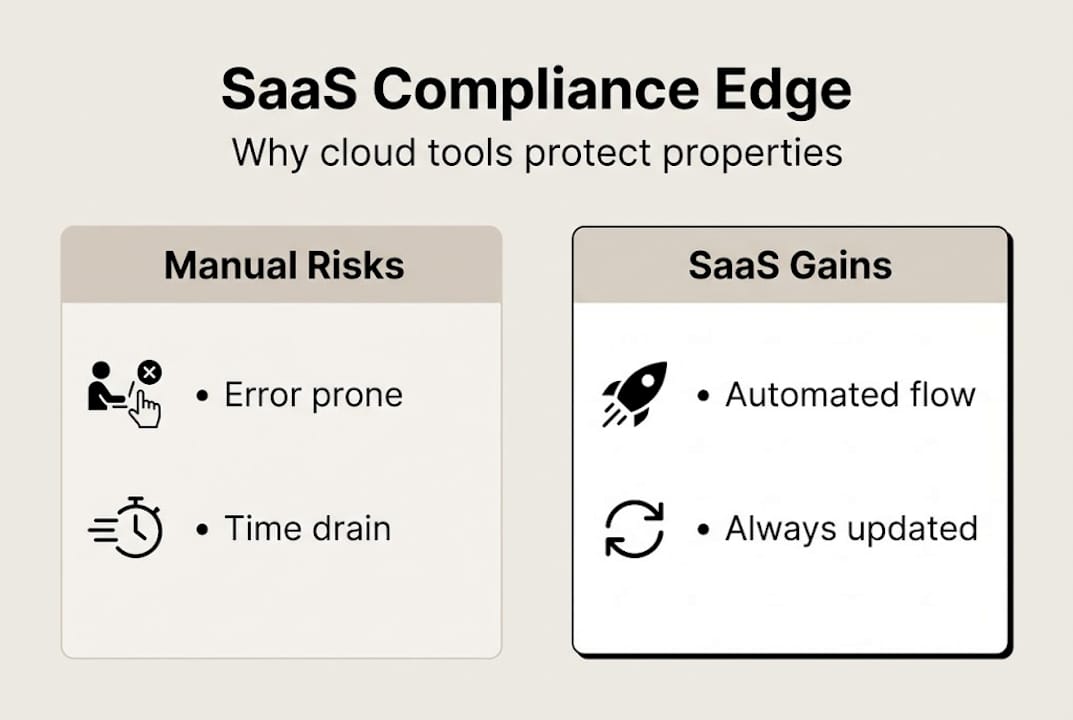
The cloud solution advantages extend beyond compliance too. Cloud-based platforms offer GDPR-compliant data storage, access from any device, and seamless integration with the OTA (Online Travel Agency) and PMS (Property Management System) tools you already use.
Pro Tip: When evaluating SaaS platforms, ask directly whether the system receives automatic regulatory updates. A platform that requires you to manually configure new rules defeats much of the purpose of switching to automation.
Real-world returns: efficiency, risk reduction, and peace of mind
The case for automation is not only about avoiding fines. It is about what becomes possible when compliance is no longer a burden.
Property managers who have moved to automated systems consistently report the following benefits:
- Faster reporting: Guest data is submitted within 24 hours of check-in, compared to days under manual processes
- Fewer errors: Automated validation catches missing fields before submission, not after an enforcement notice
- Worry-free audits: Structured audit logs mean any inspection can be handled quickly and confidently
- Smoother platform cooperation: Accurate registration numbers and timely data sharing improve relationships with OTAs and local authorities
- More time for guests: With compliance running in the background, your focus returns to delivering a great guest experience
One critical development under the new regulation is the use of SDEPs (Single Digital Entry Points), which are the centralised systems governments use to receive and process rental data. Platforms and local authorities now use SDEPs to cross-check all submitted guest data for enforcement, meaning inconsistencies or gaps in your records will be identified automatically by regulators.
“When your compliance data is structured, accurate, and submitted on time, enforcement becomes something that happens to others, not to you.”
The financial argument is equally straightforward. A single fine under the new regulation can reach €50,000. The annual cost of a reliable SaaS compliance platform is a fraction of that figure. When you automate your compliance, you are not spending on a convenience. You are protecting your revenue. To understand the broader impact of automation for rentals across the European market, the time and cost savings alone make a compelling case for switching sooner rather than later.

Our view: compliance success comes from smart automation, not shortcuts
We have worked with property managers across Europe, and one pattern stands out clearly. Those who treat compliance as a box-ticking exercise, looking for the simplest or cheapest workaround, are the ones who end up paying the most in the long run.
The short-term rental sector will face more regulation, not less. Authorities are investing in better enforcement tools, and the SDEP infrastructure introduced under EU Regulation 2024/1028 makes cross-checking far easier than it has ever been before. Manual workarounds expose you to rising fines and the very real risk of losing your listings entirely.
Software automation is now a core business asset for any property manager operating in Europe. It is not a luxury for large portfolios. Even owners managing a single property benefit from the audit trail, data accuracy, and peace of mind that a good platform provides. Our honest advice: invest early, and choose a reputable platform that keeps pace with regulation changes automatically. The cost of getting this wrong is simply too high. For more on how automation transforms compliance for European operators, the direction of travel is clear.
Take the next step: future-proof your compliance
Understanding the new EU rules is the first step. Acting on them is what protects your business. GuestAdmin.io is built specifically for property owners and managers who need reliable, automated compliance across their entire portfolio.
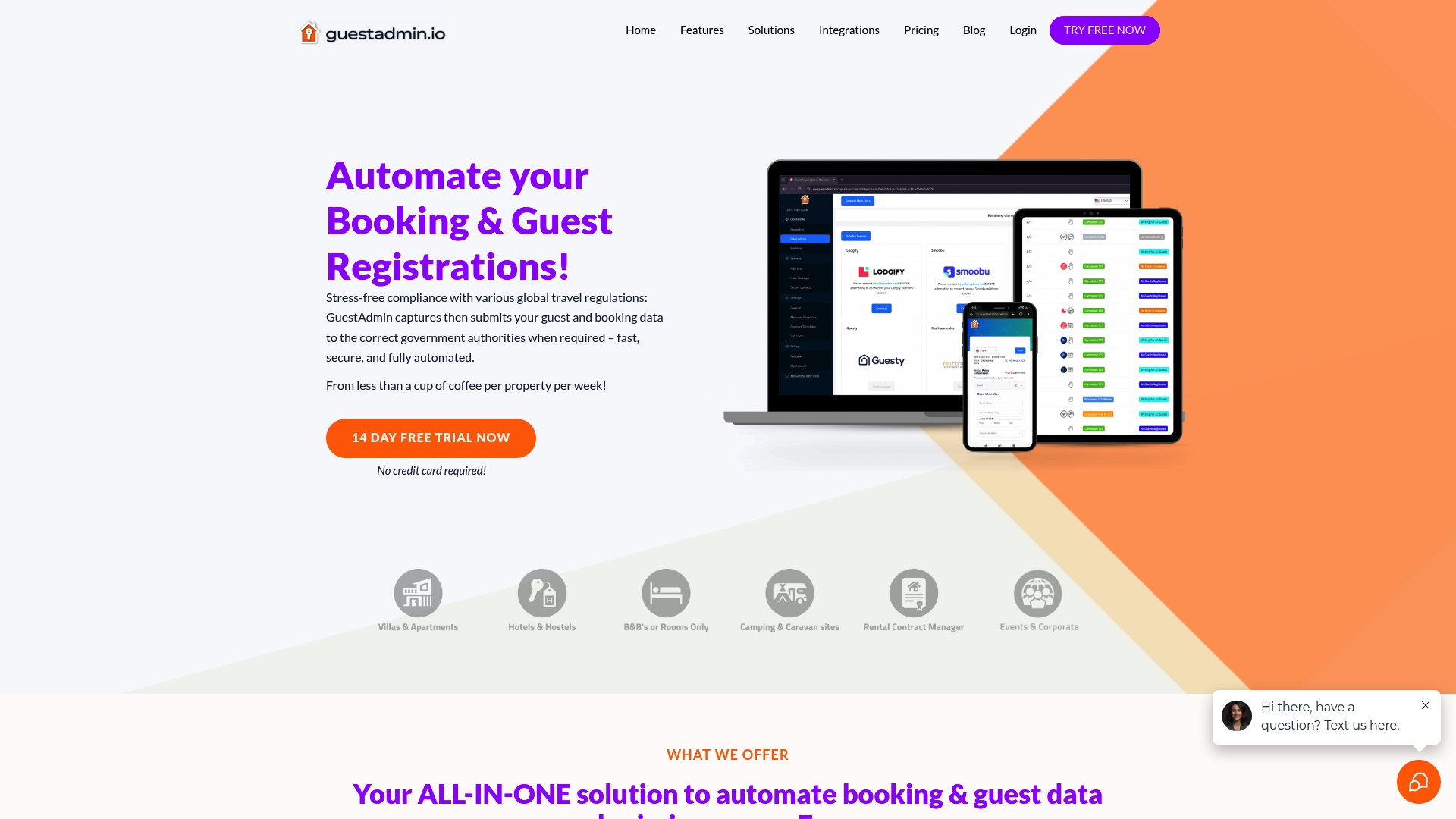
From automated guest registration to secure government data submission, GuestAdmin handles the complexity so you do not have to. Read the full short-term rental compliance guide to understand exactly where your obligations stand, or explore how automated guest registration works in practice. When you are ready to see the platform for yourself, book a compliance demo and find out how straightforward compliant operations can be.
Frequently asked questions
What does EU Regulation 2024/1028 mean for property managers?
It requires all short-term rentals in the EU to submit guest data digitally, use official registration numbers, and comply with strict reporting rules from May 2026. Every property, regardless of size, is covered by these requirements.
What are the penalties for non-compliance with short-term rental regulations?
Fines range from €1,000 to over €50,000, and enforcement can include removal of your listings or suspension of your rental licence. The financial exposure is significant even for a single violation.
How do SaaS solutions help with compliance?
They automate guest registration, data reporting, and maintain audit-ready records, ensuring your submissions meet European Union requirements accurately and on time.
Is manual guest registration still allowed in 2026?
Manual methods do not satisfy the digital submission standards required by the new EU law, and they increase the risk of errors that can trigger enforcement action.
Recommended
- Property Management SaaS – Streamlining Hospitality Compliance
- Why choose SaaS for rentals: Effortless compliance & automation
- Why automate hotel compliance: Boost efficiency, cut risks
- How automation transforms hospitality compliance in Europe
- Sichtbarkeit optimieren: Anleitung für Hotels im KI-Zeitalter