

TL;DR:
- Managing short-term rentals across Europe has become more complex due to stricter regulations, safety standards, and data requirements. Compliance now involves ongoing duties like health standards, data accuracy, licensing, and environmental standards, which require continuous attention and documentation. Automating these processes with suitable software helps property managers stay proactive, reduce risks, and focus on guest experience and business growth.
Managing short-term rentals across Europe has become significantly more demanding over the past few years. Regulatory bodies are asking harder questions, guests expect safer environments, and local authorities are enforcing rules with far greater consistency. Yet many property managers still treat compliance as a box-ticking exercise, submitting forms when reminded and hoping nothing falls through the gaps. That approach is no longer sufficient. Hospitality compliance now spans health and safety standards, duty of care obligations, guest data accuracy, and registration requirements that carry real consequences when ignored.
Table of Contents
- Defining hospitality compliance: more than just paperwork
- Why data accuracy and updates are crucial for short-term rentals
- Compliance frameworks: European and local enforcement
- Practical steps for automating hospitality compliance
- The uncomfortable truth property managers rarely acknowledge
- Effortless compliance starts here
- Frequently asked questions
Key Takeaways
| Point | Details |
|---|---|
| More than paperwork | Hospitality compliance covers health, safety, data accuracy, and guest care—not just legal forms. |
| Data must stay accurate | Authorities require property and guest data to be updated; failing to do so risks listing removal. |
| Local enforcement differs | European rules provide standards, but local authorities interpret and enforce compliance in their own ways. |
| Automation eases compliance | Automated solutions help track obligations and reduce mistakes, giving property managers peace of mind. |
| Compliance builds trust | Meeting obligations not only avoids fines but enhances your reputation with guests and authorities. |
Defining hospitality compliance: more than just paperwork
When most people hear “hospitality compliance,” they picture registration forms, licence applications, and occasional inspections. That picture is incomplete. Compliance in the hospitality sector now covers a much broader set of obligations that affect how you manage your property day to day.
True compliance means meeting your legal and ethical duties to guests, neighbours, and regulatory bodies. It includes:
- Health and safety standards: Fire safety checks, smoke and carbon monoxide detectors, emergency exit signage, and safe electrical installations.
- Duty of care: Ensuring the property is genuinely safe for guests to occupy, not just on paper but in practice.
- Guest data obligations: Collecting accurate identification information and submitting it to the relevant authorities within required timeframes.
- Licensing and registration: Holding the correct permissions to operate a short-term rental in your jurisdiction.
- Environmental and hygiene standards: Maintaining cleanliness levels that meet current expectations, particularly since public health awareness intensified post-pandemic.
The bar has risen sharply. As noted in research on post-pandemic compliance, operators across the accommodation sector now face stricter hygiene and safety obligations, with documented processes expected rather than informal arrangements. This shift affects hotels and short-term rentals equally.
“Hospitality compliance is no longer a passive obligation. It is an active, ongoing responsibility that requires documented processes, regular monitoring, and accountability at every level of your operation.”
Understanding the full scope is the starting point. The various rental compliance types that apply to your property will depend on your country, region, and the platform through which you list. Your legal compliance obligations are equally shaped by European legislation and local interpretation, which we will examine in detail shortly.
The important thing to recognise now is this: compliance is not a single task. It is a layered set of responsibilities that requires ongoing attention, not a one-off submission.
Why data accuracy and updates are crucial for short-term rentals
Understanding the bigger picture, let’s drill into the practical issue of keeping your listing compliant.
One of the most frequently overlooked aspects of compliance for European short-term rental operators is data accuracy. Not just collecting guest information, but maintaining it, updating it, and ensuring that your registration documents remain valid over time. This is not simply good practice. It is a legal requirement with direct consequences for your ability to operate.
Under EU Regulation 2024/1028, if supporting documents expire or data becomes incomplete, competent authorities may require updates. They hold the power to suspend or withdraw your registration number and order your listing removed from platforms until corrections are made. That means lost bookings, lost income, and a significant amount of time spent trying to restore your status.
Here is a clear comparison of the key data requirements and what happens when they lapse:
| Requirement | Active status | Consequence of lapse |
|---|---|---|
| Host identity verification | Confirmed and current | Registration suspended |
| Property registration number | Valid and listed | Listing disabled on platforms |
| Supporting documents (insurance, ownership) | Up to date | Authority notified, updates required |
| Guest registration data | Submitted within deadline | Fine or enforcement action |
| Platform data reporting | Accurate and timely | Platform ordered to remove listing |
The steps to maintain your registration status are straightforward when you build a system around them:
- Audit your documents quarterly. Set a calendar reminder every three months to check expiry dates on insurance, ownership certificates, and any local permits.
- Keep guest data complete at check-in. Do not allow gaps in identification information. Incomplete records are as problematic as missing ones.
- Respond immediately to authority requests. If a competent authority contacts you requesting updated information, treat it as urgent. Delays can accelerate enforcement action.
- Monitor platform requirements alongside local ones. Booking platforms are now required under EU law to verify registration numbers and report data to national authorities. If your registration lapses, platforms must act.
- Archive all submissions. Keep dated records of every submission you make, so you can demonstrate compliance if questioned.
Pro Tip: Automate your document expiry reminders rather than relying on memory or manual calendar entries. A missed renewal is one of the most common reasons operators face suspension, and it is almost entirely preventable with the right system in place.
Staying current with data privacy in hospitality is equally important. Guest data must be handled in line with GDPR (General Data Protection Regulation), which governs how personal information is collected, stored, and shared. Failure here creates a separate legal risk entirely. Automated compliance systems can handle both the submission and the secure archiving of this data, reducing the margin for error considerably.

Compliance frameworks: European and local enforcement
With data accuracy vital, it is important to understand how broader frameworks shape day-to-day compliance.
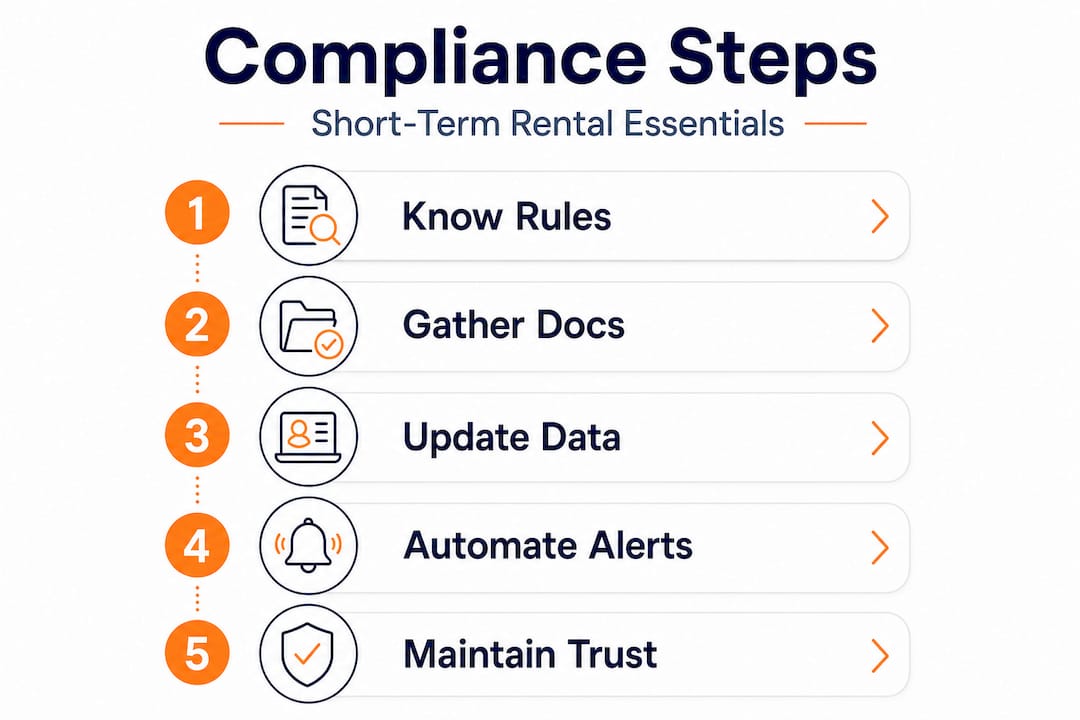
European regulations set the foundation. The EU’s approach centres on transparency and data sharing, aiming to give national and local authorities a reliable, consistent picture of short-term rental activity across member states. However, as the European Parliament’s analysis759356_EN.pdf) confirms, enforcement still depends heavily on how local regimes interpret and act on the data they receive. This includes issuing orders to platforms to remove or disable non-compliant listings.
What this means in practice is that your compliance obligations have two distinct layers:
“EU-level rules create the transparency framework. Local authorities decide how rigorously to apply it. The gap between those two layers is where most operators get caught out.”
| Level | Who sets the rules | How enforcement works |
|---|---|---|
| EU regulation | European Parliament and Council | Sets data-sharing standards, registration obligations, platform duties |
| National law | Member state governments | Translates EU rules into domestic legislation |
| Local authority | Municipal or regional bodies | Issues licences, conducts inspections, takes enforcement action |
The practical challenge here is that what satisfies requirements in one city may not be sufficient in another, even within the same country. A property manager operating in multiple jurisdictions must track each location’s specific rules separately.
Key actions to stay consistent across jurisdictions include:
- Map your obligations by location. For each property, document the relevant national and local requirements distinctly from the EU-level ones.
- Monitor local authority updates. Local rules change, particularly in high-tourism cities where political pressure leads to frequent regulatory adjustments.
- Verify platform compliance duties. Under EU rules, platforms such as online travel agencies (OTAs) now share data with authorities. Make sure your listing data matches what you have submitted to authorities.
- Use a centralised management system. When you manage properties across multiple jurisdictions, a single property management SaaS platform that tracks obligations by location is far more reliable than separate spreadsheets for each property.
The growing role of platforms in enforcement is worth noting specifically. Authorities can now instruct platforms to disable listings where operators have failed to maintain valid registration. This is not a theoretical risk. It is an active enforcement mechanism being used across several European countries. Reviewing compliance tips for managers operating across multiple locations can help you build a consistent, jurisdiction-aware approach.
Practical steps for automating hospitality compliance
Now, let us focus on how automation can transform your compliance experience.
Manual compliance management works until it does not. When you are managing one property and have a light booking schedule, tracking submissions by hand is manageable. Add a second or third property, increase your occupancy rate, and the administrative load grows rapidly. One missed deadline or an expired document can trigger consequences that far outweigh the effort it would have taken to automate the process from the start.
Automation addresses the core problem: compliance has too many moving parts for any person to track reliably over time without assistance. Hotel operators are now expected to maintain structured approaches to cleanliness, risk management, and documentation, and short-term rental operators face equivalent scrutiny.
Here is what an automated compliance system should handle for you:
- Guest registration submission: Capturing identification data at digital check-in and submitting it automatically to the relevant authority within the required timeframe.
- Document expiry tracking: Flagging upcoming expirations for insurance, licences, and permits before they lapse.
- Registration number management: Storing and displaying your valid registration numbers across all listings.
- GDPR-compliant data archiving: Retaining guest data securely for the legally required period, then deleting it automatically when retention obligations end.
- Multi-property dashboards: Giving you a single view of compliance status across all your properties, so nothing is missed.
- Integration with OTAs and PMS platforms: Ensuring the data you submit to authorities matches your live listings automatically.
Pro Tip: When evaluating compliance software, prioritise systems that include automatic document expiry alerts with sufficient lead time. A 30-day warning before an insurance policy expires gives you time to act. A 3-day warning does not.
You can explore practical property compliance examples to understand how automation works across different property types and jurisdictions. A detailed legal automation guide is also available for operators ready to move from manual processes to a fully automated workflow.
The business case for automation is straightforward. The time you currently spend managing compliance manually can be redirected to guest experience, property maintenance, and business growth. Automation does not just reduce risk. It returns your time to you.
The uncomfortable truth property managers rarely acknowledge
Here is something the industry rarely discusses openly: most property managers do not know the full extent of their compliance obligations. They know the obvious ones. Register the property. Collect guest information. Submit the form. What they underestimate is the ongoing, dynamic nature of compliance in 2026.
Regulations change. Local authorities update their requirements. EU legislation adds new layers. A property that was fully compliant eighteen months ago may have gaps today that the owner is entirely unaware of. This is not a failure of character or effort. It is a structural problem with how most operators approach compliance: reactively, after something goes wrong, rather than proactively, as a permanent operational priority.
The conventional view is that compliance is an administrative burden, something to be tolerated and minimised. That framing leads directly to the reactive behaviour that creates risk. When you view compliance as a burden, you do the minimum required and move on. When something changes, you are caught unprepared.
The more useful framing is this: compliance is the foundation of your business’s trustworthiness. Guests trust you because your property is legally registered and meets safety standards. Platforms trust you because your data is accurate. Authorities leave you alone because your records are in order. That trust translates into better reviews, more bookings, and fewer operational disruptions.
The managers who genuinely thrive in this regulatory environment are not the ones who have found clever ways to minimise their compliance workload. They are the ones who have systematised it entirely, using tools like a well-integrated SaaS compliance platform to make the process invisible and automatic. Compliance stops being something they do and becomes something their system does for them.
The uncomfortable truth is that manual, reactive compliance is not just inefficient. It is a structural vulnerability in your business. One regulatory change, one expired document, one missed submission can trigger consequences that take months to resolve. Building a proactive, automated compliance process is not optional for serious operators. It is the only approach that scales.
Effortless compliance starts here
Managing hospitality compliance across European short-term rentals does not need to be complicated or time-consuming. GuestAdmin.io is built specifically for property owners and managers who want to stay compliant without sacrificing hours each week to manual processes.
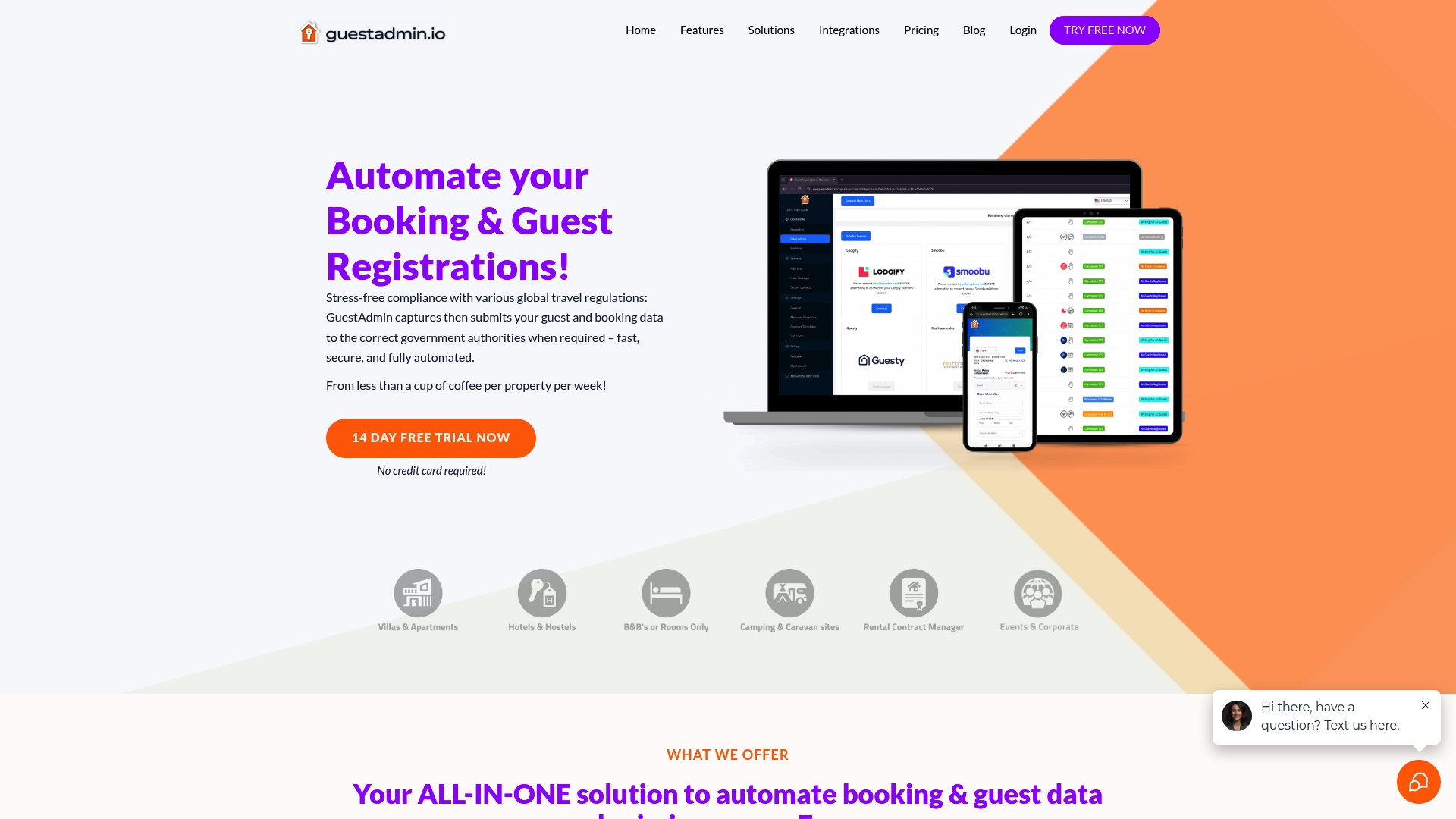
Whether you are assessing options through a thorough property management software comparison or ready to explore how automated guest registration can streamline your workflow, GuestAdmin.io has the tools to support you at every stage. The platform handles guest data capture, authority submissions, document expiry tracking, and GDPR-compliant archiving across all your properties from a single dashboard. If you have questions about how it works for your specific situation, the team is available through a direct guest registration chat to walk you through it.
Frequently asked questions
What happens if my guest or property data is not updated for compliance?
Authorities may suspend your registration number and require you to remove your listing from platforms until updated information is provided. This can result in lost bookings and income until the issue is resolved.
What health and safety requirements must short-term rentals meet?
Operators must follow strict health standards covering cleanliness, risk management, and duty of care, with documented processes now expected rather than informal arrangements. These obligations now closely mirror those applied to hotel operators since the pandemic.
Are compliance rules the same across Europe?
EU rules aim for standardisation and transparency, but enforcement depends on local759356_EN.pdf) authorities and their interpretation of national legislation. Requirements can vary significantly between cities, even within the same member state.
Can compliance be automated for short-term rentals?
Yes, property management software allows automatic tracking of documentation, guest registration submissions, and document expiry dates, reducing manual errors and ensuring deadlines are never missed.