

Short-term rental regulation across Europe has never been more demanding. Fines of €1,000 to €50,000+ now apply to non-compliant hosts in cities like Barcelona and London, and the introduction of EU-wide standardised guest data reporting means the old approach of managing compliance through spreadsheets and manual portals is no longer viable. The good news is that automated solutions can reduce your administrative burden by up to 60%, giving you more time to focus on your guests and your business. This guide walks you through the 2026 legal landscape, what you need to do to prepare, how to automate guest data management, and how to avoid the most costly mistakes.
Table of Contents
- Understanding the new 2026 legal landscape
- Preparing for compliance: what you need to do
- Setting up automated guest data management
- Common pitfalls and expert troubleshooting
- How GuestAdmin.io simplifies your compliance in 2026
- Frequently asked questions
Key Takeaways
| Point | Details |
|---|---|
| Strict 2026 compliance required | New EU rules and national registers mean legal and data duties are tougher for property hosts and managers. |
| Guest data is central | Correct collection and secure submission of guest information is now a legal backbone, with data retention for years. |
| Automation prevents errors | Automated guest data and compliance tools save time, reduce fines, and support fast-changing rules. |
| Regional rules still differ | Check local city, country, and platform requirements as details—and audit risks—vary significantly. |
Understanding the new 2026 legal landscape
Now that you know what’s at stake, let’s break down the core legal pillars you face in 2026.
EU Regulation 2024/1028 establishes a unified framework for short-term rentals across all EU member states. Under this regulation, hosts must register with local authorities where required, platforms must verify registrations, and share monthly data through Single Digital Entry Points, known as SDEPs. This is not optional. Platforms that fail to comply face suspension, and hosts who are unregistered risk delisting from major booking channels.
The rental compliance overview for Europe shows that short-term rentals now account for 25% of EU tourism supply, and over 70% of jurisdictions now require electronic submission of guest data. That is a significant shift from even two years ago.
For the UK and Ireland, the picture is slightly different but equally important. England’s national registration scheme and Ireland’s mandatory Fáilte Ireland register both launch in 2026, requiring hosts to obtain registration numbers and display them on all listings. You can find detailed guidance on UK guest registration rules to understand exactly what applies to your properties.
Local variations add another layer of complexity. Barcelona enforces strict night caps and primary residence rules. Amsterdam limits rentals to 30 nights per year. Paris requires hosts to register with the city and display a registration number on every listing. These are not minor administrative details. They carry real financial consequences.
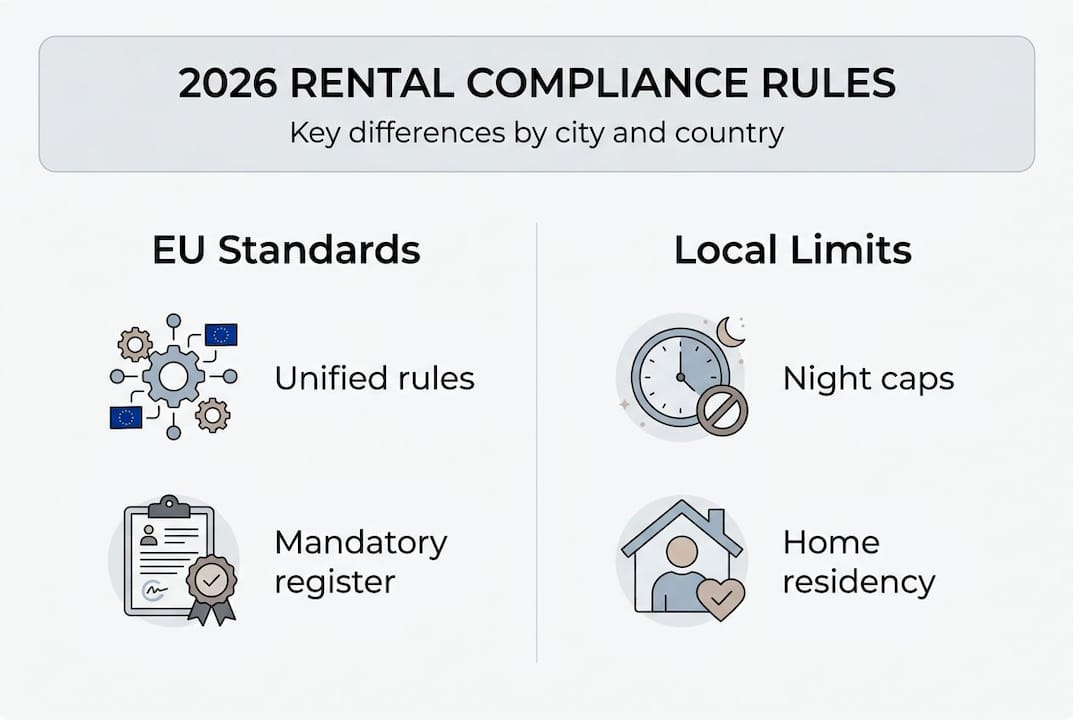
| Jurisdiction | Registration required | Guest data submission | Night cap | E-submission required |
|---|---|---|---|---|
| EU member states | Yes (via SDEP) | Monthly via platform | Varies by city | Yes (70%+) |
| England (UK) | Yes (2026 scheme) | Within 24 hours | No national cap | Yes |
| Ireland | Yes (Fáilte register, May 2026) | Within 24 hours | No national cap | Yes |
| Spain (Barcelona) | Yes, strict | Within 24 hours | Primary residence only | Yes |
| Italy | Yes | Within 24 hours | Varies by region | Yes |
Preparing for compliance: what you need to do
With these rules in mind, what concrete steps do you need to take to stay compliant?
The first thing to understand is what guest data you are legally required to collect. Registration, activity reports, and guest data must be submitted to authorities, and penalties apply for failing to do so. The table below shows the core data fields required across key markets.
| Data field | EU (general) | UK | Ireland | Spain | Italy |
|---|---|---|---|---|---|
| Full name | Required | Required | Required | Required | Required |
| Date of birth | Required | Required | Required | Required | Required |
| Nationality | Required | Required | Required | Required | Required |
| ID or passport number | Required | Required | Required | Required | Required |
| Arrival and departure dates | Required | Required | Required | Required | Required |
| Address of property | Required | Required | Required | Required | Required |
Once you know what to collect, follow this stepwise compliance checklist:
- Register your property with the relevant local authority and obtain your registration number.
- Display your registration number on all listings across every platform where you advertise.
- Set up a guest data protocol that captures all required fields at the point of booking or check-in.
- Build a compliance calendar that tracks renewal dates, submission deadlines, and inspection schedules.
- Consult a local solicitor if you operate in high-risk cities such as Barcelona, Florence, or Amsterdam, where city-specific restrictions and severe fines apply.
- Review your OTA and PMS settings to ensure data flows correctly to your submission system.
- Document everything, including consent records, submission confirmations, and registration certificates.
Spain and Italy are red-alert markets right now. Enforcement is active, fines are being issued, and authorities are cross-referencing platform listings against registration databases. If you operate there, treat compliance as urgent. The compliance workflow overview and licensing in the UK resources can help you map out your specific obligations.
Pro Tip: Build a shared compliance calendar with your team that flags every renewal, submission deadline, and local inspection window at least 30 days in advance. This single habit prevents the majority of late-submission penalties.
Setting up automated guest data management
Once you have your compliance checklist, it’s time to reduce manual work and risk with technology.

Automation reduces errors by 50% and cuts admin workload by 40 to 60%. That is not a marginal improvement. For a property manager handling 20 or more units across multiple countries, that difference is the gap between staying compliant and falling behind.
Here is how to set up automated guest data management effectively:
- Connect your PMS or OTA to a compliant automation platform that supports your markets. Ensure the integration covers all booking sources, not just your primary channel.
- Configure guest data capture so that every required field is collected automatically at the point of booking or digital check-in, with no manual entry needed.
- Set up GDPR consent flows so guests explicitly agree to data processing before their information is stored. This is a legal requirement, not a courtesy.
- Enable encrypted storage for all guest records. Data must be protected in transit and at rest, with access controls limiting who can view sensitive information.
- Schedule automated submissions to local authority portals. Automated platforms integrate with PMS and OTAs and push data directly to portals in Spain, Italy, and other markets, removing the need for manual uploads.
- Set retention rules so that guest data is automatically deleted after the legally required period, reducing your GDPR exposure.
“Automation cuts admin by up to 60% and error rates by more than 50%, giving property managers the confidence that every submission is accurate and on time.”
The European Parliament’s enforcement study759356_EN.pdf) confirms that regulatory scrutiny is intensifying, making reliable automation not just convenient but essential. Explore automated guest management options and review property management trends for 2026 to understand where the industry is heading. You should also review data security practices to ensure your setup meets current standards.
Pro Tip: Before going live with any automation system, run a full test using dummy booking data. Verify that every field submits correctly, consent records are stored, and the portal confirms receipt. Catching errors in testing costs nothing. Catching them during an audit costs a great deal more.
Common pitfalls and expert troubleshooting
Even with automation, compliance can trip up experienced managers. Here is how to avoid the pitfalls.
The most frequent mistakes property managers make include:
- Missing guest data fields: Submitting incomplete records is treated the same as not submitting at all in many jurisdictions.
- Late submissions: Even a few hours past the 24-hour window can trigger a penalty in Spain and Italy.
- Unverified registration numbers: Displaying an expired or incorrect number on a listing can result in immediate platform delisting.
- Poor OTA and PMS synchronisation: When booking data does not flow correctly between systems, guest records become incomplete or duplicated.
- Ignoring platform notices: Airbnb, Booking.com, and Vrbo now send compliance alerts. Dismissing them without action is a serious risk.
Property managers are liable as the ‘host’ under the new EU rules, and enforcement varies significantly by region. Germany has been slower to enforce, but Spain and Italy are actively auditing. The UK and Ireland schemes are new in 2026, so early compliance is your best protection while enforcement frameworks bed in.
One area that catches many managers off guard is the distinction between guest activity data and DAC7 tax reporting.
“Don’t confuse guest activity data with DAC7 tax reporting. Both matter, and both carry separate penalties if mishandled.”
Audit risk extends beyond tax to include guest activity data, and your contracts should clearly reflect ‘host’ liability so there is no ambiguity about who is responsible for submissions. Prepare a documentation pack for audits that includes registration certificates, submission confirmations, consent records, and your data retention policy.
For multi-country portfolios, review guest privacy best practice and booking automation resources to ensure your systems are consistent across all markets. A single weak link in one country can expose your entire portfolio to scrutiny.
How GuestAdmin.io simplifies your compliance in 2026
Managing guest data compliance across multiple countries, platforms, and regulatory frameworks is genuinely complex. No more juggling portals, spreadsheets, and paperwork across different jurisdictions.
GuestAdmin.io automates the entire compliance workflow, from guest data capture and GDPR consent through to encrypted storage and direct submission to local authority portals. The platform integrates with leading PMS and OTA systems, supports multi-property management from a single dashboard, and processes submissions within 24 hours using AI-powered data handling. Whether you manage two properties in Ireland or 200 across Spain, Italy, and the UK, GuestAdmin.io gives you the confidence that every submission is accurate, on time, and fully compliant. Start your free trial today and see how much time you can reclaim.
Frequently asked questions
What information must I collect from each guest?
You must collect each guest’s full name, date of birth, nationality, identification number, and stay dates. These fields are mandatory across all EU member states, the UK, and Ireland.
How quickly do I need to submit guest data to authorities?
Data submission is typically required within 24 hours of a guest’s arrival, using your local authority’s designated portal or an approved automated platform.
What is the penalty for non-compliance with short-term rental laws?
Fines range from €1,000 to €50,000+ for serious or repeated offences, and platforms can delist your property for unresolved compliance failures.
Does data automation cover GDPR consent and encryption?
Yes. Reputable platforms include encrypted storage and guest consent flows as standard, ensuring your data handling meets GDPR requirements from the moment a booking is made.
How are UK and Ireland rules different from EU member states?
The UK and Ireland are launching national registration schemes in 2026, with mandatory registration numbers and display requirements that closely mirror the EU approach, though each country has its own specific procedures and timelines.