

TL;DR:
- Short-term rental compliance involves guest data collection, property registration, electronic reporting, and GDPR adherence.
- Automation streamlines compliance tasks, reducing errors and administrative time significantly across multiple properties.
- Non-compliance fines can reach over €50,000, with risks including license revocation and platform delisting.
Short-term rental compliance has become one of the most pressing legal obligations facing property owners and managers across Europe. Regulations vary sharply by city, region, and country, and the penalties for getting it wrong are severe. Non-compliance fines can reach €50,000 or more, with additional risks including licence revocation and platform delisting. Whether you manage one property or fifty, understanding exactly what is required and how to meet those requirements efficiently is no longer optional. This guide cuts through the complexity, explains what compliance actually involves, and shows you how automation can protect your business.
Table of Contents
- What is short-term rental compliance?
- Key compliance steps every host must take
- How automation simplifies compliance and reduces risk
- What happens when you get compliance wrong?
- What most hosts miss: liability gaps, local nuances, and how to stay ahead
- Why simple compliance no longer exists—and what really works
- Take the stress out of compliance with trusted automation solutions
- Frequently asked questions
Key Takeaways
| Point | Details |
|---|---|
| Data collection is vital | You must gather and report guest identity information accurately for every stay to comply with the law. |
| Non-compliance is expensive | Fines reach €50,000 and can end your business, so timely reporting protects your operation. |
| Automation saves time | Using PMS and API integrations cuts errors, slashes admin work, and keeps records audit-ready. |
| Local rules still matter | Even with EU harmonisation, every city can add its own restrictions, so always check the latest requirements. |
What is short-term rental compliance?
With high penalties in mind, let’s clarify what short-term rental compliance actually involves. At its core, it refers to the full set of legal obligations a property owner or manager must meet when renting accommodation to guests for short periods, typically fewer than 30 consecutive nights. These obligations are set by national governments, regional authorities, and local councils, and they differ considerably across Europe.
Legal compliance for rentals in Europe covers several distinct areas:
- Guest identity data collection: You must gather each guest’s full name, date of birth, nationality, and ID or passport details before or at check-in.
- Property registration and licencing: Most jurisdictions require hosts to register their property and obtain a valid licence or registration number before accepting bookings.
- Electronic reporting to authorities: Guest data must be submitted digitally to the relevant authority, often a police or immigration portal, within a set timeframe.
- GDPR-compliant data retention: Guest records must be stored securely, accessed only by authorised personnel, and deleted after the required retention period.
- Local restrictions: Many cities impose night caps (limits on how many nights per year a property can be rented), occupancy limits, and zoning restrictions.
Electronic reporting has become the standard because manual submissions are slow, error-prone, and difficult to audit. Authorities across Spain, Italy, France, Portugal, and Germany now require digital submissions through official portals or approved third-party systems.
| Compliance element | Requirement |
|---|---|
| Guest identity data | Full name, DOB, nationality, ID/passport number |
| Property registration | Licence or registration number required |
| Reporting method | Electronic submission via authority portal |
| Reporting deadline | Typically within 24 hours of check-in |
| Data retention | GDPR-compliant secure storage |
| Local restrictions | Night caps, zoning, occupancy limits |
It is worth noting that GDPR (General Data Protection Regulation) adds a significant layer of responsibility. You are legally obligated to handle guest data with care, obtain appropriate consent, and ensure that data is not retained longer than necessary. Failure to meet GDPR requirements can result in separate fines on top of any rental-specific penalties.
Key compliance steps every host must take
Understanding what compliance means is only helpful if you know exactly what is required, step by step. The process may look straightforward on paper, but small oversights can create serious legal exposure.
- Verify your property registration status. Before accepting any booking, confirm your property has a valid registration or licence number for the relevant jurisdiction. Operating without one is among the most heavily penalised offences.
- Collect guest identity data at check-in. Gather full name, date of birth, nationality, and ID or passport type and number for every adult guest. Some cities require this for children too.
- Submit guest data electronically within 24 hours. Collecting and reporting guest data within 24 hours of check-in is required across most major European cities. Late submissions are treated as non-compliance, even if the data is eventually filed.
- Store records securely and in line with GDPR. Use encrypted, access-controlled storage. Set automatic deletion schedules based on the required retention period for each country.
- Monitor local rule changes. Night caps, occupancy rules, and registration requirements are updated frequently. Subscribe to local authority communications or use a compliance platform that tracks changes automatically.
“The most common compliance failure is not wilful neglect but process gaps: a missed submission during a busy period, a guest record stored in the wrong format, or a registration number that expired without notice.”
Poor record keeping is a recurring problem, particularly for hosts managing multiple properties. Without a clear audit trail, proving compliance during an inspection becomes very difficult. Compliance tips for managers consistently highlight the importance of centralised documentation.
Pro Tip: Build a compliance workflow for property managers that includes a pre-check-in data collection step, an automated 24-hour submission trigger, and a monthly audit of stored records. This three-step rhythm catches most errors before they become penalties.
GDPR issues are also common. Over-retaining guest data beyond the legal period, sharing records via unsecured email, or failing to respond to a guest’s data access request are all offences that can attract regulatory attention.
How automation simplifies compliance and reduces risk
While manual compliance is possible, automation has transformed how fast-growing hosts and managers stay ahead. The volume of data involved, the speed of reporting required, and the variety of local rules make manual processes increasingly unreliable at scale.

Automation via PMS and OTA API integration reduces errors by over 50% and cuts admin time by 40 to 60%. These are not marginal gains. For a manager overseeing 20 properties across three countries, that represents hours saved every day and a dramatically lower risk of missed submissions.
Key tasks that automation handles reliably:
- Guest data capture: Digital check-in forms collect and validate ID data automatically, removing manual re-entry errors.
- Authority submissions: Automated systems push guest records to the correct portal within the required timeframe, without any manual intervention.
- Booking platform integration: APIs connecting your Property Management System (PMS) or Online Travel Agent (OTA) feeds pull booking data directly, ensuring no reservation is missed.
- Reminders and alerts: Automated notifications flag upcoming deadlines, expiring licences, or missing guest records before they become problems.
- AI-powered verification: AI tools cross-check submitted data for inconsistencies, flagging potential errors before they reach the authority portal.
| Approach | Time per property per month | Error rate | Reporting speed |
|---|---|---|---|
| Manual | 6 to 10 hours | High | Variable |
| Automated | 1 to 2 hours | Low | Within 24 hours |
Automation in rentals compliance also makes scaling far more manageable. Adding a new property to an automated system takes minutes rather than days of setup and training.
Pro Tip: When evaluating automation tools, check whether the platform updates its submission rules to reflect local regulatory changes automatically. A system that requires manual configuration every time a city changes its reporting format adds risk rather than removing it. Review property automation examples to see how leading operators have structured their workflows.
What happens when you get compliance wrong?
With efficient processes in place, why is it critical to get every aspect right? Because the costs of error keep rising. Enforcement across Europe has intensified, and platforms like Airbnb are now cooperating with local authorities to identify non-compliant listings.
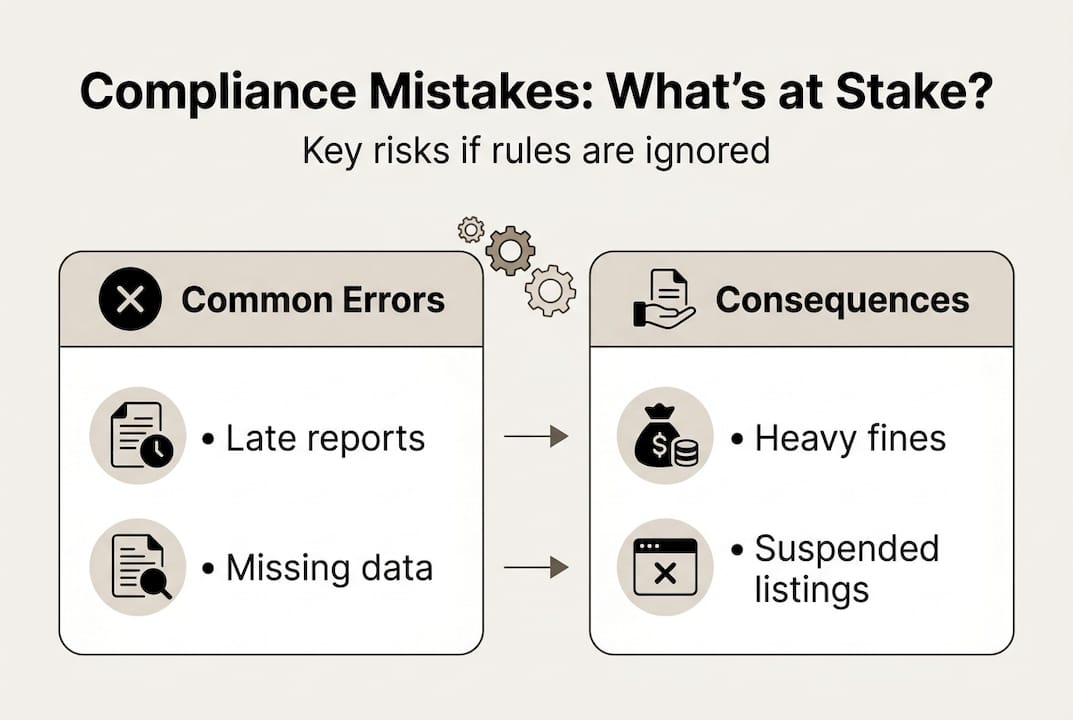
Financial penalties vary by jurisdiction but are consistently severe. Non-compliance fines range from €1,000 to over €50,000, with specific examples including €5,000 in Florence for missing guest data, over €40,000 in Spain for operating without a licence, and up to €50,000 in Germany and Vienna for serious breaches. Risks also include licence revocation, platform delistings, and forced property shutdowns.
| Jurisdiction | Example fine | Additional consequence |
|---|---|---|
| Florence, Italy | €5,000 | Missing guest data |
| Spain | €40,000+ | Operating without licence |
| Germany / Vienna | Up to €50,000 | Serious regulatory breach |
| General EU | €1,000 to €50,000+ | Licence revocation, delisting |
Beyond financial penalties, the reputational damage is significant. A delisted property loses income immediately, and the process of reinstatement can take months. In Berlin, stricter regulations759356_EN.pdf) contributed to 8,105 apartments being returned to residential use, illustrating how enforcement can permanently remove properties from the short-term rental market.
Other consequences include:
- Forced conversion of the property back to long-term residential use
- Criminal liability in certain jurisdictions for repeated or deliberate non-compliance
- Loss of trust with guests and booking platforms
- Increased scrutiny and more frequent inspections going forward
Enforcement cooperation between platforms and authorities is growing. Navigating rental regulations in 2026 means accepting that the era of informal short-term letting is over. Authorities now have better data access and more tools to identify non-compliant operators quickly.
What most hosts miss: liability gaps, local nuances, and how to stay ahead
Even well-organised hosts often overlook crucial details. Here is where most slip up, and how to avoid it.
One of the most misunderstood areas is liability. PM versus owner liability varies significantly by country. In France, a property manager acting as host must register their own SIRET business number. In Spain, it is the property owner who holds primary liability, regardless of who manages day-to-day operations. Getting this wrong means the wrong party may be fined or prosecuted.
Physical guestbooks and paper logs are no longer acceptable in most European jurisdictions. Digital records are required, and paper-based systems are treated as non-compliance during inspections.
The EU Regulation 2024/1028 has introduced a more harmonised infrastructure for short-term rental data sharing, but it does not override local rules. Local authorities retain759356_EN.pdf) substantive powers over zoning, night caps, and registration requirements. Spain and Italy have advanced rollouts, while Germany’s implementation has been delayed, creating an uneven landscape.
Platforms like Airbnb are now jointly responsible in many cities for ensuring listed properties meet local requirements. This means delistings can happen faster and with less warning than before.
A practical pre-emptive compliance checklist:
- Confirm who holds legal liability in each country where you operate
- Verify all registration numbers are current and displayed correctly on listings
- Ensure digital guest records are stored in a GDPR-compliant system
- Review night cap usage at least monthly to avoid accidental breaches
- Use automation examples for compliance to benchmark your current process against best practice
Why simple compliance no longer exists—and what really works
There is a persistent belief in the short-term rental industry that compliance is a one-time setup task. Install the right tool, connect your booking channels, and you are done. That belief is genuinely dangerous.
The reality is that compliance realities in Europe shift constantly. Rules change, registration requirements are updated, and enforcement priorities evolve. A platform that was compliant in January may not be by September if no one is monitoring the regulatory landscape.
Technology is essential, but it is not sufficient on its own. Staff training matters enormously. If the person handling check-ins does not understand why guest data must be collected in a specific format, even the best automation tool will produce flawed submissions. Process documentation, clear ownership of compliance tasks, and regular internal audits are what separate operators who stay ahead from those who get caught out.
The top operators we observe do three things consistently: they invest in automation that adapts to local rule changes, they train every team member who touches guest data, and they review their compliance process quarterly rather than annually. That rhythm is what makes compliance manageable, not just theoretically possible.
Take the stress out of compliance with trusted automation solutions
Ready to worry less about compliance? Smart solutions are closer than you think.
Managing short-term rental compliance manually is stressful, time-consuming, and increasingly risky. Automation removes the daily burden of data collection, submission tracking, and record keeping, so you can focus on growing your portfolio rather than managing paperwork.

GuestAdmin.io makes it straightforward to stay compliant across multiple properties and jurisdictions. From top compliance tips to a full legal guide to compliance, the resources and tools are ready when you are. Onboarding is quick, the interface is intuitive, and automated guest registration ensures every submission reaches the right authority on time. Secure, GDPR-compliant, and built for European property managers, GuestAdmin.io gives you the confidence to operate without compliance anxiety.
Frequently asked questions
What guest data must I collect for compliance in Europe?
You must collect each guest’s full name, date of birth, nationality, type and number of ID or passport, and arrival and departure dates. Requirements are consistent across most major European jurisdictions, though some cities require additional details.
How quickly do I need to report guest information to authorities?
Most jurisdictions require guest data submission within 24 hours of check-in. Late submissions are treated as non-compliance even if the data is eventually filed.
Are manual guestbooks or paper logs still acceptable for compliance?
No. Physical guestbooks are no longer sufficient in most European countries, which now require electronic reporting through approved digital systems.
How severe are fines for non-compliance?
Fines range from €1,000 to over €50,000 depending on the jurisdiction and the nature of the breach, and can also result in licence revocation or platform delisting.
What is the role of automation in rental compliance?
Automation tools reduce compliance errors by over 50% and cut admin time by 40 to 60%, making it far easier to meet reporting deadlines accurately and consistently.
4 Comments
Automate guest compliance and protect your rental business
[…] platform that integrates with your existing PMS and OTA accounts. If you want to understand what short-term rental compliance actually requires in your markets, or you are ready to automate your guest management entirely, […]
Legal compliance for European short-term rental owners
[…] guide Europe offers a detailed breakdown of what each obligation means in practice, and our short-term rental compliance explained resource sets out exactly where hosts most commonly go […]
2026 regulatory trends for rentals: Europe guide
[…] across all properties, so nothing slips through. For property owners and managers preparing for the short-term rental compliance demands of 2026, Guestadmin removes the administrative burden and keeps you on the right side of […]
Hospitality industry digitalization explained for managers
[…] site offer practical guidance on keeping compliance consistent at scale. You can also explore short-term rental compliance guidance to understand exactly what your obligations are and how automation removes the […]