

Managing guest data manually across multiple European short-term rentals creates constant compliance headaches. Property owners spend hours collecting identification documents, entering booking details into spreadsheets, and submitting reports to various authorities, all while risking errors that trigger fines. Effective compliance requires accurate guest data collection and timely reporting to local authorities, yet manual processes make this nearly impossible at scale. Automation transforms this burden into a seamless workflow, capturing guest information automatically and filing regulatory reports without your intervention. This guide walks you through implementing automated guest management to achieve flawless compliance whilst reclaiming your time for strategic property growth.
Table of Contents
- Understanding The Requirements: Compliance And Guest Data Essentials
- Setting Up Your Guest Management Automation Process
- Executing And Optimising Your Automated Guest Data Workflow
- Verifying Compliance And Handling Audits With Automation
- Discover Guestadmin.io For Effortless Guest Management Automation
- Frequently Asked Questions
Key takeaways
| Point | Details |
|---|---|
| Automation eliminates errors | Software captures and submits guest data automatically, removing manual mistakes that cause compliance issues. |
| Preparation matters | Understanding legal requirements and selecting suitable platforms ensures smooth implementation across your properties. |
| Structured workflows deliver results | Following clear steps from setup to daily operations creates reliable, audit-ready guest data management. |
| Verification protects your business | Regular compliance checks through automated dashboards catch issues early and simplify authority audits. |
| Multi-property efficiency scales | Centralised automation handles dozens of properties as easily as one, multiplying your management capacity. |
Understanding the requirements: compliance and guest data essentials
Before implementing automation, you need clarity on what compliance actually demands. Guest data encompasses identification documents, contact information, nationality details, arrival and departure dates, and booking references. Each piece serves specific regulatory purposes that vary across European jurisdictions. Some countries require submission within 24 hours of check-in, whilst others allow longer windows but demand more detailed information.
Local regulations create a patchwork of obligations. Spain mandates detailed guest registration through regional police portals. Italy requires submissions to local questura offices with specific data fields. France, Germany, Portugal, and other markets each impose unique requirements. Non-compliance risks fines ranging from hundreds to thousands of euros per violation, with repeat offences triggering property operation suspensions. These penalties hit hard when you’re managing multiple properties across borders.
Data privacy adds another layer. GDPR governs how you collect, store, and transmit guest information throughout Europe. You must obtain proper consent, implement security measures like encryption, limit data access to authorised personnel, and maintain records proving compliance. Failing these obligations compounds regulatory risks with substantial GDPR penalties that can reach percentages of annual revenue.
Understanding property management terminology helps you navigate compliance documentation more effectively. Terms like “tourist tax”, “alloggiati web”, and “parte de viajeros” appear frequently in regulatory contexts, and knowing what they mean prevents confusion during setup.
| Market | Key Document | Typical Data Required | Submission Deadline |
|---|---|---|---|
| Spain | Parte de Viajeros | Full ID details, nationality, dates | 24 hours |
| Italy | Alloggiati Web | Passport info, arrival/departure | 24 hours |
| France | Déclaration en Mairie | Guest count, nationality, duration | 48 hours |
| Portugal | SEF Registration | ID documents, contact details | 3 days |
| Germany | Meldeschein | Address, ID number, dates | Immediate |
Before automating, complete these preparatory actions:
- Identify all regulatory bodies governing your properties across different regions
- Catalogue specific data fields each authority requires for compliant submissions
- Audit your current guest data collection methods to identify gaps
- Verify you have proper GDPR consent mechanisms in guest booking flows
- Document your existing workflow to understand where automation will integrate
- Assess technical capabilities of your current booking systems for integration compatibility
Pro Tip: Create a compliance checklist for each property location, noting exact requirements, submission portals, and deadlines. This reference document guides your automation configuration and ensures nothing falls through the cracks during implementation.
Setting up your guest management automation process
Selecting the right automation platform determines your success. Evaluate software based on regulatory coverage for your specific markets, integration capabilities with your existing booking channels, data security certifications, user interface simplicity, and support quality. Request demonstrations focusing on your exact compliance scenarios rather than generic features. Ask how the system handles exceptions, updates for regulatory changes, and multi-property management at your scale.
Configuration starts with defining data capture fields. Map each regulatory requirement to corresponding guest information points in your booking process. The software should automatically extract passport numbers, names, nationalities, and dates from booking confirmations or check-in forms. Configure validation rules that prevent incomplete submissions, such as requiring passport expiry dates for certain jurisdictions or flagging missing nationality information before guests arrive.
Integration connects your booking ecosystem to the compliance engine. Most platforms support APIs linking property management systems like Guesty, Hostaway, or Lodgify, plus direct connections to Airbnb, Booking.com, and other OTAs. Automation can cut compliance work by up to 60%, freeing you for strategic tasks like pricing optimisation and guest experience improvements. Configure webhooks that trigger data transfers immediately when bookings confirm, ensuring the compliance system always has current information.

Understanding different property management software types helps you choose integration approaches that match your operational structure. Channel managers, PMS platforms, and standalone compliance tools each offer distinct integration pathways.
Follow these implementation milestones:
- Install the automation software and complete initial account configuration with your property details and regulatory jurisdictions.
- Connect your booking channels through API integrations or manual data import tools provided by the platform.
- Configure automated workflows that capture guest data at booking confirmation and trigger submissions at appropriate times.
- Set up notification systems alerting you to submission confirmations, errors, or missing data requiring attention.
- Run test bookings through the entire workflow, verifying data flows correctly from booking to regulatory submission.
- Train all staff members who interact with bookings on how to monitor the automation dashboard and handle exceptions.
- Activate live automation for a subset of properties initially, monitoring closely before expanding to your full portfolio.
Learn how to automate booking compliance across different European markets with platform-specific guidance.
Pro Tip: Schedule implementation during your slower season when booking volumes allow time for troubleshooting without risking compliance on high-value reservations. This reduces stress and gives you breathing room to perfect workflows before peak periods test your system.
Executing and optimising your automated guest data workflow
Daily operations become remarkably simple once automation runs properly. Guest data flows automatically from booking confirmation through regulatory submission without your intervention. The system captures information when bookings arrive, validates completeness against regulatory requirements, and submits to appropriate authorities within required timeframes. You monitor through dashboards showing submission statuses, flagged issues, and upcoming deadlines rather than manually processing each booking.
Real-time booking dashboards can reduce compliance workload by up to 50% by providing immediate oversight of your entire portfolio. These real-time booking dashboards display colour-coded submission statuses, alert you to missing data before check-in dates, and aggregate compliance metrics across all properties. You spot patterns like recurring data gaps from specific booking channels or properties with higher exception rates, enabling targeted improvements.
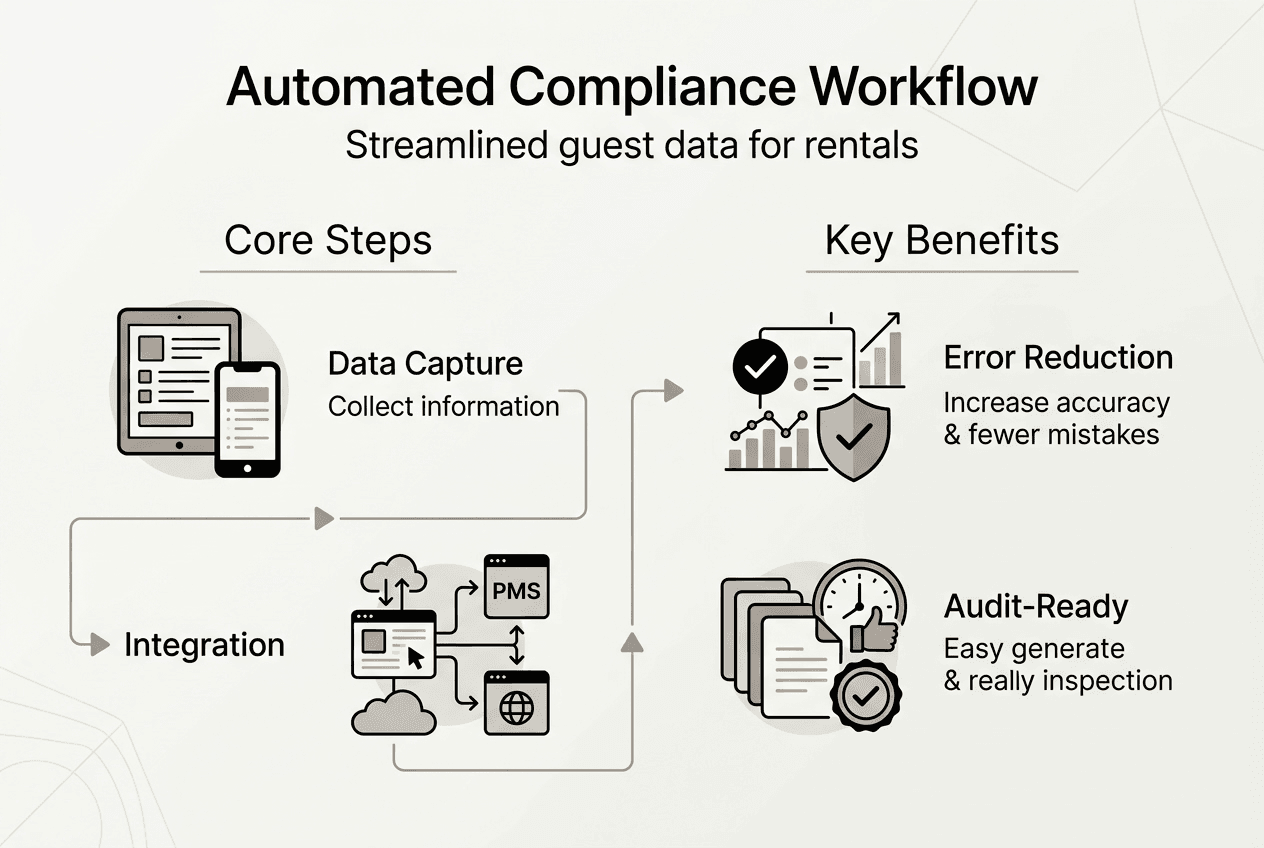
| Aspect | Manual Workflow | Automated Workflow |
|---|---|---|
| Time per booking | 10-15 minutes data entry and submission | 30 seconds reviewing automated submission |
| Error rate | 8-12% due to transcription mistakes | Under 1% with validation rules |
| Submission timing | Often delayed, risking late penalties | Consistently within required windows |
| Multi-property scaling | Linear time increase per property | Minimal additional effort regardless of portfolio size |
| Audit preparation | Hours gathering scattered records | Minutes exporting consolidated reports |
| Staff training required | Extensive for each regulatory system | Minimal dashboard monitoring skills |
Automation prevents these common errors:
- Data duplication when guests book multiple properties, creating conflicting regulatory records
- Transcription mistakes copying passport numbers or names from physical documents
- Late submissions missing 24-hour deadlines due to manual processing backlogs
- Incomplete data fields that authorities reject, requiring resubmission and causing delays
- Inconsistent formatting across different regulatory portals that manual entry often misses
- Lost paperwork when physical guest registration forms get misplaced or damaged
Understanding common mistakes submitting guest data helps you configure automation to specifically address these pitfalls from the start.
Continuous optimisation keeps your system performing at peak efficiency. Review weekly dashboard reports identifying patterns in flagged bookings. If certain OTA channels consistently provide incomplete nationality data, adjust your listing requirements or implement pre-arrival guest communication requesting missing information. Monitor submission success rates by property, investigating any location showing higher rejection rates that might indicate configuration issues or unique local requirements.
Pro Tip: Set up automated weekly summary emails highlighting key metrics like submission success rates, average processing times, and any recurring data gaps. This passive monitoring catches degrading performance early without requiring daily dashboard checks, alerting you only when intervention becomes necessary.
Verifying compliance and handling audits with automation
Regular verification ensures your automated system maintains compliance integrity over time. Access audit reports generated by your platform monthly, reviewing submission logs that document every guest data filing with timestamps, authority confirmation numbers, and data snapshots. These reports prove compliance if authorities question your records, providing audit trails that manual systems rarely achieve comprehensively.
Verifying accuracy involves spot-checking automated submissions against source booking data. Select random bookings weekly, comparing guest information in your PMS with what the automation system submitted to authorities. Discrepancies indicate configuration drift or integration issues requiring attention. Most platforms offer reconciliation tools highlighting mismatches automatically, but manual verification adds confidence, especially for high-value properties or jurisdictions with strict enforcement.
Prepare this documentation for regulatory audits:
- Complete submission logs showing date, time, and confirmation numbers for all guest data filings
- Data retention records proving you maintain guest information for legally required periods
- System configuration documentation demonstrating compliance with data security and GDPR requirements
- Integration audit trails showing how guest data flows from booking systems through submission
- Staff training records indicating personnel understand compliance obligations and system operation
- Incident reports detailing any submission failures, how you resolved them, and corrective measures implemented
When discrepancies or audit notices occur, follow these steps:
- Pull comprehensive reports from your automation platform covering the questioned period or properties immediately.
- Cross-reference submission logs with authority records to identify specific discrepancies or missing filings.
- Document any technical issues or exceptional circumstances that caused gaps, including timestamps and resolution actions.
- Prepare corrective submissions for any genuinely missing or incorrect data, using platform tools to backfill records.
- Respond to authorities with complete documentation, submission confirmations, and explanations within required timeframes.
- Review your automation configuration to prevent recurrence, adjusting validation rules or integration settings as needed.
- Update your compliance procedures based on audit findings, documenting lessons learned for continuous improvement.
Automated systems provide audit-ready reports, simplifying verification processes significantly. Instead of scrambling through emails, spreadsheets, and portal logins when authorities request records, you export consolidated reports covering any timeframe within minutes. This responsiveness demonstrates professionalism and often resolves inquiries quickly without escalation.
Implementing a structured compliance workflow for property managers ensures your verification processes remain consistent as your portfolio grows. Regular audits become routine administrative tasks rather than stressful emergency responses.
Automation reduces audit stress by maintaining perfect records automatically. You’re never uncertain whether submissions occurred or worrying about missing documentation. The system’s audit trail provides definitive answers to any compliance question, letting you respond confidently to authority inquiries. This peace of mind alone justifies automation investment for most property managers operating across European markets.
Discover guestadmin.io for effortless guest management automation
Implementing the strategies outlined above becomes straightforward with purpose-built tools designed specifically for European short-term rental compliance. GuestAdmin offers specialised automation covering regulations across Spain, Italy, France, Portugal, Germany, and other key markets where you operate properties. The platform handles the complexity of varying requirements whilst you focus on delivering exceptional guest experiences and growing your portfolio.
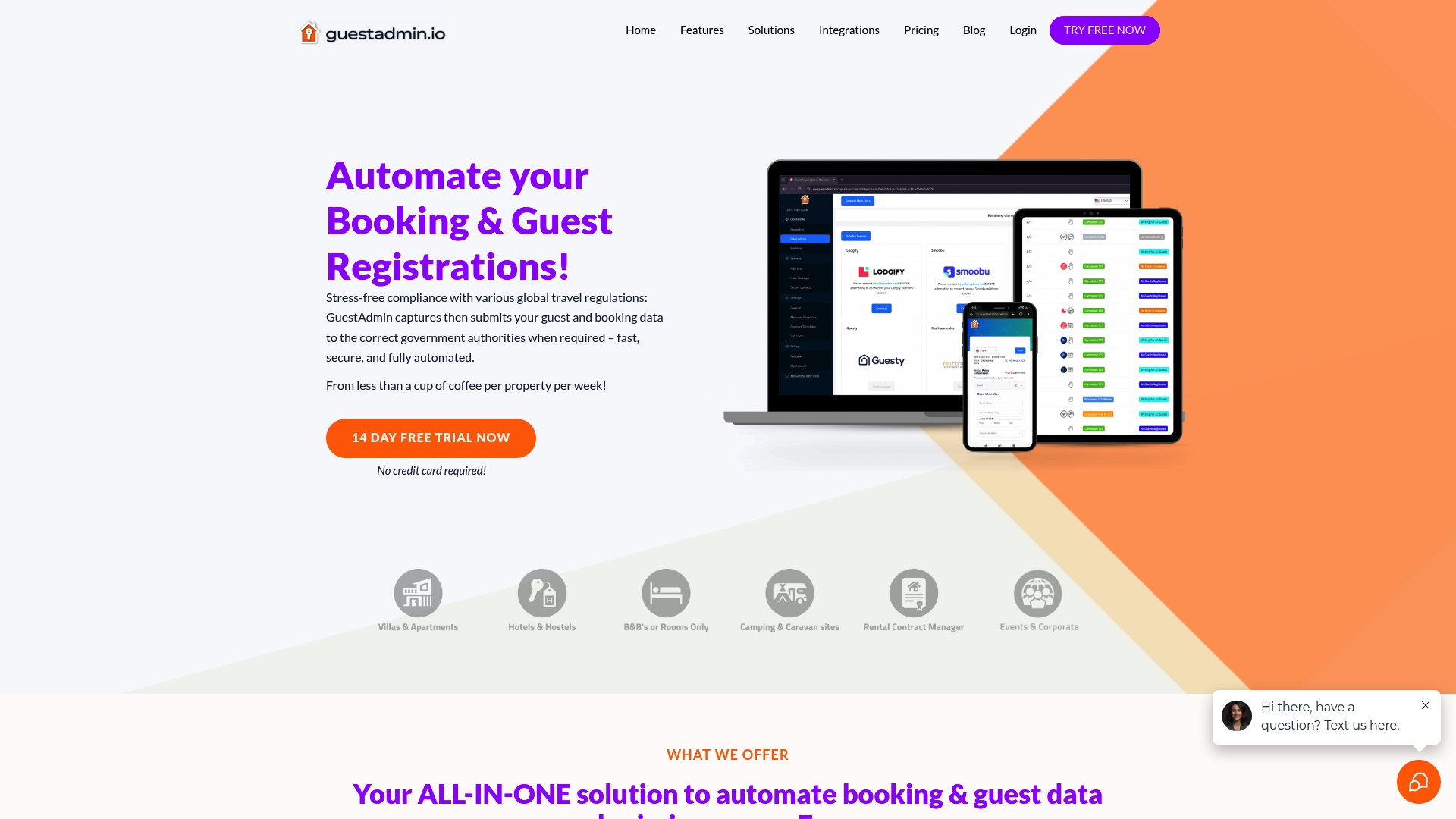
Simplify your guest data collection and reporting workflow with software that integrates seamlessly with your existing booking channels and property management systems. GuestAdmin’s AI-powered processing ensures timely submissions within 24 hours, eliminating manual data entry and reducing compliance workload significantly. Multi-property management becomes effortless through centralised dashboards providing real-time oversight of your entire portfolio’s compliance status.
Explore how to automate booking compliance specifically for your property types and markets. Familiarise yourself with essential property management terminology to navigate regulatory requirements confidently. Review the comprehensive legal compliance guide covering obligations across European jurisdictions.
Pro Tip: Leverage GuestAdmin’s integration capabilities for multi-property management, connecting all your booking channels once and letting automation handle compliance across your entire portfolio. This centralised approach scales effortlessly as you add properties without proportionally increasing administrative burden.
Frequently asked questions
What is guest management automation and why is it crucial?
Guest management automation uses software to handle guest data collection and regulatory reporting automatically, eliminating manual processing that consumes hours weekly. It ensures faster, more accurate compliance with rental laws across different European jurisdictions. Automation reduces errors that trigger fines whilst freeing you to focus on revenue-generating activities like pricing optimisation and guest experience improvements.
How does automation help with GDPR compliance for guest data?
Automation improves data security and access control, helping property owners comply with GDPR obligations effectively. Automated systems securely store and transmit guest information using encryption and controlled access permissions that meet regulatory requirements. This approach reduces risks associated with manual data handling, such as unauthorised access to physical documents or insecure email transmissions. Platforms maintain audit trails documenting data processing activities, simplifying compliance verification if authorities request evidence.
Can guest management automation be integrated with existing booking platforms?
Most automation platforms support integration with leading property management systems and booking channels, enabling seamless data flow without manual intervention. APIs connect platforms like Airbnb, Booking.com, Vrbo, and PMS systems such as Guesty or Hostaway directly to compliance software. Guest data syncs automatically from bookings into regulatory submission systems, reducing manual input and eliminating transcription errors. This integration ensures your compliance system always has current information without requiring duplicate data entry across multiple platforms.
What are common pitfalls to avoid when automating guest data management?
Common mistakes include incomplete data fields, ignoring software updates, and poor staff training on automation systems. Ensure your configuration captures all regulatory requirements for each jurisdiction where you operate properties. Regular system updates maintain compatibility with changing regulations and booking platform APIs. Thorough staff onboarding ensures team members understand how to monitor dashboards, handle exceptions, and respond to alerts effectively. Skipping these steps undermines automation benefits and creates compliance gaps despite having technology in place.
30 Comments
Master property management automation trends 2026 for compliance
[…] Automation cuts compliance errors by 60%, reducing fines and platform delistings […]
ivermectin otc
ivermectin otc
ivermectin otc
cialis canadian pharmacy
cialis canadian pharmacy
cialis canadian pharmacy
zenix
zenix
zenix
buy antibiotics for sinus
buy antibiotics for sinus
buy antibiotics for sinus
diflucan generic over the counter
diflucan generic over the counter
diflucan generic over the counter
finasteride brand
finasteride brand
finasteride brand
metoprolol tartrate 25 mg
metoprolol tartrate 25 mg
metoprolol tartrate 25 mg
Automated guest registration explained: compliance made simple
[…] Hostaway, and Lodgify, meaning your existing booking stack connects seamlessly. You can also automate guest management across all channels from a single […]
Booking data management: best practices for rental compliance
[…] guide to understand how the platform maps to your obligations. Ready to see it in action? Automate guest management and find out how quickly you can move from manual processes to a fully compliant, automated […]
How automation transforms hospitality compliance in Europe
[…] involves around 12 hours of admin work per week, with an estimated error rate of 25%. With automated guest management, the same workload drops to roughly five hours per week and the error rate falls to around 4%. That […]
minoxidil pills for hair loss
minoxidil pills for hair loss
minoxidil pills for hair loss
tadalafil dosage 40 mg
tadalafil dosage 40 mg
tadalafil dosage 40 mg
vidalista 40 mg
vidalista 40 mg
vidalista 40 mg
avanafil commercial name
avanafil commercial name
avanafil commercial name
Legal compliance for European short-term rental owners
[…] can avoid fines with compliance tips built into the platform, and use our full suite of tools to automate guest management from digital check-in through to secure SDEP data submission. With AI-powered processing, real-time […]
Guest data compliance: Protect and streamline your rental
[…] property managers ready to take the next step, effortless guest management through automation is achievable regardless of portfolio size. Platforms with API integration for […]
rogaine amazon
rogaine amazon
rogaine amazon
proscar medicine
proscar medicine
proscar medicine
minoxidil rogaine mexico
minoxidil rogaine mexico
minoxidil rogaine mexico
Guest onboarding automation: a guide for property managers
[…] The platform automates the complete guest onboarding workflow, from booking confirmation through to compliant guest data submission to European government authorities, within 24 hours of each booking. It integrates with major PMS […]
Benefits of automated guest data compliance for rentals
[…] Automate guest management for effortless rental compliance […]
ivermectin safety
ivermectin safety
ivermectin safety
vardenafil 5 mg dose analysis
vardenafil 5 mg dose analysis
vardenafil 5 mg dose analysis
avanafil vasodilation mechanism
avanafil vasodilation mechanism
avanafil vasodilation mechanism
avanafil safe access guidelines
avanafil safe access guidelines
avanafil safe access guidelines
avanafil supply chain factors
avanafil supply chain factors
avanafil supply chain factors
augmentin vs amoxicillin key differences
augmentin vs amoxicillin key differences
augmentin vs amoxicillin key differences
Peak Window Knowledge Base
Peak Window Knowledge Base
Peak Window Knowledge Base
Sildenafil Timing Concepts
Sildenafil Timing Concepts
Sildenafil Timing Concepts