

TL;DR:
- Short-term rental managers are data controllers responsible for guest personal data under GDPR.
- Proper data minimization, transparency, and response procedures are essential to GDPR compliance.
- Automation tools help manage data security, reporting, and compliance efficiently, especially post-2026 regulations.
Imagine a guest emails you two days after checkout asking for a copy of every piece of personal data you hold on them. You have 30 days to respond, you need to verify their identity, and if you miss the deadline or handle it poorly, you risk a formal complaint to your national data protection authority. As a data controller under GDPR, every property owner and manager in Europe who processes guest names, ID documents, contact details, or payment records carries real legal responsibilities. This guide breaks those responsibilities into clear, practical steps so you can protect your guests, protect your business, and stay confidently on the right side of the law.
Table of Contents
- Understanding your GDPR responsibilities as a rental manager
- What guest data must be collected—and what not to
- Providing guest transparency and upholding their rights
- Secure storage, third-party sharing and breach response
- Navigating new EU rules: harmonised reporting and automation in 2026
- The real-world path to effortless GDPR compliance in rentals
- Streamline GDPR compliance with the right technology
- Frequently asked questions
Key Takeaways
| Point | Details |
|---|---|
| You are a data controller | Property owners and managers of short-term rentals are legally responsible for protecting guest personal data. |
| Minimise & secure guest data | Only collect necessary information, secure it with encryption, and share it strictly with compliant partners. |
| Transparency is essential | Always provide guests with clear privacy notices and allow them to exercise their GDPR rights. |
| Automate to meet new rules | Automation and workflow tools help handle monthly compliance reporting under new 2026 EU regulations. |
| Respond fast to incidents | Report breaches within 72 hours and delete guest data when your legal obligation ends. |
Understanding your GDPR responsibilities as a rental manager
Your legal position under GDPR is not optional or ambiguous. Short-term rental managers act as data controllers the moment they begin collecting, storing, or sharing guest personal data. A data controller is the person or organisation that decides why and how personal data is processed. That means the decisions sit with you, not with your booking platform or cleaning company.
Personal data in this context covers a wide range of information. Names, email addresses, phone numbers, passport or ID scans, nationality, payment card details, and even IP addresses from your booking website all qualify. If it can identify a person, it counts.
“GDPR is not just about storing data safely. It is about being accountable for every decision you make regarding personal information, from the moment you collect it to the moment you delete it.”
The key GDPR principles for rentals include lawfulness, fairness, transparency, purpose limitation, data minimisation, accuracy, storage limitation, integrity, and accountability. In practice, each principle translates directly into a process you need to have in place. Lawfulness means you need a valid legal basis for every type of data you collect. Minimisation means you only collect what you genuinely need. Accountability means you can demonstrate compliance if asked.
Your GDPR obligations are triggered by the following:
- Collecting a guest’s name, email, or phone number at booking
- Scanning or copying a passport or ID document at check-in
- Processing a payment and retaining card or bank details
- Sharing guest information with a property management system (PMS), cleaning staff, or a local authority
- Sending marketing emails to past guests
- Using CCTV or smart locks that log access data
Reviewing a GDPR compliance checklist is a practical starting point, and understanding the broader picture of legal compliance in Europe will help you see how GDPR fits alongside other regulations. You should also familiarise yourself with published GDPR policies to understand the standard expected of data controllers.
What guest data must be collected—and what not to
Once you’ve understood your role, it’s time to get specific about the information you require and what risks over-collection introduces. Data minimisation and purpose limitation are two of the most frequently violated GDPR principles in short-term rentals, often because check-in forms were designed years ago and never reviewed.
The table below summarises what you must collect, what is optional, and what you should never request:
| Data type | Status | Legal basis |
|---|---|---|
| Full name | Required | Contract / legal obligation |
| Nationality | Required (for guest register) | Legal obligation |
| Date of birth | Required in some countries | Legal obligation |
| ID or passport number | Required in many EU states | Legal obligation |
| Email address | Required | Contract performance |
| Payment details | Required | Contract performance |
| Guest occupation | Not required | No valid basis |
| Next of kin details | Not required (unless law mandates) | No valid basis |
| Marketing preferences | Optional | Consent |
| Social media handles | Not required | No valid basis |
The legal basis you rely on matters enormously. Contract performance covers booking data, such as contact details and payment records. Legal obligation covers data you must submit to authorities for guest registration. Legitimate interest can cover security measures such as CCTV, but you must carry out a legitimate interest assessment (LIA) first. Consent is required for any marketing communications, and it must be freely given, specific, and easy to withdraw.
Pro Tip: Go through your digital or paper check-in forms right now and remove any field that does not have a clear legal basis. Every unnecessary field is a compliance risk and a potential source of guest concern.
Common examples of unnecessary data that managers mistakenly collect include:
- Guest occupation or employer name
- Next-of-kin contact details (unless a specific national law requires it)
- Vehicle registration numbers (unless parking is managed on-site and relevant)
- Dietary preferences stored beyond the stay
- Copies of both sides of an ID card when only one side is legally required
- Signed copies of house rules retained indefinitely after departure
Reviewing your guest registration requirements by country will clarify exactly what authorities expect, so you can align your forms precisely. The data minimisation guidance published by data protection practitioners offers additional practical frameworks for auditing your collection practices.
Providing guest transparency and upholding their rights
With data collection defined, you must next ensure guests know their rights and can exercise them easily and securely. Transparency is not a box-ticking exercise. It is a genuine obligation to inform guests, in plain language, about what you collect, why, and what they can do about it.

A clear privacy notice at the point of collection must include the following: what data you collect, the purpose of collection, the legal basis, how long you keep it, who you share it with, and what rights the guest holds. This notice should appear at booking confirmation, at check-in, and on your website if you take direct bookings.
Pro Tip: Create a one-page privacy statement and attach it automatically to every booking confirmation email. It takes 30 minutes to write and saves hours of explaining if a guest ever raises a concern.
When a guest submits a data subject access request (DSAR), here is how to handle it correctly:
- Receive and log the request on the date it arrives. The clock starts immediately.
- Verify the guest’s identity before sharing any data. Ask for a booking reference and the email used at reservation. Do not release data to an unverified requester.
- Locate all data held across your PMS, email accounts, spreadsheets, and any third-party systems.
- Compile the response in a clear, readable format. Include all data held, the purposes it was processed for, and who it was shared with.
- Respond within one month of the original request. If the request is complex, you may extend by two additional months, but you must notify the guest within the first month.
- Document the process so you can demonstrate compliance if challenged.
Guest rights under GDPR include the right to access their data (via a DSAR within one month), the right to rectification of inaccurate data, the right to erasure once the retention period has passed, the right to restrict processing, the right to data portability, and the right to object to processing based on legitimate interest. You can reduce GDPR errors significantly by automating DSAR tracking and retention schedules. Understanding the broader importance of data security will reinforce why these rights matter practically, not just legally. For further context on handling data subject requests, established GDPR practitioners provide clear procedural guidance.
Secure storage, third-party sharing and breach response
Transparency and guest rights are only meaningful if your storage and sharing procedures back them up. Many managers focus on what they collect but neglect how they store it, who can access it, and what happens when something goes wrong.
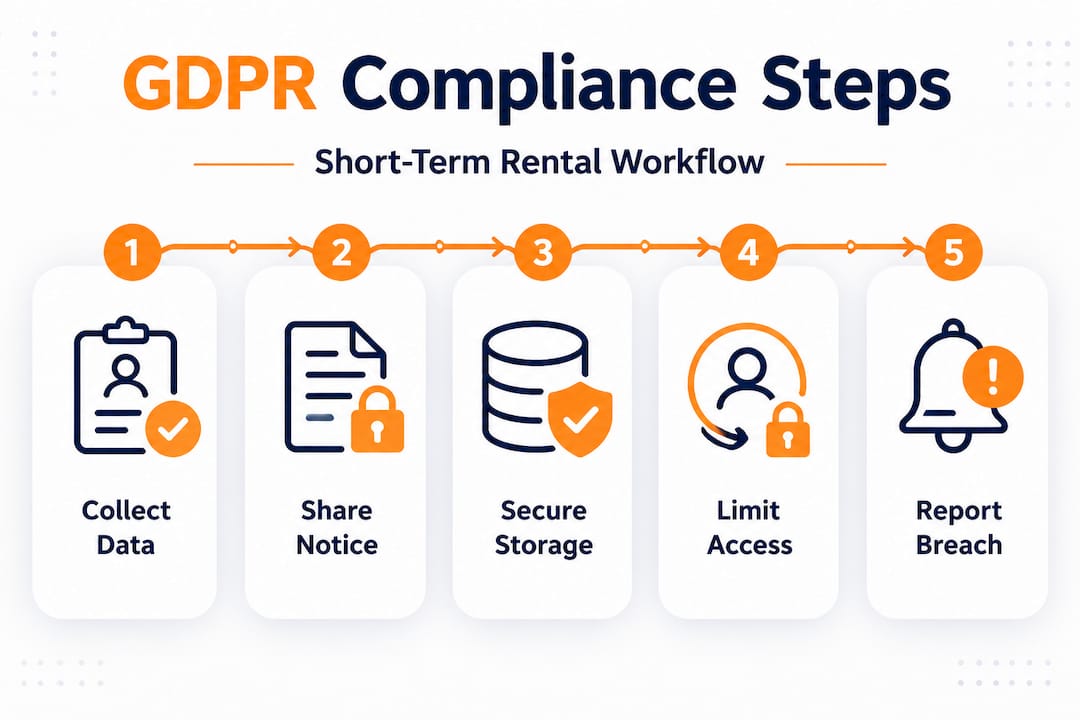
The comparison below shows the difference between manual and automated data storage workflows:
| Feature | Manual workflow | Automated workflow |
|---|---|---|
| Data entry | Human input, error-prone | API-driven, validated |
| Access control | Often shared logins | Role-based, auditable |
| Encryption | Inconsistent | Enforced by default |
| Retention and deletion | Manual reminders, often missed | Scheduled auto-deletion |
| Audit trail | Spreadsheets or paper | Timestamped logs |
| Breach detection | Reactive | Proactive alerts |
Secure storage requires encryption, role-based access controls, two-factor authentication (2FA), and for physical documents, locked storage with restricted access. Auto-deletion schedules must be set so that data is removed once the retention period expires.
A Data Processing Agreement (DPA) is a legally binding contract between you and any third party that processes guest data on your behalf. DPAs are required when sharing data with a PMS provider, a channel manager, a cleaning company that accesses guest schedules, or any platform that handles booking data. The DPA must specify what data is shared, for what purpose, and what security measures the processor maintains.
“A data breach is not just a technical incident. It is a legal event with a 72-hour reporting clock, and your response in those first hours defines your liability.”
If a breach occurs, follow these steps without delay:
- Contain the breach immediately by revoking compromised access or isolating affected systems.
- Assess the scope: what data was affected, how many guests, and what the likely impact is.
- Notify your national data protection authority within 72 hours if the breach poses a risk to individuals.
- Inform affected guests directly if the risk to their rights is high, for example if payment data or ID documents were exposed.
- Document everything, including the cause, the response, and the outcome.
Pro Tip: Restrict staff access to guest data using role-based controls from day one. A cleaner needs a checkout time, not a guest’s passport number. Limiting access by role reduces both breach risk and your liability exposure.
Reviewing government reporting for rentals will show how data security intersects with your reporting duties. The case for automation for data security is compelling: automated systems eliminate the human errors that cause most breaches. For a broader view of practical GDPR compliance measures, established compliance resources outline the technical and organisational steps expected of data controllers.
Navigating new EU rules: harmonised reporting and automation in 2026
With fundamentals covered, it is crucial to understand how 2026 rules and automation reshape your compliance reality. The landscape has shifted significantly with EU Regulation 2024/1028759356_EN.pdf), which came into effect in May 2026 and introduces harmonised data collection and sharing requirements for short-term rentals across all EU member states.
Under this regulation, platforms such as Airbnb and Booking.com are required to share activity data monthly with national Single Digital Entry Points (SDEPs). The regulation is designed to be GDPR-compliant, but it significantly increases the volume and frequency of reporting obligations for everyone in the chain.
| Role | Reporting obligation | Frequency |
|---|---|---|
| OTA platforms | Share booking and host activity data with SDEPs | Monthly |
| Single-property managers | Register with national SDEP, provide required data | As required by member state |
| Multi-property managers | Register all properties, submit consolidated data | Monthly via platform or direct |
| Property management companies | Ensure all managed properties are registered and compliant | Ongoing |
The automated workflows now essential for compliance include API integration for data capture at booking, AI-powered ID verification, auto-submission to authorities, and encrypted storage with scheduled auto-deletion. Managers who still rely on spreadsheets and manual submissions face a growing risk of missing deadlines and submitting incomplete data.
Key steps for transitioning to compliance under the new regulation:
- Register all properties with your national SDEP before the applicable deadline
- Audit your check-in forms to ensure they capture only the data required under the new rules
- Confirm that your PMS or booking platform submits data to the SDEP automatically or provides an export in the required format
- Review your DPAs with platforms to confirm they cover the new reporting obligations
- Set up automated retention and deletion schedules aligned with the new data categories
- Train any staff who handle guest data on the updated requirements
Automation trends in 2026 show that property managers using integrated compliance platforms report significantly fewer errors and spend considerably less time on administrative tasks compared to those managing compliance manually. The efficiency gains are not marginal. They are transformative for businesses managing five or more properties.
The real-world path to effortless GDPR compliance in rentals
Having mapped the essential compliance steps and new rules, it is worth reflecting on what actually works in practice versus what looks good in theory.
In our experience working with property managers across Europe, the most common compliance failures are not caused by ignorance of the law. Most managers know they need a privacy notice and a data retention policy. The failures happen in execution. A privacy notice buried in a booking confirmation that guests never read. A retention schedule that exists on paper but is never actually applied. Consent records that were collected but never stored in a way that can be retrieved if challenged.
The uncomfortable truth is that GDPR compliance is a documentation problem as much as it is a legal one. If you cannot produce evidence of consent, a record of your DSAR response, or a log of who accessed guest data and when, you are exposed even if you did everything correctly. Regulators cannot verify what you cannot show them.
The contrarian lesson here is that building a single, centralised compliance record, what you might call a “single source of truth” for all guest data activity, is not just good practice. It is the single most effective step you can take to reduce both your workload and your anxiety. When everything is in one place, audits become straightforward, DSARs become manageable, and breach responses become faster.
Understanding your owner responsibilities for EU rentals in full will also reveal how GDPR sits alongside licensing, tax reporting, and registration obligations. Managers who treat compliance as an integrated system rather than a checklist of separate tasks consistently report lower stress and fewer regulatory issues.
Streamline GDPR compliance with the right technology
For those who want to cut compliance complexity and error risk, technology offers a ready-made path. Managing GDPR obligations manually across multiple properties, platforms, and national jurisdictions is not just time-consuming. It is genuinely risky. Missed deadlines, inconsistent records, and gaps in audit trails are almost inevitable without the right tools.
GuestAdmin.io is built specifically for property owners and managers navigating exactly this challenge. The platform automates guest data capture, applies role-based access controls, schedules data deletion, and submits required information to authorities, all within a GDPR-compliant framework. Whether you manage one property or fifty, it removes the administrative burden so you can focus on your guests. Explore how rental compliance explained can help you avoid costly fines, and discover how multi-property management solutions scale compliance effortlessly as your portfolio grows.
Frequently asked questions
Do I need a data protection officer (DPO) for managing just one or two rental properties?
No, small landlords with one or two properties do not require a DPO under GDPR, but you must still comply as a data controller and may need to register with your national authority.
How long should I keep guest data for legal compliance?
You should retain guest data for up to 12 months for guest registers in most cases, or between two and six years where national law requires it, followed by secure and documented deletion.
What should I do if a guest requests their personal data?
You must respond within one month, verify the guest’s identity using booking references or other reliable means, and then provide, correct, or delete the relevant data as the request requires.
How do I report a data breach affecting guest information?
Report the breach to your national data protection authority within 72 hours of becoming aware of it, and notify affected guests directly if the breach poses a high risk to their rights or freedoms.
Will the new EU data reporting regulation change how I manage GDPR compliance?
Yes, Regulation 2024/1028759356_EN.pdf) increases monthly data reporting obligations and harmonises requirements across EU member states, making automated compliance tools significantly more important for rental managers in 2026 and beyond.
Recommended
- Top tips for short-term rental managers to stay compliant
- Data Privacy in Rentals: 50% Fewer GDPR Errors with Automation
- Short-term rental terminology: your guide to EU compliance
- Short-term rental legal guide: compliance and automation 2026
- Streamline your Cape Coral short-term rental workflow
- Rental Income Best Practices Guide
2 Comments
GDPR for short-term rentals: Guest data compliance guide
[…] whichever is higher. For smaller property managers, even mid-range penalties can be damaging. Our GDPR compliance guide outlines the exact steps operators need to take, and understanding data security in rentals is a […]
GDPR in hospitality explained: a practical guide
[…] on three of them. Understanding which basis applies to each data type is the foundation of any GDPR compliance guide for […]