

TL;DR:
- APIs automate compliance tasks by enabling real-time data sharing with government systems.
- Automation reduces errors, saves time, and enhances guest and partner trust.
- APIs support broader property management innovations beyond compliance, boosting business growth.
Managing short-term rental compliance across Europe has become one of the most demanding operational challenges property managers face. Regulatory frameworks are multiplying, national reporting systems differ wildly from one country to the next, and the penalties for getting it wrong are severe. Yet many managers are still relying on manual processes, spreadsheets, and fragmented portals to stay on top of it all. APIs (Application Programming Interfaces) are quietly transforming this picture, automating the most burdensome compliance tasks and connecting the systems that previously refused to talk to one another. Understanding how they work is no longer optional for serious property operators.
Table of Contents
- Why compliance in European property management became so complex
- How APIs automate compliance and streamline property operations
- Leveraging open banking APIs for tenant screening and fraud prevention
- Edge cases and compliance pitfalls: what property managers must watch out for
- Making APIs your competitive advantage: building trust and efficiency
- Why the real value of APIs in property tech goes beyond compliance
- Take the next step with compliance-ready property management tools
- Frequently asked questions
Key Takeaways
| Point | Details |
|---|---|
| APIs enable effortless compliance | Property managers use APIs to automate EU-required reporting, registration, and guest checks. |
| Automation reduces risk and saves time | Relying on APIs minimises errors, admin work, and potential for costly compliance fines. |
| Open banking APIs streamline screening | Modern systems leverage banking APIs to verify guests and tenants quickly across Europe. |
| Human oversight still matters | Automated systems must be audited regularly to prevent and spot data issues or compliance gaps. |
| API adoption creates a business edge | Embracing API-driven processes boosts trust, opens finance options, and keeps your rentals future-proof. |
Why compliance in European property management became so complex
For years, short-term rental compliance in Europe was a patchwork of local rules, paper-based registration, and inconsistent enforcement. Property managers juggled multiple portals, submitted guest data manually, and hoped nothing slipped through the cracks. That approach is no longer sustainable.
The regulatory environment has shifted significantly. EU Regulation 2024/1028, effective 20 May 2026, mandates interoperable systems for data sharing between platforms, national authorities, and Single Digital Entry Points (SDEPs). This means your property management system must be able to communicate with government databases in real time, not just on request.
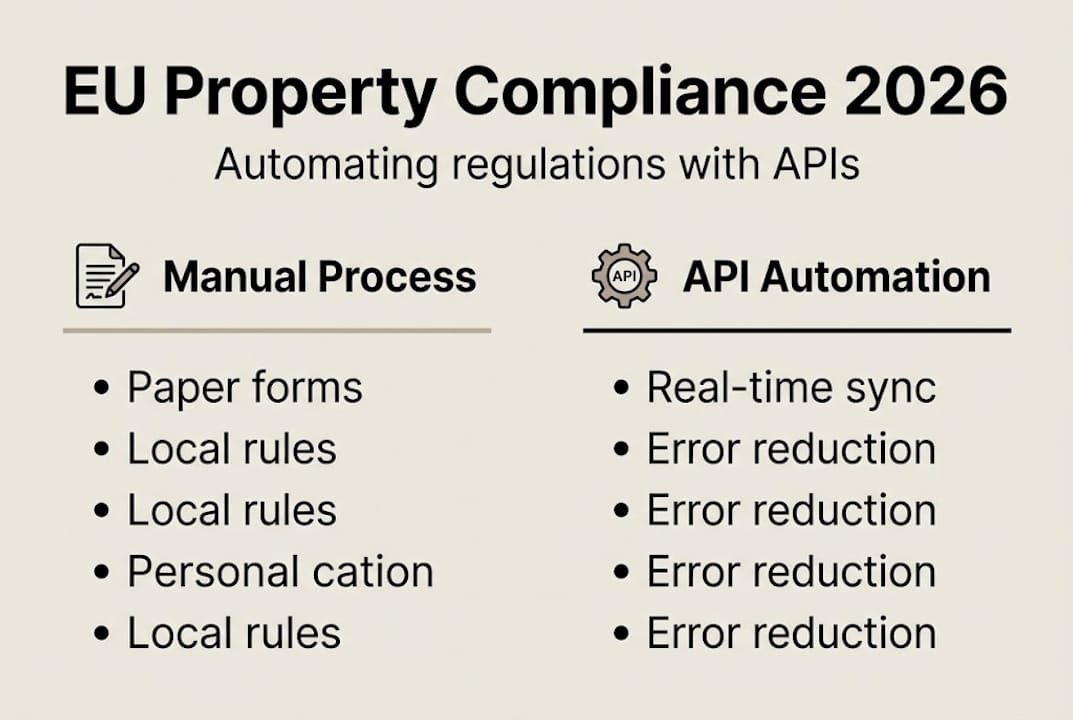
The rollout is staggered across Europe. Spain activated its national SDEP framework in 2026, while Germany is scheduled for 2027. This fragmented timeline creates genuine operational risk for managers with properties in multiple countries, as navigating EU rental regulations requires tracking different deadlines and technical standards simultaneously.
GDPR adds another layer of complexity. Any system handling guest data must meet strict standards for storage, access, and deletion. Non-compliance carries significant financial consequences.
GDPR fines can reach up to 4% of annual global turnover, making data mishandling one of the costliest operational risks in property management today.
Here is what property managers are now expected to manage:
- Real-time registration number verification for every listing
- Automated nightly guest data reporting to national authorities
- Interoperable data sharing across platforms and SDEPs
- GDPR-compliant storage and access controls for all guest records
- Country-specific compliance timelines and technical formats
Without the right technical infrastructure, meeting all of these requirements manually is not just inefficient. It is practically impossible at scale.
How APIs automate compliance and streamline property operations
After clarifying why compliance has grown so burdensome, it is worth understanding exactly how APIs turn these challenges into manageable, largely automated workflows.
An API is essentially a standardised connection between two software systems. In property management, API-driven compliance means your booking platform, property management system (PMS), and government reporting portal can exchange data automatically, without manual input at each step.
APIs enable real-time synchronisation between Property Management Systems, OTAs, and SDEPs for regulation compliance. This is the technical backbone of the new EU framework, and it matters because real-time data exchange eliminates the delays and errors that come with manual reporting.
Here is what a typical API sync achieves for a short-term rental manager:
- A new booking is confirmed on an OTA such as Airbnb or Booking.com
- Guest data is automatically pulled into your PMS via API
- The registration number for that property is verified against the national database
- A nightly report is generated and submitted to the relevant SDEP
- Guest records are archived in a GDPR-compliant format, with access controls applied
| Task | Manual process | API-powered process |
|---|---|---|
| Guest data entry | Typed in manually per booking | Auto-synced from OTA to PMS |
| Registration verification | Checked individually per listing | Verified automatically at booking |
| Nightly reporting | Submitted by hand to each portal | Submitted in real time via API |
| GDPR archiving | Managed in spreadsheets | Automated with access controls |
| Multi-country compliance | Tracked across separate systems | Unified through a single integration |
For managers using API integration for property managers, the operational gains are immediate. Fewer errors, faster reporting, and no more logging into separate government portals for each country.

Pro Tip: Build a single source of truth for each property by connecting your PMS, channel manager, and compliance tools through a unified API layer. This reduces double bookings, eliminates data conflicts, and makes multi-channel management far easier to audit.
Leveraging open banking APIs for tenant screening and fraud prevention
Once real-time operations are automated, APIs also support a critical area that many property managers overlook: tenant due diligence and fraud prevention.
Open banking APIs connect directly to financial institutions, allowing property managers to run identity checks and affordability assessments without requesting physical documents or waiting days for manual verification. This matters because fraudulent bookings and identity misrepresentation are genuine risks in the short-term rental market.
Open banking APIs such as Yapily provide real-time KYC (Know Your Customer) and affordability screening across 2,000 institutions in 19 EU countries. That level of coverage means you can verify a guest’s identity and financial standing in minutes, regardless of where they bank.
Practical use cases for property managers include:
- Real-time identity verification at the point of booking, reducing fraudulent reservations
- Automated affordability checks for longer stays or corporate bookings requiring deposit guarantees
- Document-free onboarding for guests, improving the check-in experience while maintaining compliance
- Fraud pattern detection through transaction history analysis, flagging high-risk bookings before they confirm
The benefits extend beyond security. When guests know their data is handled securely and efficiently, trust increases. For property managers, fewer fraud incidents mean fewer disputes, lower insurance costs, and stronger reviews. Linking this to data security in property management practices ensures that your open banking integrations remain GDPR-compliant throughout.
| Open banking capability | Coverage |
|---|---|
| Financial institutions connected | 2,000+ |
| EU countries supported | 19 |
| KYC checks | Real-time identity verification |
| Affordability screening | Automated income and balance checks |
| Fraud detection | Transaction pattern analysis |
Edge cases and compliance pitfalls: what property managers must watch out for
Even with automation in place, hidden risks remain. Knowing where automated systems can fail is just as important as knowing how they work.
One of the most common pitfalls is data mismatches. If the registration number stored in your PMS does not exactly match the record held by the national authority, the system flags it. Data mismatches between platforms trigger human-reviewed delistings rather than automatic bans, but the result is still a listing taken offline while the issue is investigated. That means lost bookings and revenue.
Compliance is not a one-time setup. It is an ongoing operational discipline that requires regular audits, not just initial configuration.
Here is what to do if an API sync fails or data does not match with government records:
- Check the error log in your PMS or compliance platform immediately
- Cross-reference the flagged data field against the original registration document
- Correct the discrepancy in your system and trigger a manual resync
- Contact the relevant national authority if the mismatch persists after correction
- Document the incident and resolution for your GDPR audit trail
Fragmented country rollouts add further complexity. A property manager with listings in Spain and Germany faces two different compliance timelines, two different SDEP formats, and two different sets of reporting requirements. Automation helps, but it does not remove the need for human oversight.
Following property management compliance best practices means treating your API integrations as living systems that need regular maintenance, not set-and-forget tools.
Pro Tip: Schedule a quarterly audit of all system integrations. Reconcile your PMS records against the relevant national portals and check that registration numbers, guest data formats, and reporting schedules are all current. This simple habit prevents the majority of delisting incidents and GDPR penalties.
Making APIs your competitive advantage: building trust and efficiency
Finally, it is worth stepping back to see the broader business case. APIs are not just a compliance tool. For managers who embrace them fully, they become a genuine competitive advantage.
When your systems share accurate, real-time data across every channel, disputes become rare. Overbookings drop to near zero. Guest records are always current. This single source of truth reduces the administrative friction that eats into margins and damages guest relationships.
Guests notice when things run smoothly. Automated check-in, instant confirmation, and transparent data handling all contribute to a more professional experience. That professionalism builds the kind of trust that generates repeat bookings and strong reviews. Compliance as a competitive advantage also extends to better access to institutional financing, as lenders and partners increasingly require demonstrable regulatory compliance before engaging with property portfolios.
The key business benefits of a mature API strategy include:
- Time savings: Automated reporting and data sync free up hours each week for higher-value tasks
- Reduced errors: Eliminating manual data entry removes the most common source of compliance failures
- Guest trust: Transparent, automated compliance signals professionalism to guests and partners alike
- Future readiness: A well-integrated tech stack adapts more easily to new regulations as they emerge
- Access to finance: Institutional partners favour operators with clean, auditable compliance records
Tracking time savings with automation across your portfolio gives you a clear picture of the return on investment from API adoption, and the numbers tend to be compelling.
Why the real value of APIs in property tech goes beyond compliance
There is a tendency in the industry to treat API adoption as a box-ticking exercise. Get the integrations in place, meet the 2026 deadline, move on. That mindset misses the bigger opportunity entirely.
Property managers who invest in SaaS for property management as a strategic foundation are building something more valuable than compliance. They are creating the infrastructure for dynamic pricing, personalised guest experiences, and scalable multi-property portfolios. These are the capabilities that separate growing businesses from those that plateau.
Compliance is the floor, not the ceiling. The managers who will lead their markets in the next five years are not those who met the minimum requirements. They are the ones who used the regulatory push as a reason to modernise their entire operation. APIs make that modernisation accessible, even for smaller operators with limited technical resources. The investment pays back in efficiency, trust, and agility, not just in avoided fines.
Take the next step with compliance-ready property management tools
Understanding APIs is one thing. Having the right platform to put them to work is another.
GuestAdmin.io is built specifically for property owners and managers navigating the European compliance landscape. Whether you manage one property or a hundred, the platform connects your existing systems through proven API integrations, automates guest data reporting, and keeps you aligned with the latest regulatory requirements. Explore our short-term rental compliance guide to understand your obligations, review our multi-property management solutions for portfolio-scale operations, or visit GuestAdmin.io to book a demo and see API-led compliance in action before the 2026 deadlines arrive.
Frequently asked questions
How do APIs help short-term rental managers meet EU compliance in 2026?
APIs synchronise property systems with government platforms to automate registration, data reporting, and guest verification as required by the new EU 2024/1028 regulation. This removes the need for manual submissions to each national authority.
What are the risks if property managers do not use API-enabled systems?
Manual compliance significantly increases the risk of missed reporting, GDPR fines reaching up to 4% of turnover, double bookings, and listing delistings triggered by data errors.
How do open banking APIs improve tenant screening?
They automate KYC and affordability checks in real time across 2,000 institutions in 19 EU countries, reducing fraud and cutting the administrative overhead of manual document collection.
Can all compliance issues be resolved through automation alone?
No. Certain edge cases involving data mismatches trigger human-reviewed delistings rather than automatic resolution, meaning human oversight and regular system audits remain essential.
Are APIs relevant for smaller property owners, not just large managers?
Yes. APIs automate compliance and reporting for properties of all sizes, reducing admin burden and improving guest experience regardless of portfolio scale.