

TL;DR:
- European short-term rental regulations require digital guest registration and timely data sharing.
- Data minimization and GDPR compliance are essential to reduce risks and ensure privacy.
- Automation tools improve accuracy, efficiency, and help manage complex multi-property compliance workflows.
European short-term rental regulations are tightening fast. EU Regulation (EU) 2024/1028 mandates digital guest registration and monthly data sharing with authorities by May 2026, and non-compliance carries serious financial and legal consequences. For property managers handling bookings manually, the margin for error is shrinking. This article walks you through exactly what data you must collect, how to protect guest privacy, where automation delivers the biggest gains, and how to handle the complex edge cases that catch even experienced operators off guard.
Table of Contents
- Know your compliance requirements
- Collect only what’s necessary: Data minimisation and privacy
- Automate wherever possible: From APIs to secure storage
- Prepare for special cases: Multi-property, amendments, and edge risks
- Why compliance is about process, not just technology
- Take the next step: Automated solutions for effortless compliance
- Frequently asked questions
Key Takeaways
| Point | Details |
|---|---|
| EU rules require data vigilance | Stay up to date with changing national and EU regulations to avoid fines and disruptions. |
| Automate for lower risk | Automation cuts errors and admin load, boosting deadline compliance from under 70% to nearly 100%. |
| Privacy is non-negotiable | Only collect the guest data you need and secure it for both legal compliance and guest trust. |
| Edge cases demand extra care | Multi-property governance, amendment handling, and regular audits are key to avoiding costly slip-ups. |
Know your compliance requirements
With these challenges in view, the first task is clarifying exactly what data must be handled, and on what terms. Across Europe, the regulatory landscape is not uniform. Spain, Italy, Portugal, France, and other popular short-term rental markets each have their own reporting portals, submission deadlines, and data retention rules. Understanding what applies to each property you manage is the foundation of any workable compliance strategy.
The core guest data fields required by law across most European jurisdictions include:
- Full name of every adult guest
- Date of birth
- Nationality
- Identification number (passport or national ID)
- Check-in and check-out dates
- Property address where the stay takes place
Retention timelines vary significantly. Most countries require you to keep guest records for between 2 and 6 years, and some require near-real-time submissions to police or tourism authorities. Missing a deadline is not simply an administrative inconvenience. It can trigger fines, removal from booking platforms, or loss of your rental licence.
The new EU rental regulations add another layer. From May 2026, platforms and hosts operating across EU member states must support digital registration and structured data sharing. This affects how you design your check-in workflows and which tools you use to capture and store guest information.
| Country | Submission deadline | Retention period |
|---|---|---|
| Spain | Within 24 hours of check-in | 3 years |
| Italy | Within 24 hours of check-in | 5 years |
| Portugal | Within 3 days of check-in | 5 years |
| France | On request by authorities | 2 years |
Understanding the guest registration rules for each country where you operate is not optional. It is the starting point for building a compliant process.
Pro Tip: Create a jurisdiction-specific compliance checklist for each property you manage. List the required data fields, submission deadlines, reporting portal details, and retention periods. Review it every six months as rules change.
Collect only what’s necessary: Data minimisation and privacy
Once requirements are clear, property managers must ensure privacy principles are at the core of data collection. Collecting more guest data than the law requires does not make you safer. It actually increases your risk.
GDPR (General Data Protection Regulation) applies to any property manager handling the personal data of EU residents, regardless of where your business is based. The GDPR principles that apply directly to short-term rental operations are:
- Lawfulness, fairness, and transparency: Guests must know what data you collect and why.
- Purpose limitation: Data collected for compliance cannot be repurposed for marketing without separate consent.
- Data minimisation: Collect only what is strictly required by law.
- Storage limitation: Delete data once the legally required retention period expires.
- Integrity and confidentiality: Store data securely and restrict access.
- Accountability: You must be able to demonstrate compliance at any time.
That last point is critical. Regulators do not simply take your word for it.
“Audit trails are your insurance policy in a compliance audit. Without them, demonstrating that you handled guest data correctly is nearly impossible, and fines of up to 4% of annual turnover become a real risk.”
In practice, data minimisation means reviewing your check-in forms and removing any fields that are not legally required. If your current form asks for guests’ email addresses, phone numbers, or travel purposes purely out of habit, those fields need to go unless you have a separate lawful basis for collecting them.
Updating your workflows also means training anyone who handles guest data, whether that is a front-of-house team member, a co-host, or a virtual assistant. A well-designed form means little if the person using it does not understand why certain data is collected and how it must be stored. You can find practical guidance on data security in rentals to help structure your internal policies.

Review your privacy notice too. Guests must be informed at the point of data collection about what you hold, how long you keep it, and their rights under GDPR. A short, plain-language notice at check-in is sufficient for most operators.
Automate wherever possible: From APIs to secure storage
Having established privacy needs, the next step is leveraging technology to reduce manual workload and risks. Manual data entry is the single biggest source of compliance errors in short-term rental management. Transposed ID numbers, missed submissions, and forgotten deletion schedules are not just inconvenient. They are the kind of failures that attract regulatory attention.
Automation tools that integrate with your property management system (PMS) or online travel agency (OTA) can handle the entire data lifecycle. Here is a logical sequence for building an automated compliance workflow:
- Connect your PMS or OTA via API to capture booking data automatically at the point of reservation.
- Use AI-powered ID verification to validate guest documents at check-in without manual review.
- Trigger automated submissions to the relevant national or local authority portal within the required timeframe.
- Store encrypted guest records in a GDPR-compliant environment with role-based access controls.
- Schedule auto-deletion of records once the legally required retention period expires for each jurisdiction.
The results speak for themselves. Automation reduces errors by over 50% and cuts administrative time by up to 60%, with deadline adherence improving to between 98% and 100% for operators using integrated systems.
This is not a marginal gain. For a property manager handling 20 or more units across multiple countries, the difference between manual and automated compliance is the difference between a manageable workload and a constant fire-fighting exercise. Manual process failures759356_EN.pdf) at scale are well-documented, and the consequences range from missed deadlines to significant regulatory penalties.
Explore how automated guest registration works in practice, and consider how it fits your current setup before committing to a platform.
Pro Tip: Always test your automated workflow with dummy booking data before going live. Verify that submissions reach the correct authority portal, that data is encrypted in transit, and that auto-deletion rules trigger correctly for each jurisdiction.
Prepare for special cases: Multi-property, amendments, and edge risks
Even robust automation can be challenged by real-world booking complexities. Standard bookings follow a predictable path. But cancellations, last-minute amendments, late data submissions, and multi-property workflows introduce variables that many compliance systems are not built to handle cleanly.
For operators managing a single property, the compliance workflow is relatively straightforward. For those managing five, ten, or fifty properties across different countries, the complexity multiplies quickly. Each property may fall under different national rules, use a different reporting portal, and require data in a different format.
| Scenario | Standard booking | Complex case |
|---|---|---|
| Data submission | Single automated trigger | Multiple triggers per amendment |
| Retention period | Fixed by jurisdiction | May vary if guest nationality differs |
| Cancellation handling | Archive and flag | Notify authority if already submitted |
| Validation errors | Auto-flagged | Requires manual review and resubmission |
The edge cases that most frequently cause compliance failures include:
- Guest amendments after check-in: If a guest’s ID details change or were entered incorrectly, the original submission may need to be updated with the authority.
- Cancellations post-submission: Some jurisdictions require you to notify the authority if a booking is cancelled after data has already been submitted.
- Over-retention risks: Keeping guest data beyond the legally required period is itself a GDPR violation. Automated deletion schedules must account for jurisdiction-specific timelines.
- Incomplete data at check-in: Guests who arrive without valid ID create a gap in your records. Your workflow must include a clear escalation process for these situations.
A practical multi-property compliance guide can help you map out the specific rules that apply to each property in your portfolio. Consult the amendment rules for rentals in each country to understand your obligations when booking details change after submission.
Why compliance is about process, not just technology
After addressing standard and edge scenarios, it is vital to see automation as only part of a resilient compliance strategy. Here is a view that does not get enough attention: the best compliance software in the world will not protect you if the process behind it is poorly designed.
Tools automate what you tell them to automate. If your check-in form has an error, the automated submission will contain that error. If your staff do not know how to handle a guest who refuses to provide ID, no software will resolve that gap. Manual processes fail at scale759356_EN.pdf), but so do automated ones when the underlying process is weak.
Audit trails are what protect you when a regulator asks questions. They are the documented evidence that you collected the right data, submitted it on time, stored it securely, and deleted it when required. Without them, you are relying on memory and goodwill, neither of which holds up in a formal investigation.
Our recommendation is to treat compliance as an ongoing operational discipline, not a one-time setup task. Schedule quarterly internal reviews. Run data drills with your team. Check that auto-deletion schedules are firing correctly. Verify that your submission logs match what the authority has on record. Book a compliance demo to see how a structured audit trail works in practice.
Technology is the engine. Process is the driver. You need both.
Take the next step: Automated solutions for effortless compliance
Managing guest data across multiple European jurisdictions does not have to mean constant stress and manual checking. GuestAdmin.io is built specifically for property managers and owners who need reliable, automated compliance without the administrative burden.
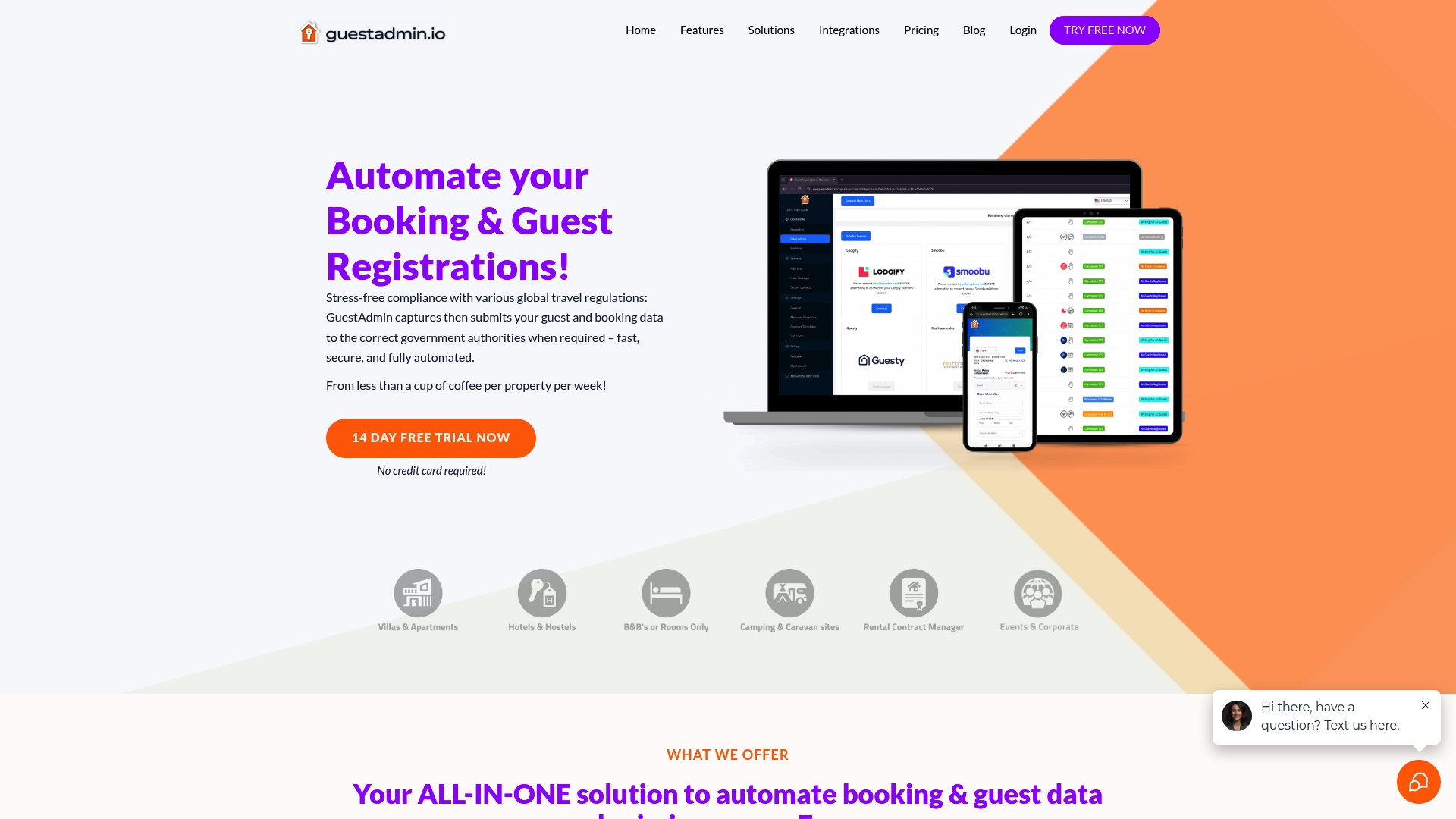
From AI-powered ID verification to encrypted storage and automatic authority submissions, every feature is designed with data minimisation and GDPR compliance built in. Whether you are managing one property or fifty, you can explore our rental compliance guide to understand how the platform maps to your obligations. Ready to see it in action? Automate guest management and find out how quickly you can move from manual processes to a fully compliant, automated workflow.
Frequently asked questions
What guest data must be collected for European short-term rental compliance?
Full name, date of birth, nationality, identification number, and check-in and check-out dates are the minimum requirements across most European countries. Some jurisdictions also require the property address and the guest’s country of residence.
What is the penalty for missing a data submission deadline?
Penalties can include fines of up to 4% of annual turnover759356_EN.pdf) under GDPR, and some countries also impose administrative sanctions or temporary suspension of your rental registration. Maintaining clear audit trails is the most effective way to demonstrate compliance and avoid these outcomes.
How long must guest data be retained?
Retention varies by country but is generally between 2 and 6 years as required by national law. Automated deletion schedules tied to each jurisdiction help ensure you do not retain data beyond the permitted period.
Is manual compliance enough for multi-property managers?
Manual processes at scale759356_EN.pdf) are prone to submission errors, missed deadlines, and incomplete audit trails. Automation with built-in audit logging is strongly recommended for any operator managing more than one or two properties across different jurisdictions.