

TL;DR:
- Automation reduces compliance workload by up to 87% and minimizes errors.
- Automated systems ensure timely submissions and GDPR compliance, lowering fines and delisting risks.
- Centralized dashboards streamline portfolio management across multiple countries and regulations.
Managing short-term rental compliance across Europe has never been more demanding. Regulations are tightening, enforcement is increasing, and the paperwork involved in guest registration, data submission, and GDPR obligations can consume hours every week. For property managers running multiple listings, the burden multiplies fast. One missed submission or an incorrectly stored guest record can trigger fines that far outweigh any administrative savings. The good news is that automation is no longer a luxury reserved for large hotel chains. It is now an accessible, practical solution that transforms compliance from a daily headache into a reliable, largely hands-off workflow.
Table of Contents
- The challenges of manual hotel compliance
- How automation transforms compliance tasks
- Reducing risk: Fines, GDPR, and enforcement
- Advanced automation: Centralising compliance for portfolio management
- A smart safeguard, not a silver bullet
- Automate compliance with confidence
- Frequently asked questions
Key Takeaways
| Point | Details |
|---|---|
| Cut workload dramatically | Automating compliance can reduce admin effort by up to 87 percent. |
| Protect against fines and GDPR breaches | Automation keeps records, ensures encrypted storage, and prevents costly compliance risks. |
| Boost competitive advantage | Fully compliant listings stay online and occupy less-crowded markets as enforcement tightens. |
| Stay audit-ready | Digital logs and instant reporting mean you can prove compliance at a moment’s notice. |
| Scale with peace of mind | Portfolio automation supports managers as they expand into new markets and face stricter regulations. |
The challenges of manual hotel compliance
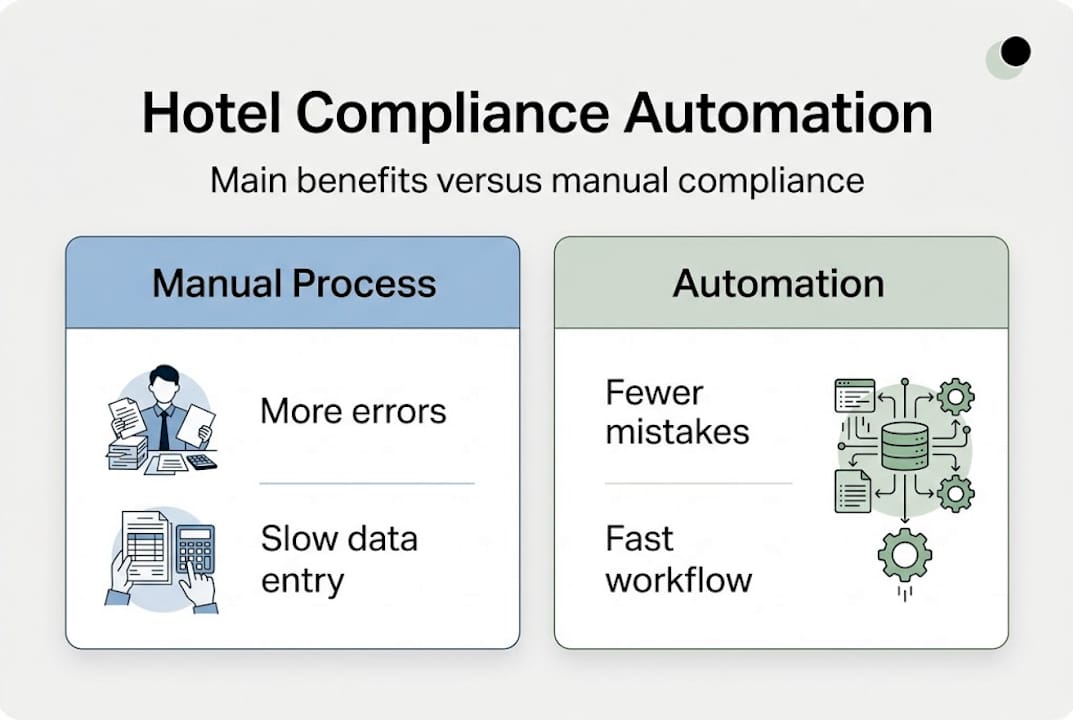
Manual compliance is, at its core, a volume problem. Every booking generates a chain of tasks: collecting guest ID documents, entering data into local authority portals, cross-referencing booking details, filing records for GDPR retention periods, and keeping on top of licence renewals. When you manage even a handful of properties, these tasks stack up quickly.
The automation time-saving tips available to property managers today exist precisely because manual processes are so fragile. A single data entry mistake can cascade into a compliance failure. Spreadsheets get out of date. Portals go down at inconvenient moments. Staff turnover means institutional knowledge disappears overnight.
The financial stakes are also rising sharply. Fines for non-compliance range from €1,000 to €50,000 or more per violation, and EU Regulation 2024/1028, effective May 2026, introduces OTA delisting risks for operators who fall short. Losing your listing on a major booking platform is not just a reputational issue. It is an immediate loss of revenue.
The hidden costs of manual compliance go beyond fines. Consider the following:
- Admin time: Property managers routinely spend 5 to 10 hours per week on compliance-related data entry and reporting.
- Error risk: Manual data entry introduces inconsistencies that are difficult to catch before an authority review.
- Staff dependency: Compliance knowledge concentrated in one team member creates a single point of failure.
- Audit unpreparedness: Without a clear digital trail, responding to an enforcement query takes days rather than minutes.
“Automation reduces manual admin workload by 40 to 87% for guest registration and compliance reporting.”
The automation impact on compliance is not marginal. It is transformative. As authorities across Europe invest in digital monitoring tools, the gap between compliant and non-compliant operators is widening. Manual processes simply cannot keep pace.
How automation transforms compliance tasks
Automation, in practical terms, means connecting your property management system (PMS) or online travel agency (OTA) feed to a compliance platform via API or webhook. When a booking is confirmed, guest data flows automatically into the system, is validated, and is submitted to the relevant authority within the required timeframe. No manual re-entry. No missed deadlines.
Here is what the journey of a single booking looks like with automation in place:
- Booking confirmed: Guest data is captured automatically from the OTA or PMS.
- Data validated: The system checks for missing fields, formatting errors, and ID document completeness.
- Submission triggered: Validated data is sent directly to the local authority portal via API.
- Confirmation logged: A submission receipt is stored in the compliance dashboard with a timestamp.
- Retention managed: Guest records are archived securely and flagged for deletion at the end of the required retention period.
The contrast with manual workflows is stark. The table below illustrates the difference:
| Factor | Manual process | Automated process |
|---|---|---|
| Data entry time per booking | 15 to 25 minutes | Under 2 minutes |
| Error rate | High (human input) | Low (validated automatically) |
| Submission speed | Dependent on staff availability | Within 24 hours, always |
| Audit trail | Fragmented or absent | Complete and timestamped |
| Regulatory update response | Manual process changes needed | Platform updates centrally |
Error rates drop by 50 to 60% with automated data validation and submission. That is not a marginal gain. For a portfolio of 20 properties with high occupancy, it represents dozens of potential compliance failures avoided every month.

The automated guest registration guide covers the technical setup in detail, but the principle is straightforward: remove humans from repetitive data tasks and reserve human attention for exceptions and oversight.
Pro Tip: Before the EU Regulation 2024/1028 deadline in May 2026, test all API integrations thoroughly in a staging environment. Do not wait until the regulation is live to discover that your PMS connection has a data mapping issue.
For operators managing automated booking compliance, the shift also reduces stress considerably. Staff spend less time on repetitive tasks and more time on guest experience and property management.
Reducing risk: Fines, GDPR, and enforcement
Compliance risk in 2026 sits at the intersection of financial penalties, data protection law, and platform access. Each of these carries its own consequences, and manual processes leave you exposed on all three fronts.
Under GDPR, property managers are data controllers. That means you are responsible for how guest data is collected, stored, and deleted. Manual processes risk GDPR violations from insecure storage or improper retention, while automation ensures encrypted storage and auto-deletion at the correct intervals. A spreadsheet on a shared drive is not GDPR-compliant storage. A secure, access-logged platform is.
The key GDPR automation features to look for in any compliance platform include:
- Encrypted data storage at rest and in transit
- Automatic deletion of guest records after the legally required retention period
- Access logs showing who viewed or edited records and when
- Role-based access controls limiting data visibility to authorised staff only
- Data processing agreements with the platform provider
On the enforcement side, digital monitoring by authorities now flags unlicensed listings and non-compliant operators, meaning the risk of being caught has increased significantly. Compliant operators gain a competitive advantage as illegal supply is reduced from the market.
The comparison below shows how the risk profile changes with automation:
| Risk area | Manual compliance | Automated compliance |
|---|---|---|
| Data privacy | Vulnerable (unsecured files) | Protected (encrypted, access-controlled) |
| Audit trail | Incomplete | Full and timestamped |
| Submission errors | Frequent | Rare |
| Enforcement resilience | Low | High |
With GDPR automation safeguards built into your workflow, you are not just avoiding fines. You are building the kind of operational credibility that regulators and guests increasingly expect. And with compliance regulations 2026 evolving rapidly, being audit-ready is no longer optional. It is a competitive necessity.
Advanced automation: Centralising compliance for portfolio management
For property managers overseeing multiple listings across different cities or countries, the compliance challenge is exponentially more complex. Each jurisdiction may have different reporting formats, submission deadlines, and authority portals. Keeping track of all of this manually is not just inefficient. It is genuinely unsustainable at scale.
This is where centralised dashboard solutions make the biggest difference. A well-designed compliance platform gives you a single view of submission status, outstanding actions, and regulatory alerts across your entire portfolio. You can see at a glance which properties are fully compliant, which have pending submissions, and which require immediate attention.
Multi-property managers need centralised dashboards because EU regulation rollouts are fragmented. Spain and Italy are ahead of other markets in implementing EU Regulation 2024/1028 requirements, which means country prioritisation is essential. A platform that allows you to filter by country and set jurisdiction-specific rules saves significant time during phased rollouts.
When evaluating automation platforms for multi-property use, audit for the following capabilities:
- Unified dashboard showing real-time compliance status across all properties
- Country-specific rule sets that update automatically as regulations change
- Bulk submission tools for processing multiple bookings simultaneously
- Alert and escalation workflows that notify the right team member when action is needed
- Integration depth with the PMS and OTA platforms you already use
- Reporting exports formatted for authority submission in each jurisdiction
The multi-property workflow guide outlines how to structure your compliance operations as your portfolio grows. The core principle is that each property should have its own compliance profile within a shared platform, so nothing falls through the gaps.
Pro Tip: Even with a robust automation platform in place, schedule a monthly manual audit of a sample of submissions. Automation handles volume well, but periodic human review catches configuration errors or edge cases that automated validation may miss.
The hospitality automation compliance landscape is maturing quickly, and platforms that offer portfolio-wide visibility are becoming the standard expectation for serious operators.
A smart safeguard, not a silver bullet
Automation genuinely changes the compliance picture for short-term rental operators. It reduces workload, cuts errors, and keeps you on the right side of increasingly assertive regulators. But it is worth being honest about what it cannot do on its own.
A European Parliament report on digital enforcement759356_EN.pdf) cautions against overreliance on automation, noting that while it is a cost-effective safeguard for compliant operators, it also enables more rigorous enforcement that raises broader housing policy questions. The technology works both ways.
The best operators we see treat automation as a foundation, not a finish line. They configure their platforms carefully, stay informed about regulatory changes, and maintain periodic manual oversight. They do not assume that because a system is running, everything is correct. Regulations change. Platforms have edge cases. Local authorities update their requirements without much notice.
Automation gives you the capacity to be compliant at scale. Human oversight ensures you stay that way. The two are not in competition. They are complementary, and the most resilient compliance strategies use both.
Automate compliance with confidence
If the volume of compliance tasks is growing faster than your team can manage, it is time to look at what the right tools can do for you.
GuestAdmin.io is built specifically for European short-term rental operators who need reliable, automated compliance without the administrative overhead. Whether you manage one property or a portfolio across multiple countries, the platform handles guest registration, data submission, and GDPR-compliant archiving automatically. Start with the short-term rental compliance guide to understand your obligations, explore multi-property compliance tools for portfolio managers, or review the government reporting guide to see how automated submissions work in practice.
Frequently asked questions
What tasks can hotel compliance automation handle?
Automation can manage guest registration, ID validation, data submission to authorities, GDPR-compliant data storage, and real-time status monitoring. Platforms like GuestAdmin.io reduce manual admin workload by 40 to 87% across these core compliance tasks.
How does automation help avoid fines or delisting?
Automation ensures accurate data submission and timely reporting, drastically lowering the risk of costly mistakes or OTA removal. With fines reaching €50,000 or more per violation under EU Regulation 2024/1028, the cost of getting it wrong is simply too high to leave to manual processes.
Is automated compliance safe under GDPR?
Yes. Automation provides encrypted storage and automatic data deletion, meeting the main GDPR data protection requirements. Manual processes risk violations through insecure storage, whereas a compliant platform handles retention and deletion automatically.
Is automation suitable for managing multiple properties?
Centralised dashboards make it straightforward to monitor and control compliance status across entire property portfolios, even across different EU countries. Multi-property managers benefit most from platforms that support country-specific rule sets and bulk submission workflows.
4 Comments
Optimise booking data workflows for secure, compliant rentals
[…] managers who fare best in this environment are those who invest in automation and risk reduction as a core part of their operations, not an afterthought. Scalable solutions, clean audit records, […]
Effective bed bug control for hotels: Safeguard your reputation
[…] Why automate hotel compliance: Boost efficiency, cut risks […]
GDPR compliance guide for short-term rental managers
[…] for rentals will show how data security intersects with your reporting duties. The case for automation for data security is compelling: automated systems eliminate the human errors that cause most breaches. For a broader […]
Streamline property onboarding for rental compliance
[…] your portfolio confidently, whether from 5 properties to 15 or from 15 to 50. You can explore why automating hotel compliance boosts efficiency and reduces risk at every […]