

TL;DR:
- European short-term rental regulations are rapidly enforced, requiring owners to register properties and report activity. Non-compliance leads to fines, delisting, and legal risks, emphasizing the importance of automated, up-to-date compliance management. Proper preparation, documentation, and adherence to both EU and local rules are essential for continuous rental income and competitive advantage.
Imagine waking up to find your Airbnb listing removed overnight, not because of a bad review, but because your registration number was missing or expired. Across Europe, this is happening to property owners and managers who underestimated how quickly enforcement has accelerated. Regulation (EU) 2024/1028 is reshaping the short-term rental landscape, introducing standardised registration, reporting duties, and real consequences for non-compliance. Fines, platform delistings, and legal disputes are no longer theoretical risks. This guide gives you the practical steps, country comparisons, and automation strategies you need to stay compliant and keep your properties earning.
Table of Contents
- Understanding new EU short-term rental registration rules
- Preparing your property for registration
- How to register your short-term rental: Step-by-step
- Monthly and annual data reporting: What, when and how
- Avoiding common pitfalls and ensuring ongoing compliance
- Why compliance is now a strategic advantage for European short-term lets
- Next steps: Streamline your rental compliance with the right tools
- Frequently asked questions
Key Takeaways
| Point | Details |
|---|---|
| EU-wide rules start May 2026 | Most EU countries will standardise short-term rental data registration and sharing as of 2026, though local exemptions exist. |
| Correct documents speed up approvals | You need ownership proof, local permissions, and digital versions ready for quick registration. |
| Platforms enforce compliance strictly | Listings with invalid or missing registration risk removal and fines within days of a platform audit. |
| Monthly and annual reports mandatory | Prepare to submit regular guest and rental data via national portals or automated tools for ongoing compliance. |
| Automation saves time and reduces error | Using digital tools for registration and ongoing reporting helps property owners avoid mistakes and focus on guests. |
Understanding new EU short-term rental registration rules
Now you know why acting is essential, let’s break down the rules that shape your obligations.
Regulation (EU) 2024/1028759356_EN.pdf) mandates a standardised framework for data collection and sharing for short-term rentals across member states, with full implementation from May 2026. The regulation requires property owners and managers to obtain a registration number, display it on all listing platforms, and ensure that rental activity data is reported regularly to competent authorities. It does not replace national rules. It sets a minimum standard that countries must meet, and many go further.
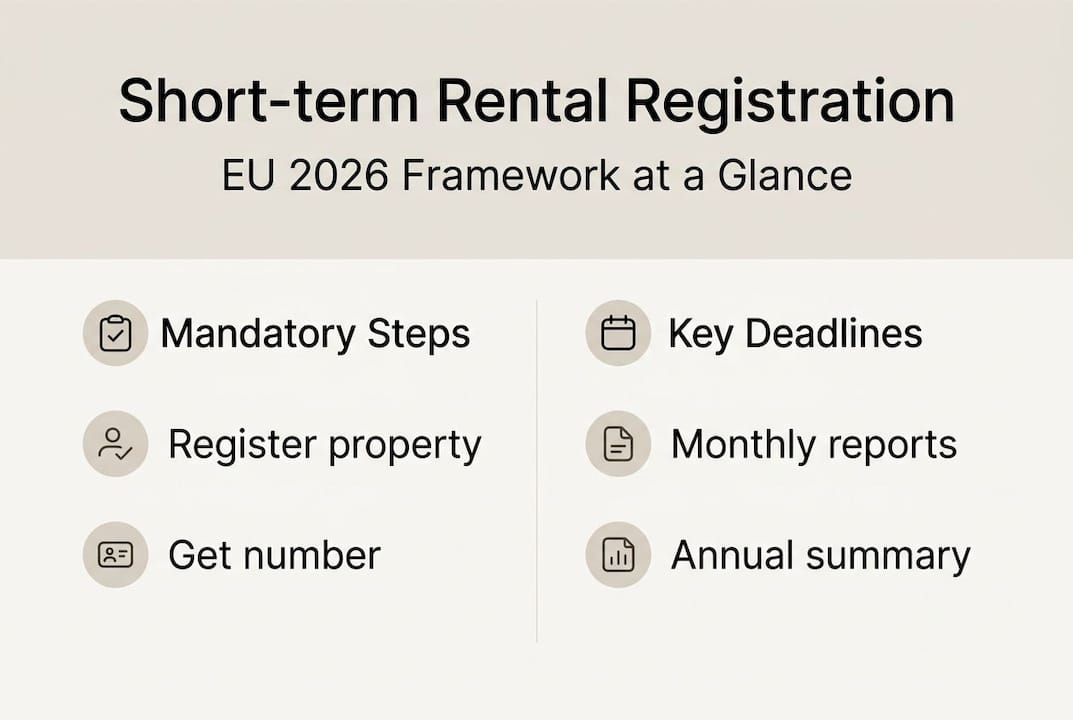
For a clearer picture of EU compliance terminology and how specific terms apply to your situation, it is worth reviewing the official definitions before you begin.
Countries already enforcing registration requirements include:
- Spain: National register operational since 2024 via land registry portal
- France: Mandatory declaration in municipalities with housing pressure zones
- Italy: National CIN (Codice Identificativo Nazionale) required for all rentals
- Portugal: RNAL (Registo Nacional de Alojamento Local) with strict capacity rules
- Germany: Many cities require Zweckentfremdungsverbot permits for short-term use
- Netherlands, Austria, Greece: Regulations in place at national or municipal level
Countries still catching up include several smaller member states where local implementation is pending, though the May 2026 deadline applies universally.
| Requirement | EU regulation (floor) | Local rules (ceiling) |
|---|---|---|
| Registration number | Required | May include additional local ID |
| Display on platforms | Mandatory | Some platforms require immediate display |
| Monthly reporting | Via SDEP | Frequency and format may vary |
| Annual summary | Required | Deadlines differ by country |
Pro Tip: Always check both your national registration portal and your municipality’s local rules. The EU regulation is the minimum standard, and local authorities often add requirements that can catch owners off-guard.
Failing to display a valid registration number or submitting late reports can trigger enforcement actions, particularly in Spain and Italy where authorities have already begun systematic checks.
Preparing your property for registration
Understanding what you need beforehand means fewer surprises when you start the process.

Before you open any registration portal, gather the following documents. Missing even one can delay your application by weeks.
Commonly required documents include:
- Proof of ownership (title deed or land registry extract)
- Valid building permit or habitability certificate
- Cadastral reference number (used in Spain and Italy)
- Homeowners’ association consent, where applicable
- Floor plan and property description
- Tax identification number of the owner or manager
- For non-EU owners: apostilled or legalised copies of all documentation
Spain offers a useful practical contrast. Spain requires the NRUA (National Register of Urban Accommodation) registration number through the land registry portal, with the cadastral reference and proof of ownership as core requirements. In France, registration is handled at the municipality level, and in many cities, a simple declaratory process applies. However, Paris and other high-demand areas require more detailed documentation, including proof that the property is your primary residence if you want to rent for more than 90 nights per year.
“Fines and delistings may occur if registration is incomplete or invalid for more than 10 days.”
Property managers handling multiple properties need to pay particular attention to renewal dates. Registration is not a one-time task. Spain, for example, requires renewal every five years, and France requires an annual update in some municipalities. Use your compliance checklist to track these deadlines across your portfolio.
Pro Tip: Prepare digital copies of all documents in PDF format before starting any application. Many national portals only accept specific file types and sizes, and uploading incorrect formats can reset your application entirely.
How to register your short-term rental: Step-by-step
With documents ready, you’re set for the actual registration, step by step.
The process varies by country, but the following steps apply broadly across most EU member states.
- Prepare your documents: Compile proof of ownership, building permits, cadastral references, and any local authority consent forms.
- Access your national registry portal: In Spain, this is the land registry portal; in France, your local mairie (town hall) website or ANAH platform; in Italy, the SUAP regional portal.
- Complete the application form: Enter property details, owner or manager information, and upload required documents.
- Pay the registration fee: Fees vary. In Spain, the fee is approximately €30 and registration is completed online, with over 215,000 properties registered by 2025.
- Receive your registration number: Typically issued within a few days to two weeks, depending on the country.
- Add your number to all platform listings: Airbnb, Booking.com, Vrbo, and others require this number to be visible on your listing page.
- Confirm platform verification: Platforms cross-check numbers against official registers. Non-compliant listings are removed promptly.
Airbnb was fined €64 million for non-compliance in Spain, underscoring how seriously platforms and regulators now take this. Platforms are required to verify registration numbers and act on authority orders, removing invalid listings within 48 hours to 10 days.
| Step | Spain | France | Typical EU country |
|---|---|---|---|
| Portal | Land registry | Local mairie or ANAH | National or regional portal |
| Fee | ~€30 | Free to low cost | Varies |
| Processing time | Days to 2 weeks | 1 to 4 weeks | 1 to 6 weeks |
| Renewal | Every 5 years | Annual in some areas | Varies |
| PM can register? | Owner must register | PM can act as host | Country-dependent |
For a broader view of how guest registration in Europe works across different country systems, or to understand how automated booking compliance fits into the process, these resources provide practical detail.
Monthly and annual data reporting: What, when and how
Once you’re registered, staying compliant means regular, accurate reporting.
Registration is step one. Ongoing reporting is where many property owners fall short. The EU regulation introduces the SDEP, or Single Digital Entry Point, a centralised system through which rental activity data must flow from platforms to national authorities.
Platforms must share monthly rental activity759356_EN.pdf) data including host identity, property details, registration number, nights rented, and guest count with authorities via SDEP. While platforms handle the technical submission, you as the owner or manager are responsible for the accuracy of the underlying data.
Monthly data fields typically required:
- Host identification number
- Property registration number
- Number of nights rented
- Number of guests per booking
- Revenue figures (in some jurisdictions)
- Booking platform used
| Report type | Frequency | Submitted by | Deadline |
|---|---|---|---|
| Activity data | Monthly | Platform via SDEP | Within 30 days of month end |
| Annual summary | Yearly | Owner or platform | February (Spain); varies elsewhere |
| SDEP transmission | Monthly | Platform | Automated once connected |
In Spain, the annual summary must reach authorities by February each year, covering the prior calendar year. France operates differently, with reporting integrated into the local declaration process.
For detailed guidance on government reporting compliance and a practical government reporting guide tailored to property owners, both resources break down the process clearly.
Pro Tip: Use digital tools to automate data pulls from your property management system. Manual uploads are where errors creep in, and a single incorrect figure can trigger an audit or invalidate a submission.
Avoiding common pitfalls and ensuring ongoing compliance
To keep your property generating income without interruption, avoiding missteps is just as important as registering correctly.
Even experienced property managers make avoidable compliance errors. The most common ones include:
- Letting registration numbers expire without renewing
- Submitting monthly reports late or with incorrect guest counts
- Uploading documentation in unsupported formats
- Failing to update platform listings after renewal
- Assuming registration in one municipality covers other properties
- Ignoring local amendments to national rules
The consequences are serious. Early enforcement in Spain and Italy759356_EN.pdf) shows that platforms remove invalid listings within 48 hours to 10 days after receiving an authority order. Beyond delisting, owners face fines that in some jurisdictions run into thousands of euros, legal disputes with guests, and potential loss of operating licences.
Enforcement is intensifying as 2026 progresses. Authorities in Spain, France, and Italy are cross-referencing platform data against national registers more frequently. A property that appeared compliant a year ago may now trigger a review if renewal documentation is outdated.
For a thorough review of your obligations, the legal rental compliance guide covers the 2026 landscape in detail.
Pro Tip: Set calendar reminders 60 days before each registration renewal deadline, and subscribe to regulatory update notifications from your national authority. Better still, use compliance software that sends automatic alerts when action is required.
An annual compliance review is good practice. Audit your data submissions, confirm registration numbers are current across all platforms, and verify that any local rule changes have been accounted for in your reporting process.
Why compliance is now a strategic advantage for European short-term lets
Most property owners still think of compliance as a cost centre. A drain on time, money, and attention that produces nothing of value. We think that framing is increasingly wrong, and the market is starting to prove it.
As platforms tighten their verification processes and cross-EU enforcement grows more coordinated, properties with clean, consistent compliance records will simply stay listed. Those without them will not. That gap is a genuine competitive advantage, not an abstract one.
Automation is the real lever here. Operators who build digital systems around their reporting obligations reduce errors, cut the time spent on admin, and scale portfolios without multiplying regulatory risk. A manager running 15 properties manually cannot keep pace with monthly SDEP submissions, renewal deadlines, and local rule changes across multiple jurisdictions. A manager using integrated compliance tools can.
Looking ahead, the direction is clearly towards more data sharing, real-time cross-border enforcement, and heavier penalties for persistent non-compliance. Guests are also becoming more aware of registration requirements, and a valid, prominently displayed registration number builds trust that translates into bookings.
Understanding your property owner responsibilities under EU and national rules today means you are not scrambling to catch up in 2027. Compliance, done well and supported by the right tools, is a business asset.
Next steps: Streamline your rental compliance with the right tools
If you’re ready to make rental compliance seamless, here are resources and tools to get you started.
Managing registration numbers, monthly SDEP submissions, annual deadlines, and platform verifications across multiple properties is a significant operational challenge. GuestAdmin.io is built to remove that burden. The platform automates guest data capture, processes reporting submissions within 24 hours, and integrates with your existing property management systems and OTA platforms.

For property managers overseeing multiple properties, centralised dashboards give you visibility across your entire portfolio in one place. No more juggling portals, spreadsheets, and paperwork. Explore compliance made simple with our reporting guide, get familiar with compliance terminology explained, or go directly to our guest registration services to see how GuestAdmin handles the process end to end.
Frequently asked questions
Is short-term rental registration required in every EU country now?
No, registration is not mandatory EU-wide, but local rules apply759356_EN.pdf) where member states implement requirements following Regulation (EU) 2024/1028, with full rollout expected from May 2026.
What happens if I do not register my short-term rental?
Non-compliance can result in fines and your listing being removed from platforms. Invalid registrations are delisted within 48 hours to 10 days after an official authority order.
How do platforms like Airbnb verify my registration number?
Platforms cross-check numbers against official national registers. Platforms verify registration numbers and remove listings where the number is missing, invalid, or not updated after renewal.
Do I need to submit rental activity data if I rent without platforms?
Non-platform rentals may be exempt from national reporting systems in some jurisdictions, but local rules still apply and reporting duties may exist at municipal level regardless.
Can property managers register on behalf of property owners?
It depends on the country. In France, a property manager may register as the host, while in Spain, registration must be completed by the owner directly through the land registry portal.
5 Comments
Guest data compliance: Protect and streamline your rental
[…] this framework is the first step in our rental registration guide. In practical terms, the regulation means that platforms and property owners must ensure guest and […]
Types of short-term rental regulations in Europe
[…] including mobile and app versions, displays the correct registration number. Use the Guestadmin registration guide for Europe as a reference for what each Member State currently […]
Guest registration laws in 2026: what hosts must know
[…] I have seen work consistently is investing in a short-term rental registration guide early, before the season begins, and then building submission workflows around it rather than […]
How to meet travel regulations for short-term rentals
[…] are set nationally, so check the specific cutoff date for each country. For a full breakdown of the 2026 European registration requirements, the rules vary enough that country-by-country verification is the only reliable […]
Rental property liability: a guide for European landlords
[…] Short-term rental registration guide for Europe 2026 […]